Proteins · Paper 1 — Free Biology SL Practice Questions
Free questions
Open in full, with answers, mark scheme and examiner insights.
Amino acids, peptide bonds and polypeptide diversity
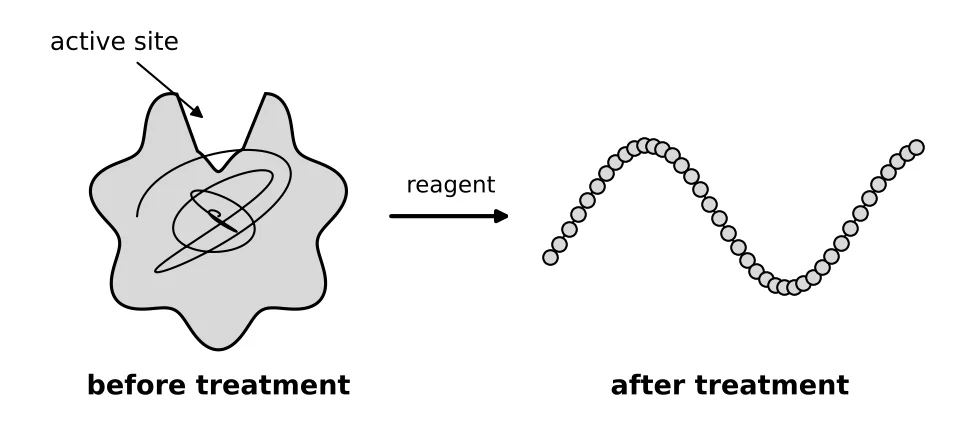
The shows an enzyme before and after treatment with a reagent that breaks some of the bonds holding it in its folded shape. Which statement describes the enzyme after treatment?
revisionprep.com
Summary Answer
Not available for this question.
Model Answer
Not available for this question.
Marking Scheme
Not available for this question.
Examiner Insights
Not available for this question.
Amino acids, peptide bonds and polypeptide diversity
All amino acids share the same basic structure. Which part of the molecule differs from one amino acid to another?
revisionprep.com
Summary Answer
Not available for this question.
Model Answer
Not available for this question.
Marking Scheme
Not available for this question.
Examiner Insights
Not available for this question.
Amino acids, peptide bonds and polypeptide diversity
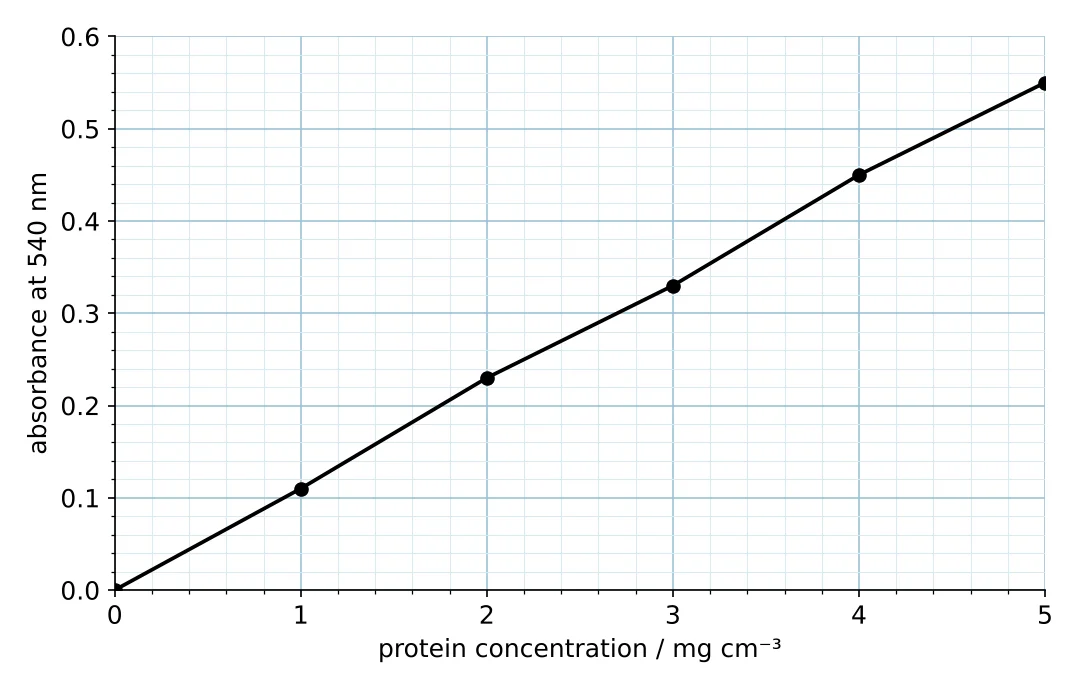
Biuret reagent turns purple in the presence of peptide bonds. A student made a calibration graph using protein solutions of known concentration, measuring the absorbance of each with a colorimeter at 540 nm. A sample of milk was diluted ten times with water and tested in the same way. Its absorbance was 0.36.
State the bond that biuret reagent detects.
Determine the protein concentration of the diluted milk sample, using the graph.
Calculate the protein concentration of the undiluted milk.
Explain why the biuret test gives the same result for a protein before and after it has been denatured by heat.
Suggest why the milk was diluted before testing.
revisionprep.com
Summary Answer
Not available for this question.
Model Answer
Not available for this question.
Marking Scheme
Not available for this question.
Examiner Insights
Not available for this question.
Protein folding and denaturation
Pepsin is a protease secreted into the stomach. Its activity was measured at different pH values at 37 °C. The graph shows the results.
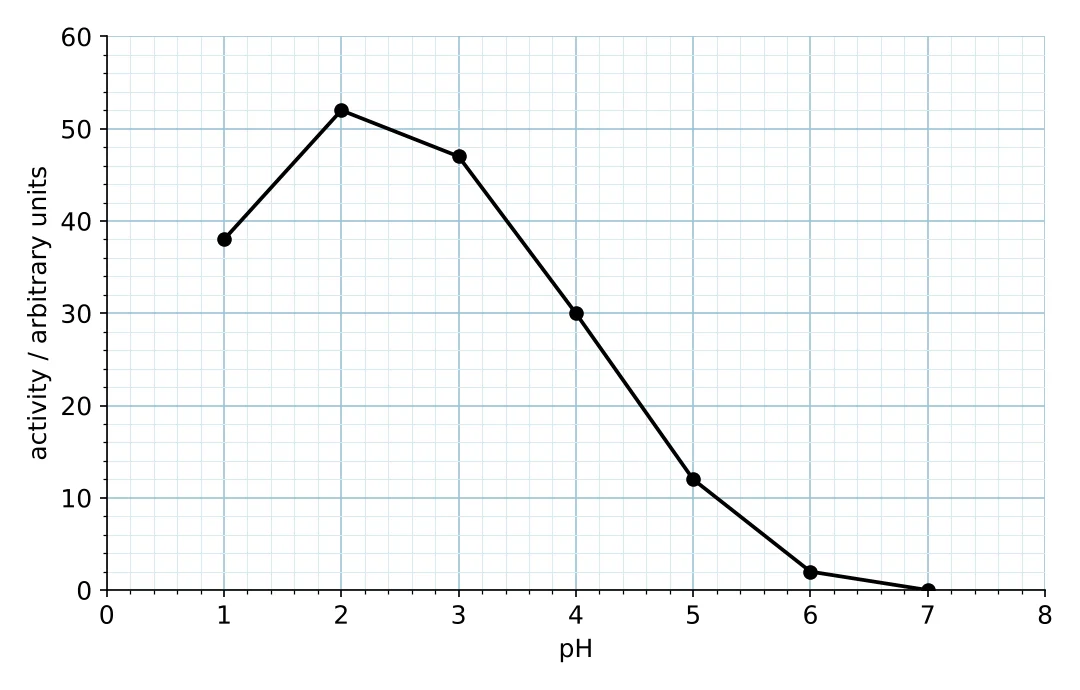
State the optimum pH of pepsin shown by the data.
Calculate the activity at pH 5.0 as a percentage of the maximum activity.
Explain why pepsin shows almost no activity at pH 6.0.
Suggest how the investigation could be changed to find the optimum pH more precisely.
revisionprep.com
Summary Answer
Not available for this question.
Model Answer
Not available for this question.
Marking Scheme
Not available for this question.
Examiner Insights
Not available for this question.
Amino acids, peptide bonds and polypeptide diversity
The table shows the number of amino acids and the relative molecular mass of four hypothetical polypeptides, P, Q, R and S. Each is a single unbranched chain. Assume the mean relative molecular mass of the free amino acids is 128. (Relative molecular mass of water = 18)
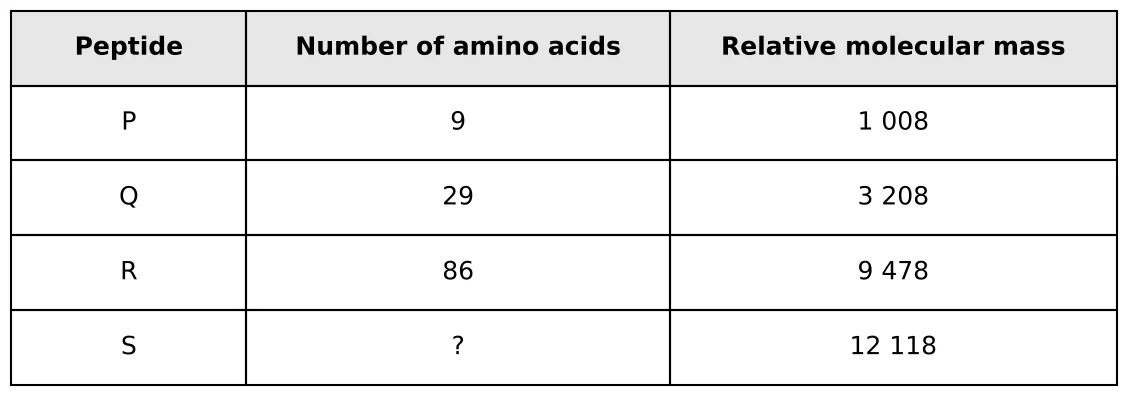
State the number of peptide bonds in polypeptide Q.
Show that the relative molecular mass of P is consistent with a mean free amino acid mass of 128.
Calculate the number of amino acids in polypeptide S.
Explain why the relative molecular mass of a polypeptide is not equal to the number of amino acids multiplied by 128.
Suggest why the number of amino acids calculated in this way for a real protein is only an estimate.
revisionprep.com
Summary Answer
Not available for this question.
Model Answer
Not available for this question.
Marking Scheme
Not available for this question.
Examiner Insights
Not available for this question.
Protein folding and denaturation
Amylase from a bacterium living in a hot spring remains active at 75 °C. Human salivary amylase is denatured at this temperature. What is the most likely reason for the difference?
revisionprep.com
Summary Answer
Not available for this question.
Model Answer
Not available for this question.
Marking Scheme
Not available for this question.
Examiner Insights
Not available for this question.
That's every free question here — 6 of 58.
+52 more questions, plus Mock Papers & Worksheets, are waiting in Premium.