You're viewing 3 free preview questions for Biology SL — subscribe to unlock 72 more, plus the Full Question Bank, Mock Papers & Worksheets.Upgrade
Carbohydrates and Lipids · Paper 2 — Free Biology SL Practice Questions
1MasterySAQ-SStructure and function of carbohydrates and lipids8 marksPaper 2~12 min

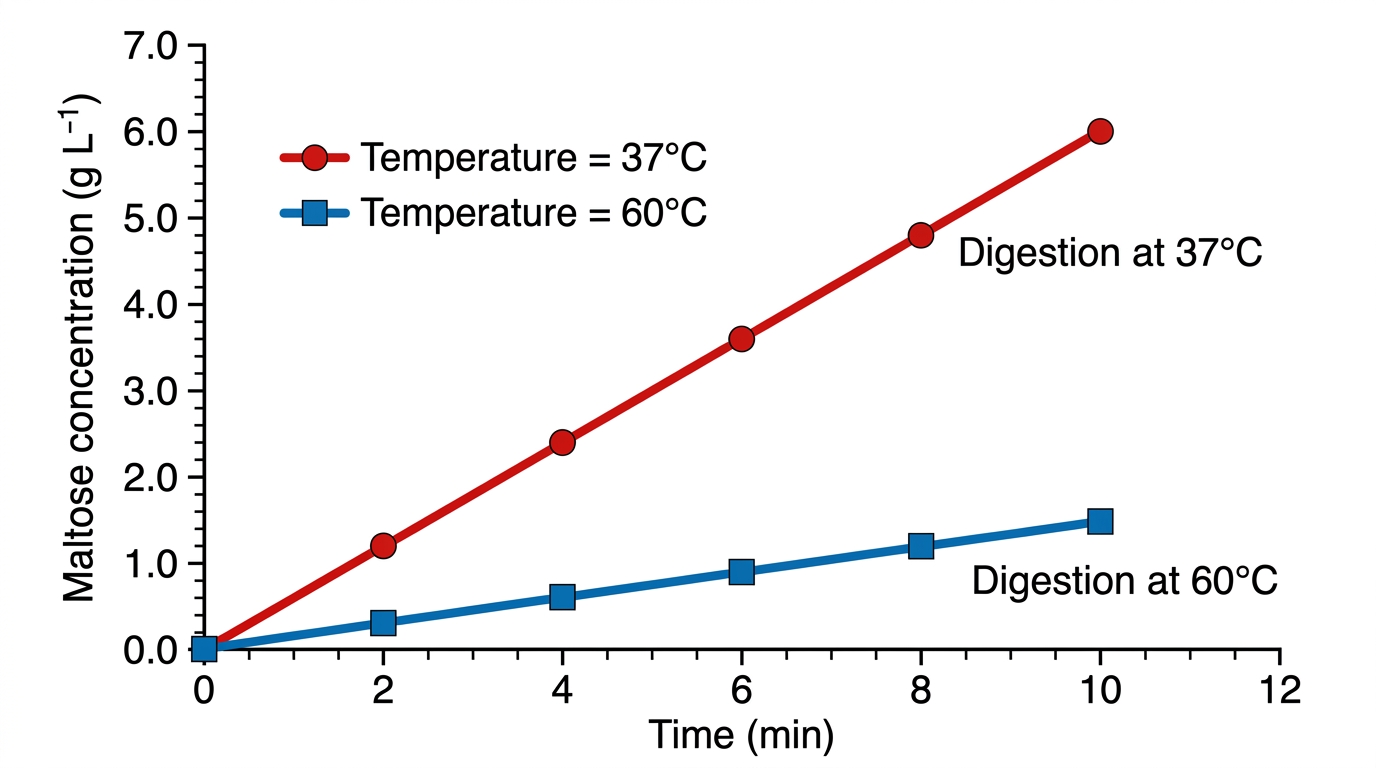
A student investigates the effect of temperature on the rate of starch digestion by amylase. She adds amylase to a starch solution at and at , then measures the concentration of maltose produced every 2 minutes for 10 minutes. Her results are shown below.
Time (min) — Maltose at () — Maltose at ()
0.0 — 0.0
2 — 1.2 — 0.3
4 — 2.4 — 0.6
6 — 3.6 — 0.9
8 — 4.8 — 1.2
10 — 6.0 — 1.5
(a)
State the structural relationship between starch and maltose. [1 mark]
(b)
Calculate the rate of maltose production at between 2 and 6 minutes. Give your answer in . [2 marks]
(c)
Describe how the structure of amylase allows it to break down starch into maltose. [2 marks]
(d)
Explain why the rate of maltose production is lower at than at . [2]
(e) The student repeats the experiment at but adds fresh amylase every 2 minutes throughout the 10-minute period. Predict and justify whether the final maltose concentration at 10 minutes would be higher than, lower than, or equal to . [3 marks]

Solutions
2MasterySAQ-SStructure and function of carbohydrates and lipids7 marksPaper 2~11 min
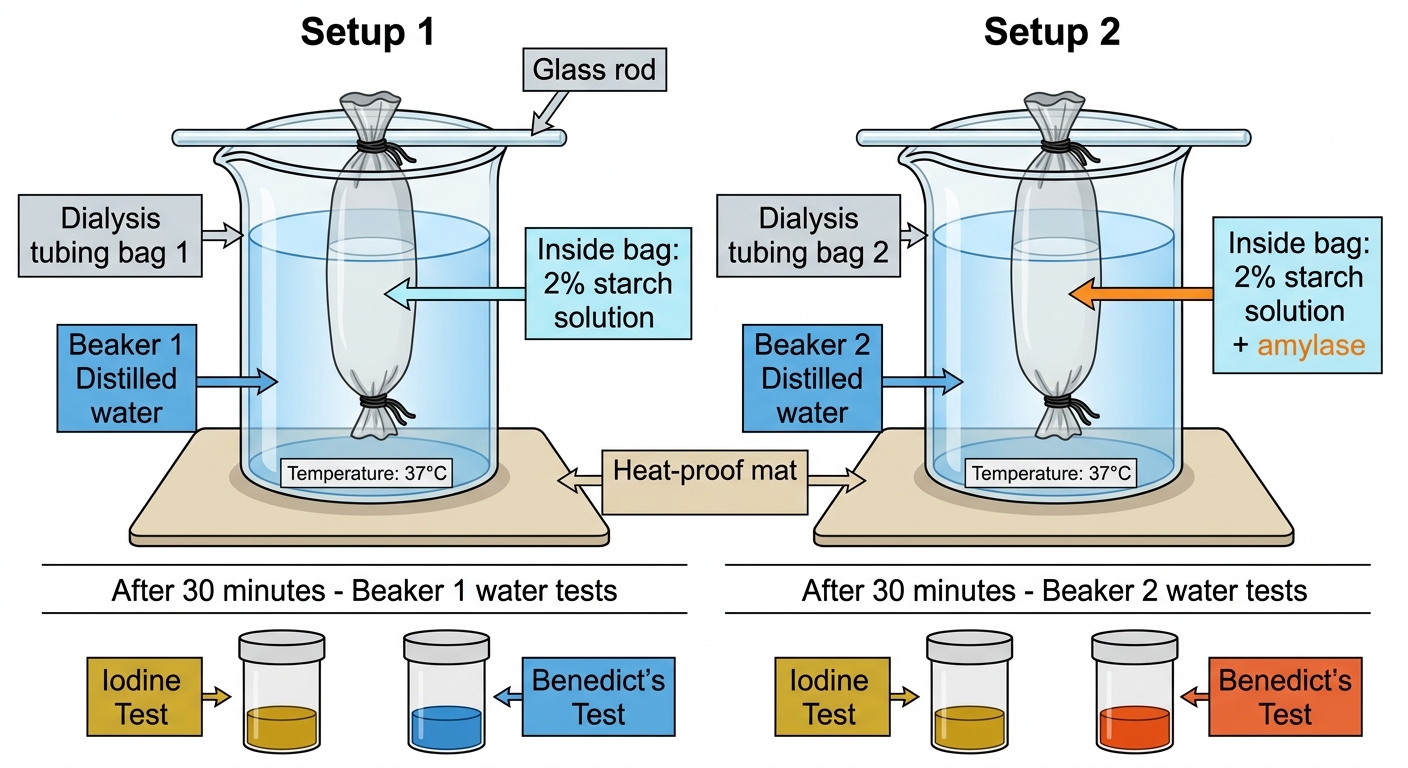
A biology student sets up an experiment using dialysis tubing to model the digestion of starch. She fills one bag with a starch solution and a second bag with a starch solution mixed with amylase. Both bags are placed in separate beakers of distilled water at . After 30 minutes, she tests the water outside each bag for the presence of starch (using iodine solution) and for reducing sugars (using Benedict's reagent).
Results:
- Bag 1 (starch only): iodine test — water remains yellow-brown; Benedict's test — water remains blue.
- Bag 2 (starch + amylase): iodine test — water remains yellow-brown; Benedict's test — water turns orange-red.
(a)
State the property of starch that prevents it from passing through the dialysis tubing. [1 mark]
(b)
Describe the structural change that occurs to starch in Bag 2 that allows a product to pass through the tubing. [2 marks]
(c)
Determine the mass of reducing sugar that diffused into the beaker water outside Bag 2, given that the concentration of reducing sugar in that beaker is and the beaker contains of water. [1 mark]
(d)
The student claims that Bag 1 acts a control for this experiment. Evaluate this claim, identifying what Bag 1 controls for and stating one limitation of the experimental design. [3 marks]
Solutions
3ChallengeSAQ-LStructure and function of carbohydrates and lipids8 marksPaper 2~12 min
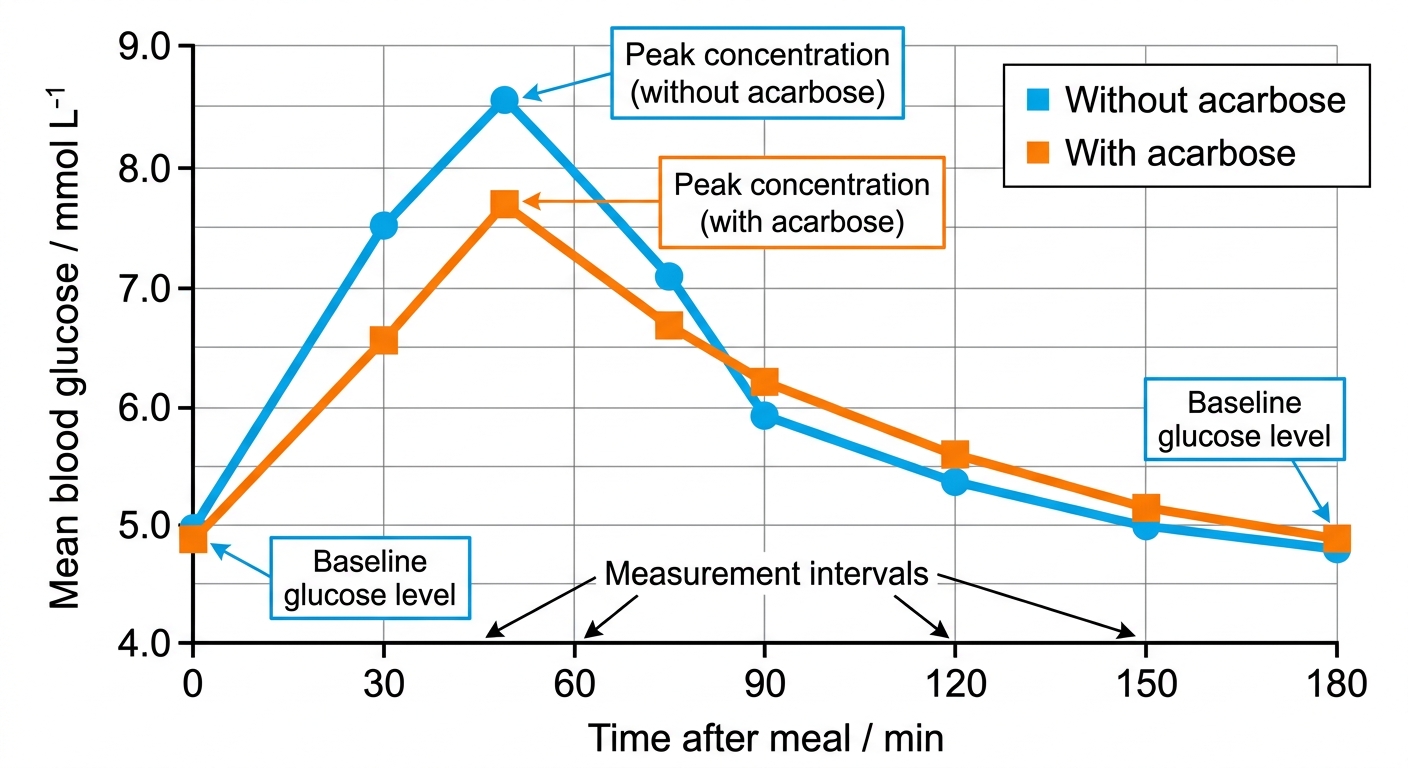
A study investigated the effect of acarbose, an amylase inhibitor, on starch digestion in humans. Eight healthy volunteers each consumed a standard meal containing of starch. Blood glucose concentration was measured at 30-minute intervals for 180 minutes after the meal. The experiment was repeated one week later with the same volunteers; each volunteer took of acarbose immediately before the meal.
Time after meal — Mean blood glucose without acarbose — Mean blood glucose with acarbose
0 — 4.8
30 — 7.2 — 6.1
60 — 8.5 — 6.8
90 — 7.9 — 6.4
120 — 6.5 — 5.7
150 — 5.6 — 5.2
180 — 5.0 — 4.9
(a)
Calculate the percentage decrease in peak blood glucose concentration caused by acarbose. [2 marks]
(b)
Explain the mechanism by which acarbose causes the observed reduction in peak blood glucose concentration. [3 marks]
(c)
Evaluate the use of acarbose as a treatment for type 2 diabetes mellitus, referring to both its advantages and its limitations. [3 marks]
Solutions
That's every free question here — 3 of 75.
+72 more questions, plus Mock Papers & Worksheets, are waiting in Premium.