You're viewing 3 free preview questions for Biology SL — subscribe to unlock 71 more, plus the Full Question Bank, Mock Papers & Worksheets.Upgrade
Ecological Niches · Paper 2 — Free Biology SL Practice Questions
1MasterySAQ-SEcological niche concept5 marksPaper 2~8 min

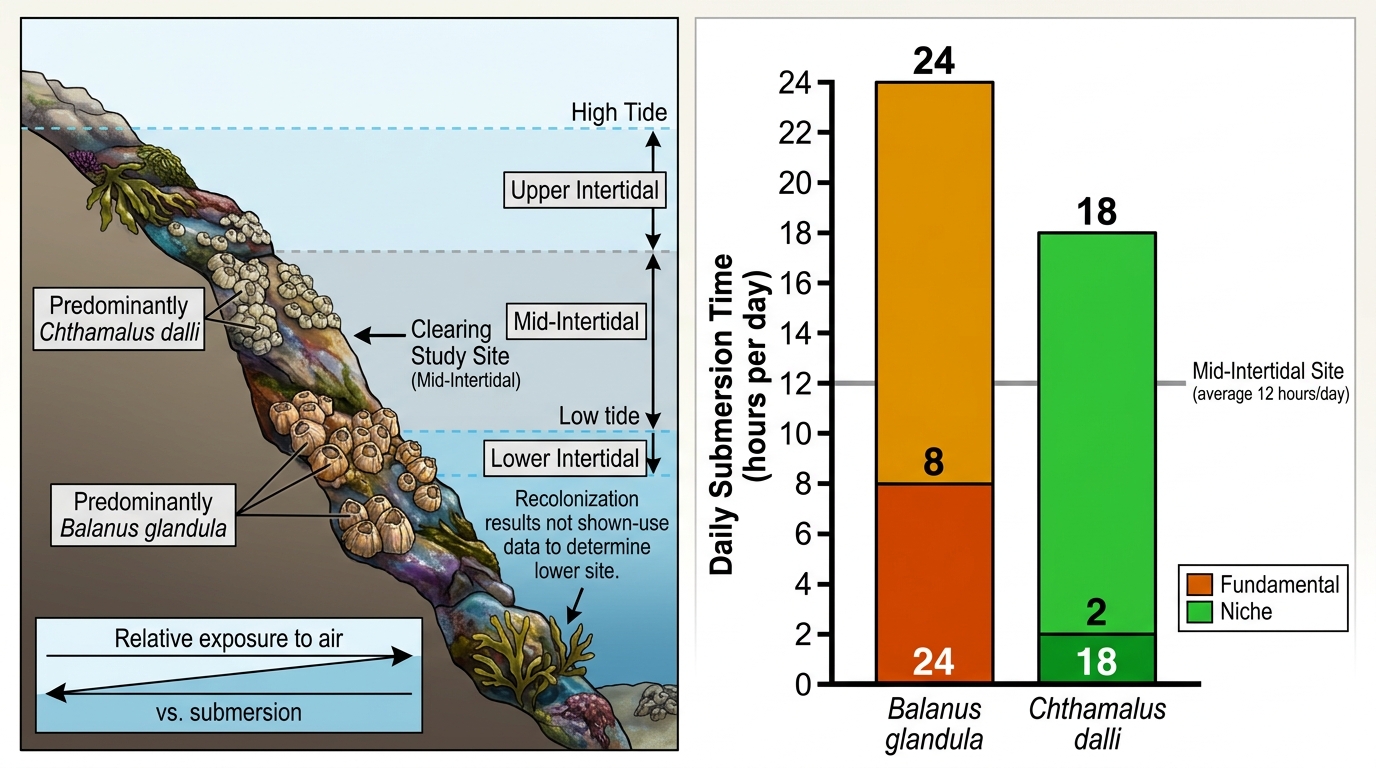
The intertidal zone of a rocky shore in the Pacific Northwest is home to two species of barnacle: Balanus glandula (acorn barnacle) and Chthamalus dalli (thatched barnacle). Balanus grows faster and outcompetes Chthamalus in the lower intertidal zone but is less tolerant of desiccation during low tide. Chthamalus can survive higher on the shore where air exposure is longer. Researchers measured the fundamental niche of each species in the laboratory by growing them across a gradient of submersion times.
- Balanus fundamental niche: – hours submersion per day
- Chthamalus fundamental niche: – hours submersion per day
Researchers then cleared a section of the mid-intertidal zone (average hours submersion per day) of all barnacles and monitored recolonisation over two years. After two years, only Balanus was present in the cleared zone.
(a)
State the fundamental niche of Chthamalus dalli in terms of submersion time. [1 mark]
(b)
Calculate the overlap between the two fundamental niches a percentage of the Chthamalus fundamental niche range. [2 marks]
(c)
Explain why the realised niche of Chthamalus in the mid-intertidal zone differs from its fundamental niche, using the recolonisation data as evidence. [2 marks]

Solutions
2MasterySAQ-SEcological niche concept5 marksPaper 2~8 min
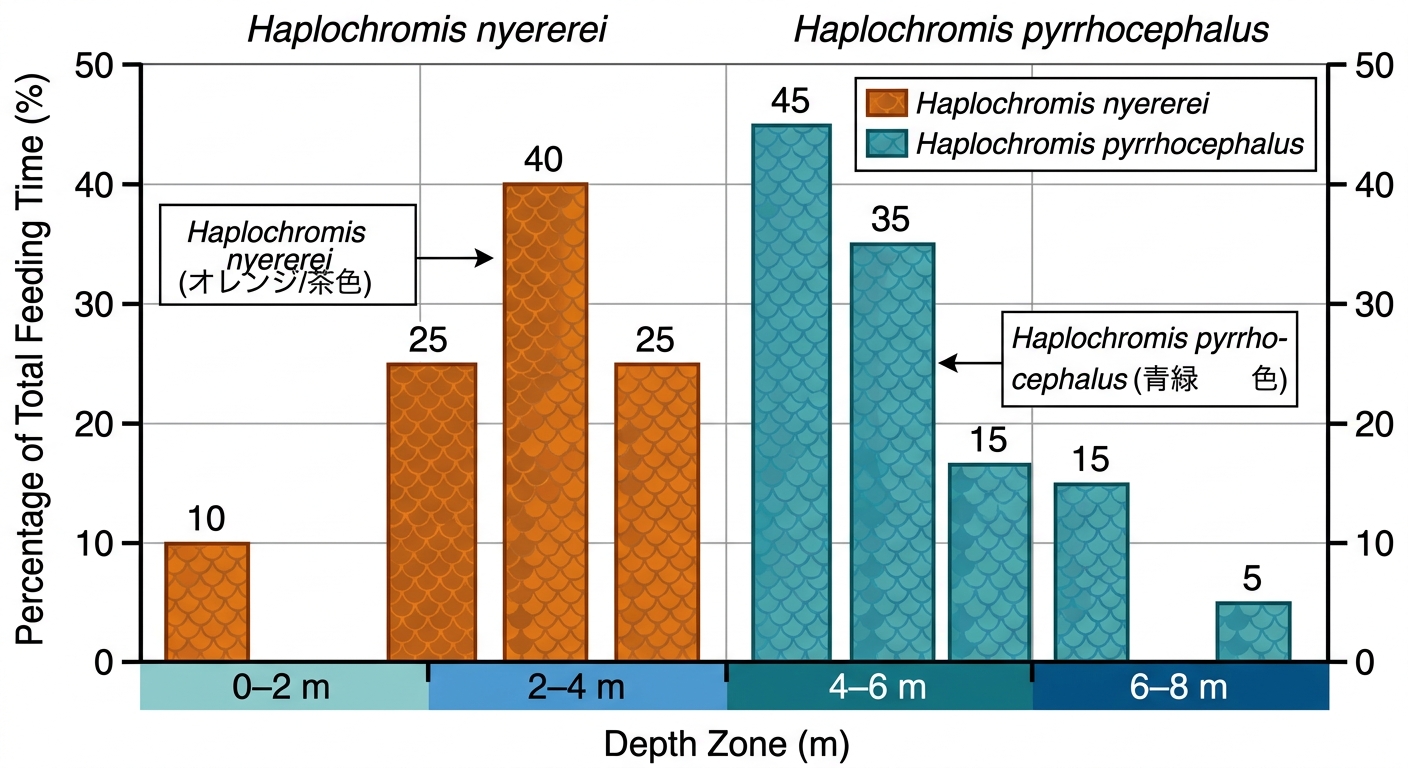
In a freshwater lake in Uganda, two species of cichlid fish (Haplochromis nyererei and Haplochromis pyrrhocephalus) coexist. Both feed on zooplankton but have different mouth morphologies allowing prey capture at different depths. Researchers measured stomach contents of 50 individuals of each species across four depth zones. The table shows the percentage of each species' total feeding time spent in each zone.
Depth zone — H. nyererei — H. pyrrhocephalus
— —
— —
— —
— —
(a)
State the depth zone where H. nyererei spends the highest percentage of its feeding time. [1 mark]
(b)
Calculate the combined percentage of feeding time that H. pyrrhocephalus spends in the two shallowest zones ( and ), and compare this with the equivalent combined percentage for H. nyererei. [2 marks]
(c)
Evaluate, using the data, the extent to which niche differentiation between the two species would reduce the likelihood of competitive exclusion. [2 marks]
Solutions
3ChallengeSAQ-LEcological niche concept8 marksPaper 2~12 min
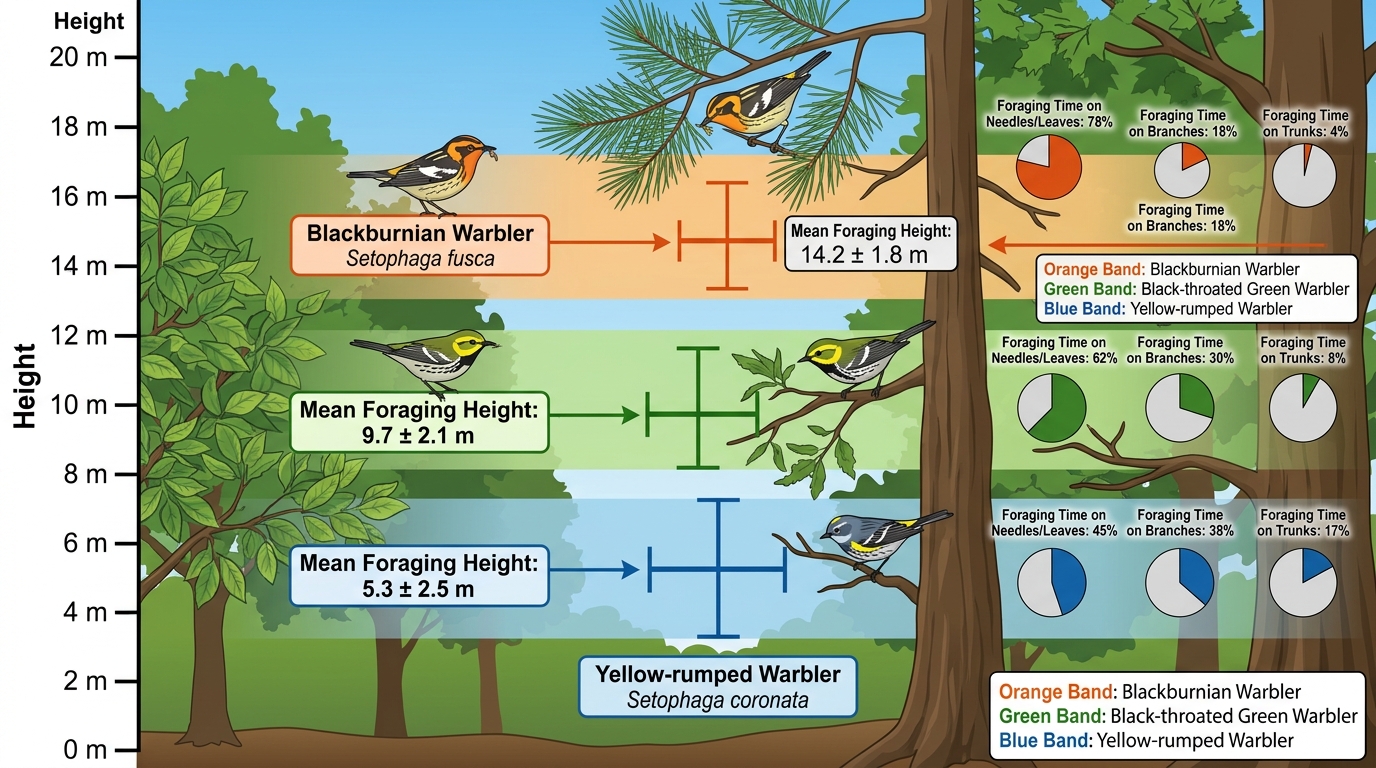
A study was conducted in a temperate deciduous forest in Vermont, USA, to investigate the ecological niches of three sympatric warbler species: the Blackburnian Warbler (Setophaga fusca), the Black-throated Green Warbler (Setophaga virens), and the Yellow-rumped Warbler (Setophaga coronata). Researchers recorded foraging height and the percentage of time spent foraging on different tree parts over three breeding seasons.
Table 1: Foraging data for three warbler species
Species — Mean foraging height SD (m) — Needles/leaves (%) — Branches (%) — Trunks (%)
Blackburnian — — 78 — 18 — 4
Black-throated Green — — 62 — 30 — 8
Yellow-rumped — — 45 — 38 — 17
(a)
State which two adjacent warbler species have the greatest overlap in vertical foraging range, using the SD values to justify your answer. [1 mark]
(b)
Calculate the percentage of foraging time that the Yellow-rumped Warbler spends on non-leaf substrates (branches and trunks combined), and compare this value to the equivalent figure for the Blackburnian Warbler. [2 marks]
(c)
Explain how the observed patterns of resource partitioning among these three warbler species reduce interspecific competition. [2 marks]
(d)
Evaluate the hypothesis that the niche differences observed are a result of character displacement driven by past interspecific competition. [3 marks]
Solutions
That's every free question here — 3 of 74.
+71 more questions, plus Mock Papers & Worksheets, are waiting in Premium.