You're viewing 3 free preview questions for Biology SL — subscribe to unlock 77 more, plus the Full Question Bank, Mock Papers & Worksheets.Upgrade
Gas Exchange · Paper 2 — Free Biology SL Practice Questions
1MasterySAQ-SRespiratory structures in animals and plants5 marksPaper 2~8 min

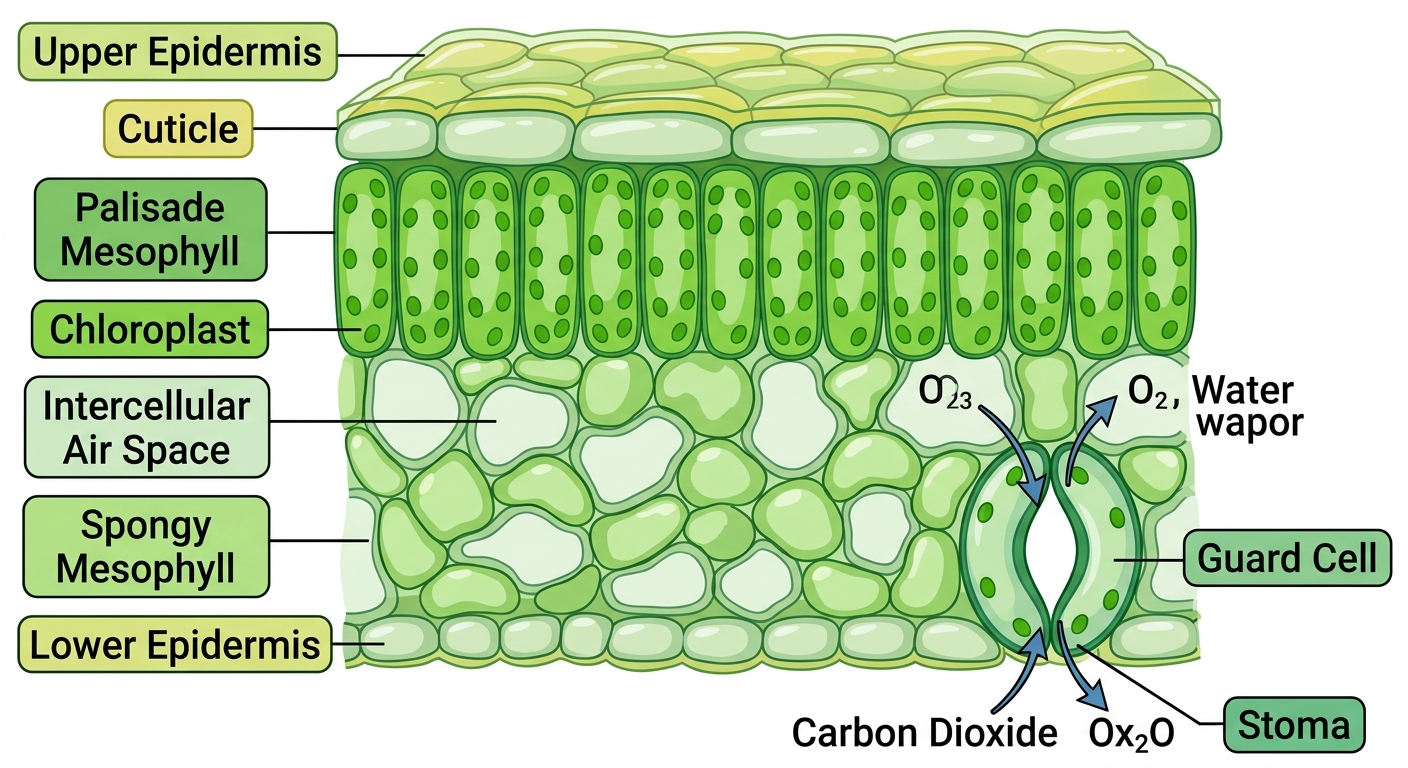
A student investigates gas exchange in the leaves of a terrestrial plant, Zebrina pendula. She examines a cross-section under a light microscope and identifies the following layers: upper epidermis, palisade mesophyll, spongy mesophyll, and lower epidermis containing stomata surrounded by guard cells. Large air spaces are visible between the spongy mesophyll cells.
(a)
State one structural feature of the spongy mesophyll that facilitates gas exchange. [1 mark]
(b)
The student measures transpiration rate under two conditions. When stomata are fully open (aperture ), the transpiration rate is . Transpiration rate is proportional to the square of the stomatal aperture. Calculate the transpiration rate when the aperture is . Show your working. [2 marks]
(c)
A second plant of the same species is grown in arid environment with high light intensity. Evaluate how the conflicting demands of photosynthesis and water conservation affect stomatal regulation in this plant. [2 marks]

Solutions
2MasterySAQ-SRespiratory structures in animals and plants5 marksPaper 2~8 min
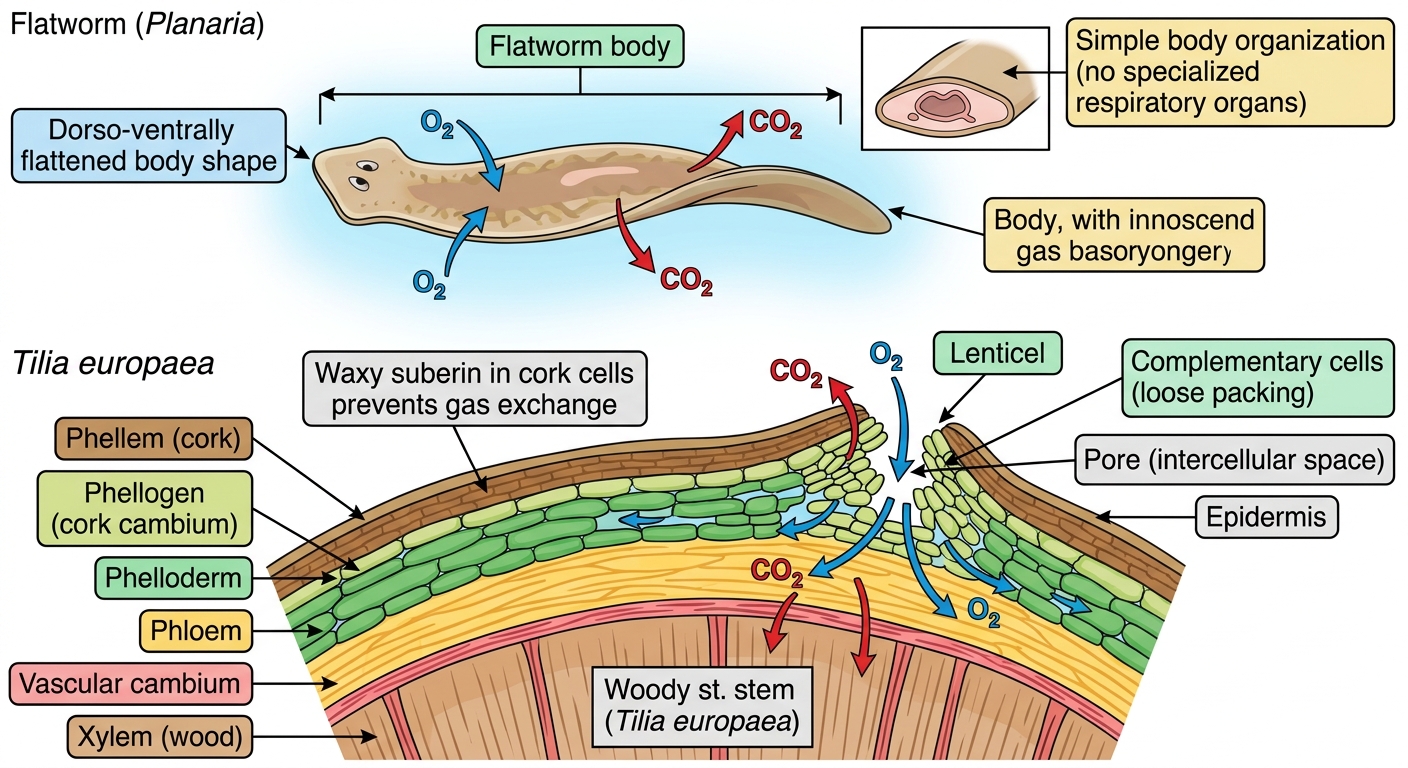
A student compares gas exchange in a flatworm (Planaria) and a woody stem (Tilia europaea). The flatworm lacks specialised respiratory organs. The woody stem is covered by bark containing lenticels.
(a)
State one structural feature of Planaria that allows gas exchange by diffusion alone. [1 mark]
(b)
The body thickness of Planaria is . The oxygen flux through its body surface is . Its oxygen consumption rate is . Calculate whether diffusion alone can supply sufficient oxygen. Show your working. [2 marks]
(c)
Explain why lenticels are necessary for gas exchange in woody stems. [2 marks]
Solutions
3ChallengeSAQ-LRespiratory structures in animals and plants7 marksPaper 2~11 min
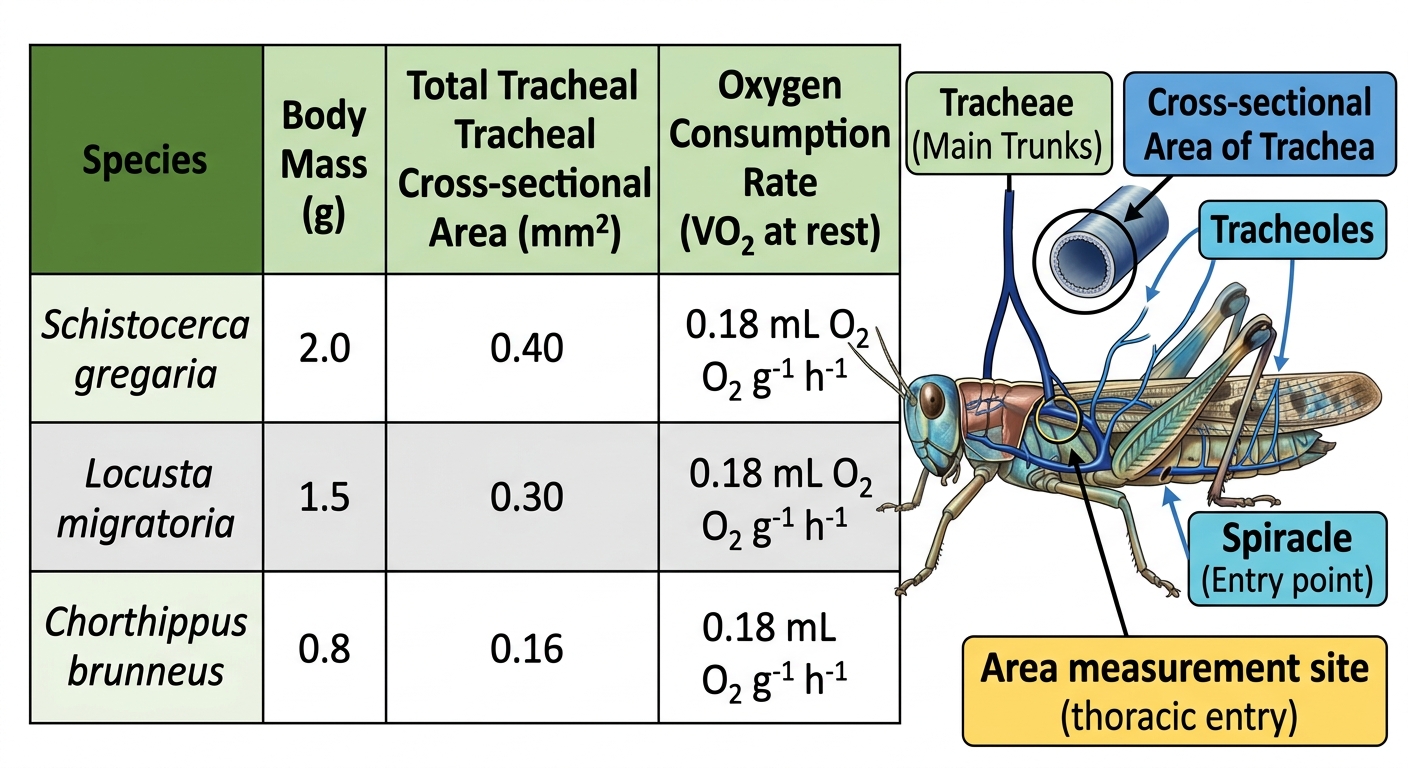
A group of students investigated the effect of body mass on the tracheal system of insects. They measured the total cross-sectional area of the main tracheal trunks entering the thorax of three species of grasshopper and recorded the data below. They also calculated the rate of oxygen consumption () for each species at rest.
Species — Body mass / g — Total tracheal cross-sectional area / — /
Schistocerca gregaria — — —
Locusta migratoria — — —
Chorthippus brunneus — — —
(a)
Calculate the ratio of total tracheal cross-sectional area to body mass for each species, and state the relationship between body mass and total tracheal cross-sectional area in these grasshoppers. [2 marks]
(b)
Explain how the structure of the tracheal system insects allows efficient gas exchange without a circulatory system for oxygen transport. [3 marks]
(c)
A grasshopper of body mass is proposed. Using the relationship from (a), calculate the predicted total tracheal cross-sectional area for this grasshopper. Evaluate whether a grasshopper of this mass could survive using only a tracheal system, with reference to how oxygen demand diffusion path length scale with body size. [2 marks]
Solutions
That's every free question here — 3 of 80.
+77 more questions, plus Mock Papers & Worksheets, are waiting in Premium.