Membranes and Membrane Transport · Paper 2 — Free Biology SL Practice Questions
Free questions
Open in full, with answers, mark scheme and examiner insights.
Simple diffusion, osmosis and channel proteins
Dialysis (Visking) tubing is partially permeable. A tube containing a mixture of starch and glucose was placed in a beaker of water. After 30 minutes the water in the beaker was tested. The results are shown in the table.
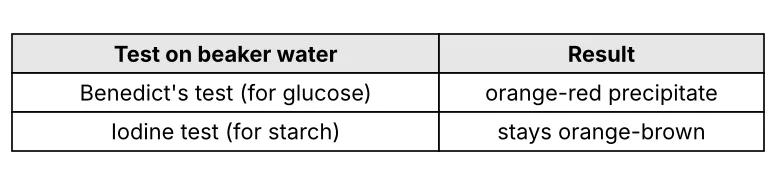
State what the results show about the movement of glucose and starch.
Explain these results in terms of the tubing.
Predict, with a reason, what happens to the volume of liquid inside the tubing.
revisionprep.com
Summary Answer
Not available for this question.
Model Answer
Not available for this question.
Marking Scheme
Not available for this question.
Examiner Insights
Not available for this question.
Fluid mosaic model
The table shows the permeability of an artificial phospholipid bilayer (no proteins) to five substances.
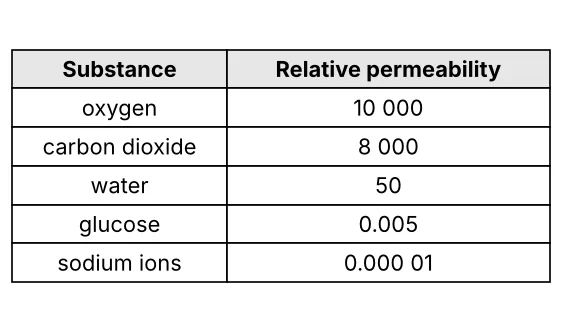
Identify the property shared by the two substances that cross most easily.
Calculate how many times more permeable the bilayer is to oxygen than to water.
Explain why the bilayer is almost impermeable to sodium ions.
Real cell membranes are far more permeable to water and glucose than this bilayer. Explain how.
revisionprep.com
Summary Answer
Not available for this question.
Model Answer
Not available for this question.
Marking Scheme
Not available for this question.
Examiner Insights
Not available for this question.
Simple diffusion, osmosis and channel proteins
Agar cubes containing an indicator were placed in acid. The acid diffused in, changing the indicator colour. The time for each cube to change colour completely was recorded. The results are shown in the table.
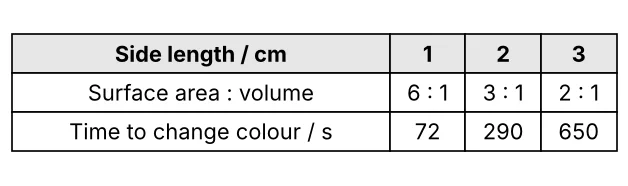
Describe the relationship between surface area to volume ratio and the time taken.
Explain why the largest cube takes longest.
Suggest why large single-celled organisms are rare.
revisionprep.com
Summary Answer
Not available for this question.
Model Answer
Not available for this question.
Marking Scheme
Not available for this question.
Examiner Insights
Not available for this question.
Active transport, pumps, endocytosis and exocytosis
The giant alga Nitella lives in pond water. The concentrations of three ions inside its cells and in the pond water are shown. The results are shown in the table.
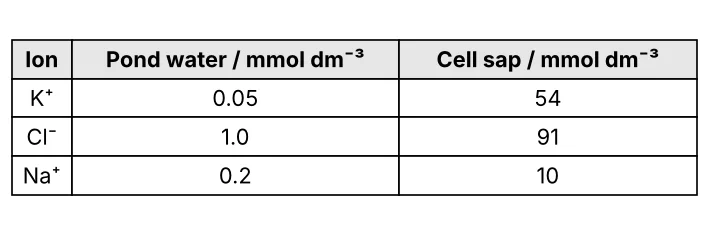
Calculate how many times more concentrated K⁺ is inside the cell than outside.
Deduce, with a reason, how these ions enter the cells.
Explain why this uptake would stop if the cells were kept in the dark for several days with no oxygen.
Suggest why the cell does not simply let these ions diffuse back out.
revisionprep.com
Summary Answer
Not available for this question.
Model Answer
Not available for this question.
Marking Scheme
Not available for this question.
Examiner Insights
Not available for this question.
Active transport, pumps, endocytosis and exocytosis
Uptake of glucose and of an amino acid into cells was measured at different external concentrations, with and without a respiratory inhibitor (the internal concentration was kept low for glucose and high for the amino acid). The results are shown in the table.
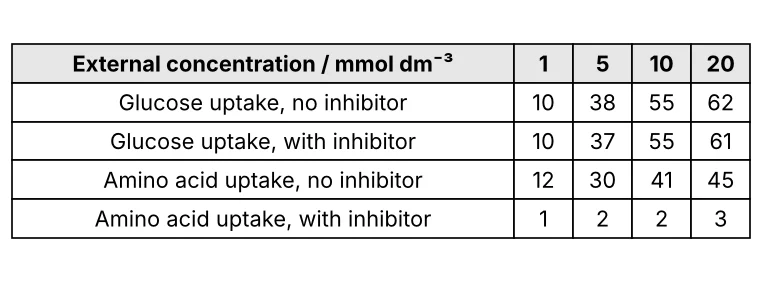
Deduce the method of glucose uptake, giving two reasons from the data.
Deduce the method of amino acid uptake, giving a reason.
Explain why glucose uptake levels off at high concentrations.
Explain why the respiratory inhibitor reduces amino acid uptake.
Calculate the percentage decrease in amino acid uptake at 10 mmol dm⁻³ caused by the inhibitor.
Suggest why the glucose uptake values with and without the inhibitor are not exactly the same.
Suggest why amino acid uptake without the inhibitor levels off at high external concentrations.
revisionprep.com
Summary Answer
Not available for this question.
Model Answer
Not available for this question.
Marking Scheme
Not available for this question.
Examiner Insights
Not available for this question.
Lipid bilayer and membrane proteins
The permeability of a membrane to a series of alcohols was measured. Lipid solubility increases with the length of the carbon chain. The results are shown in the table.
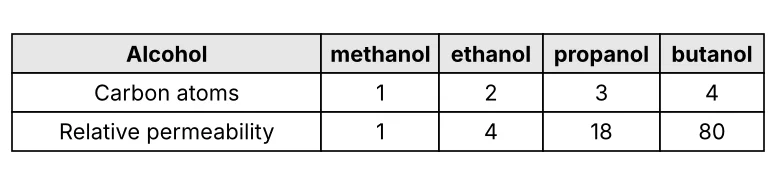
Calculate how many times more permeable the membrane is to butanol than to ethanol.
Describe the relationship between chain length and permeability.
Explain this relationship using the structure of the membrane.
Predict, with a reason, how the permeability to glucose would compare with these alcohols.
State the method by which these alcohols cross the membrane.
Predict the relative permeability of the membrane to pentanol, which has five carbon atoms. Give a reason based on the data.
Water is much less lipid-soluble than methanol but crosses many plasma membranes rapidly. Suggest why.
revisionprep.com
Summary Answer
Not available for this question.
Model Answer
Not available for this question.
Marking Scheme
Not available for this question.
Examiner Insights
Not available for this question.
That's every free question here — 6 of 115.
+109 more questions, plus Mock Papers & Worksheets, are waiting in Premium.