Organelles and Compartmentalization · Paper 2 — Free Biology SL Practice Questions
Free questions
Open in full, with answers, mark scheme and examiner insights.
Compartmentalization of processes in eukaryotic cells
The micrograph shows part of a eukaryotic cell with its nucleus and a lysosome. The nuclear envelope is a double membrane with pores. The lysosome contains hydrolytic enzymes that work best at pH 5.0; the cytoplasm is at about pH 7.2.
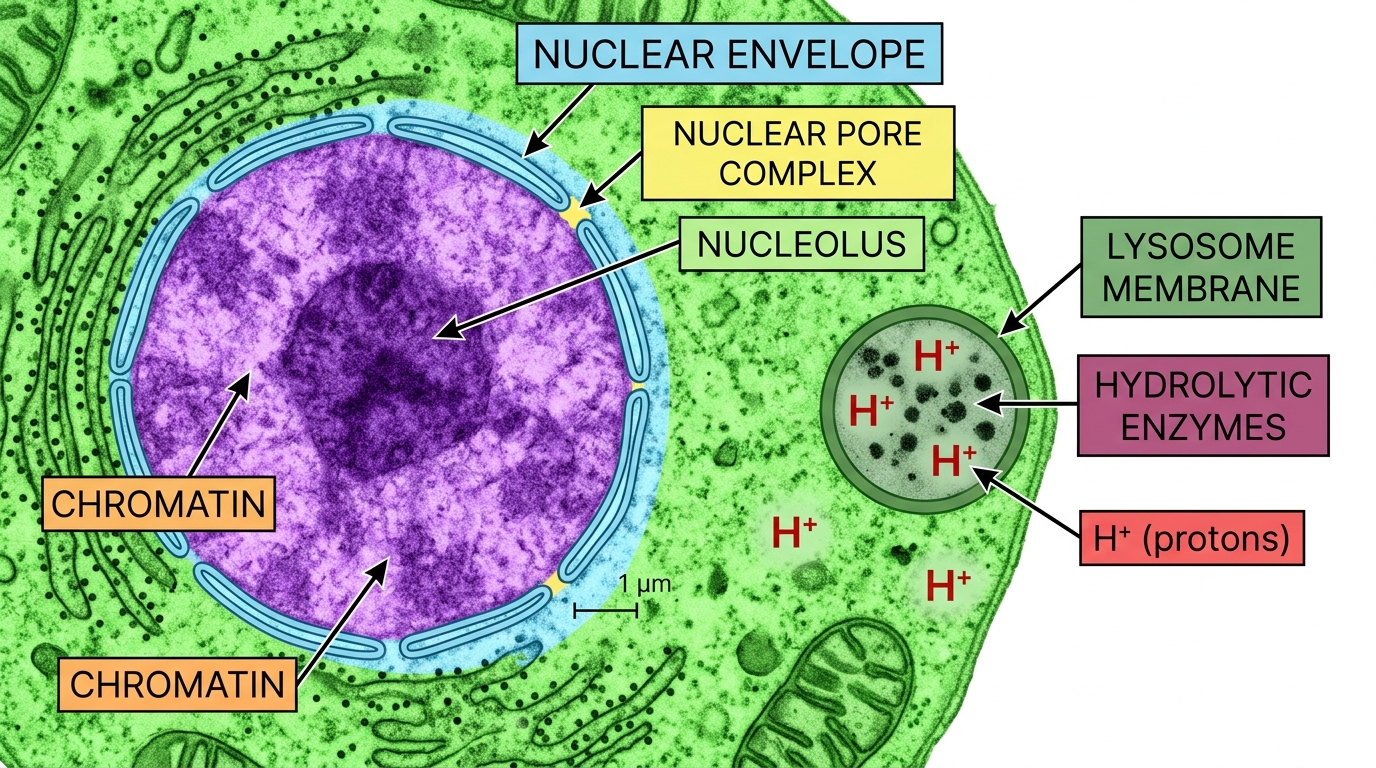
State one substance that leaves the nucleus through the nuclear pores.
Explain why the difference in pH between the lysosome and the cytoplasm helps protect the cell.
Outline one advantage to the cell of the nuclear envelope separating the nucleus from the cytoplasm.
revisionprep.com
Summary Answer
Not available for this question.
Model Answer
Not available for this question.
Marking Scheme
Not available for this question.
Examiner Insights
Not available for this question.
Role of organelles in cellular function
The diagram shows the ultrastructure of an animal cell as seen in an electron micrograph.
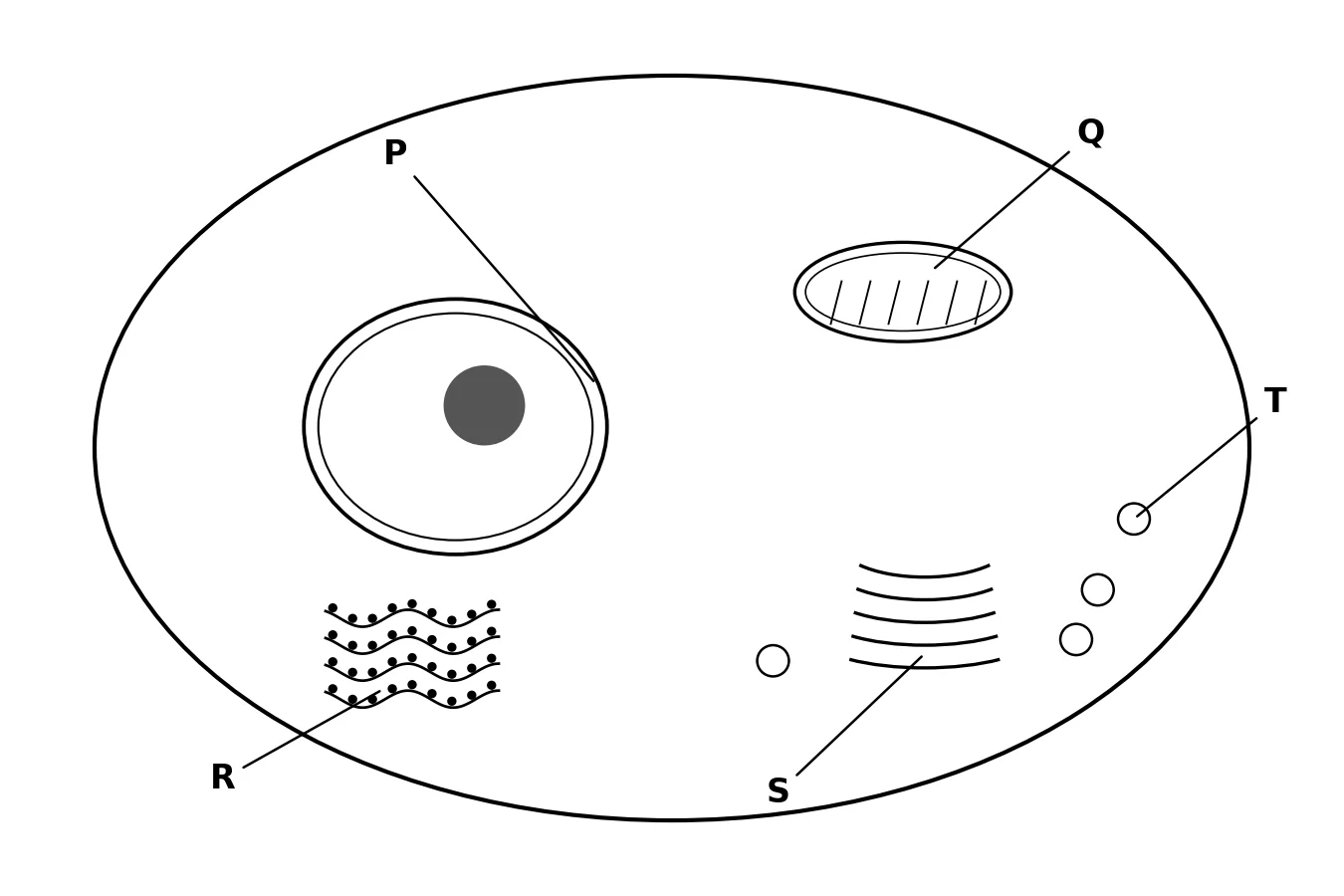
Identify organelles P, Q, R and S.
State the function of structure T.
Outline how organelles R, S and T work together in secreting a protein.
revisionprep.com
Summary Answer
Not available for this question.
Model Answer
Not available for this question.
Marking Scheme
Not available for this question.
Examiner Insights
Not available for this question.
Compartmentalization of processes in eukaryotic cells
The diagram shows a normal cell and a modified cell in which the lysosome membrane has been made permeable to hydrogen ions (). In the normal cell, proteins in the lysosome membrane pump into the lysosome using ATP.
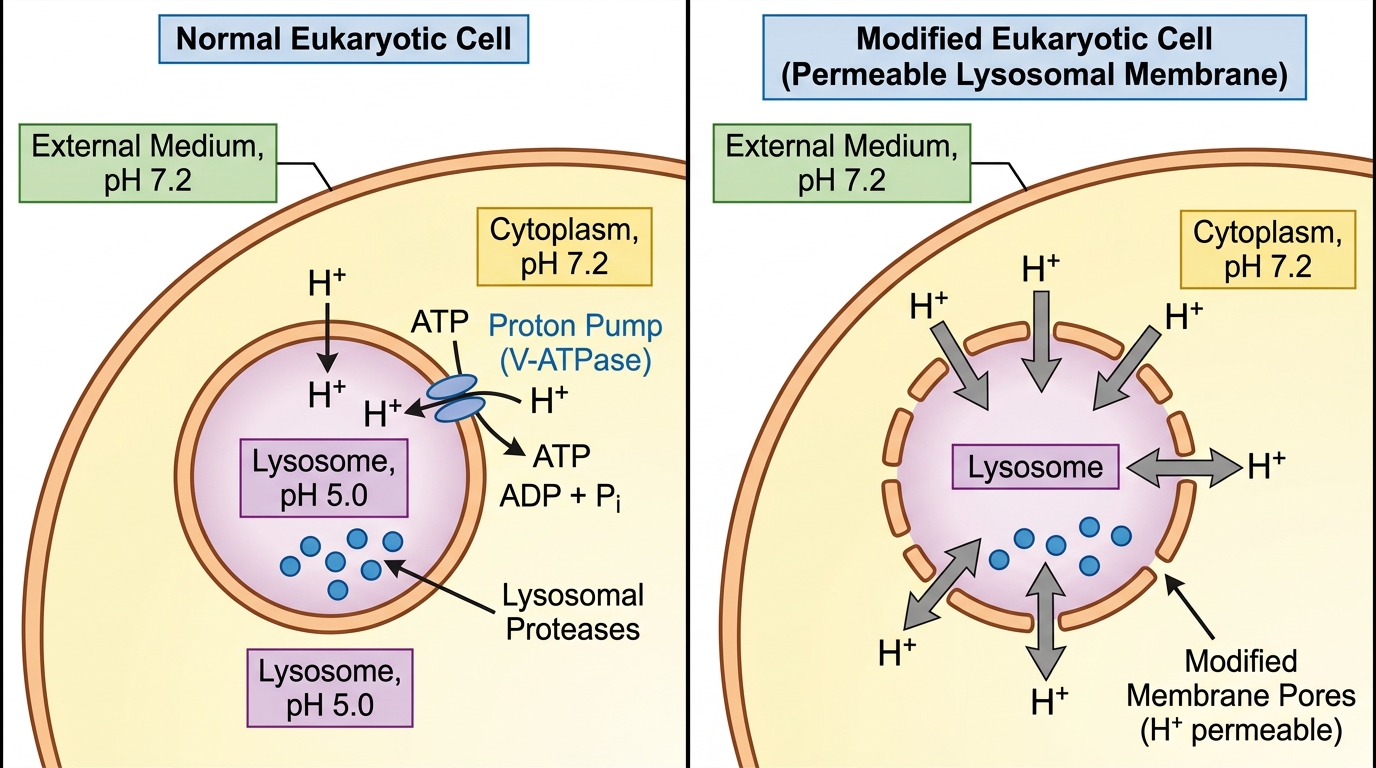
State the pH inside the lysosome of the normal cell.
Explain how the lysosome membrane keeps the inside of the lysosome more acidic than the cytoplasm.
Predict, with a reason, how the activity of lysosomal proteases in the modified cell will differ from that in the normal cell.
revisionprep.com
Summary Answer
Not available for this question.
Model Answer
Not available for this question.
Marking Scheme
Not available for this question.
Examiner Insights
Not available for this question.
Role of organelles in cellular function
Electron micrographs of a palisade mesophyll cell and a root hair cell from the same plant were used to count organelles in equal areas of cytoplasm.
Palisade cell: 62 chloroplasts, 18 mitochondria, large central vacuole Root hair cell: 0 chloroplasts, 41 mitochondria, large central vacuole
State why the root hair cell has no chloroplasts.
Suggest why the root hair cell has more mitochondria than the palisade cell.
Explain how the palisade cell can carry out photosynthesis and aerobic respiration at the same time.
Explain one advantage to both cells of storing ions and waste products in a vacuole.
revisionprep.com
Summary Answer
Not available for this question.
Model Answer
Not available for this question.
Marking Scheme
Not available for this question.
Examiner Insights
Not available for this question.
Compartmentalization of processes in eukaryotic cells
The graph shows how the activity of cathepsin D, a lysosomal protease, varies with pH. Fibroblasts were treated with a drug that makes lysosome membranes leaky. Cathepsin D activity measured at pH 7.2 in the cytosol was 2 units per mg protein before treatment and 8 units after 30 minutes. After 60 minutes, the cells began to die.
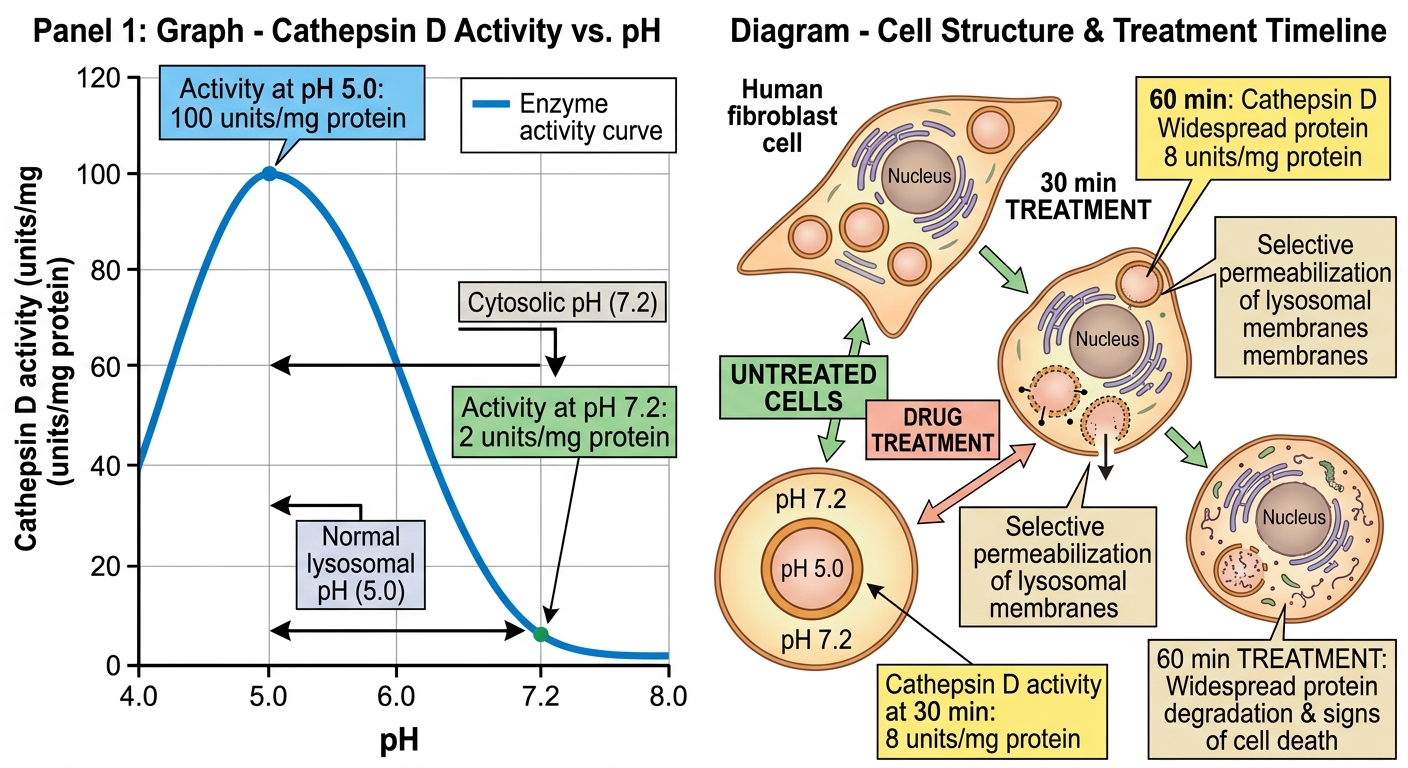
State the pH at which cathepsin D is most active.
Using the graph, compare the activity of cathepsin D in the lysosome (pH 5.0) with its activity in the cytosol (pH 7.2).
Explain why activity in the cytosol rose after drug treatment.
Discuss whether the low pH inside lysosomes or the lysosome membrane does more to protect the cell from its own enzymes.
Suggest why the cells began to die only after 60 minutes.
Outline two advantages to a cell of keeping its hydrolytic enzymes inside lysosomes.
revisionprep.com
Summary Answer
Not available for this question.
Model Answer
Not available for this question.
Marking Scheme
Not available for this question.
Examiner Insights
Not available for this question.
Endoplasmic reticulum, Golgi apparatus, mitochondria, and nucleus
Pancreatic cells were given a 2-minute pulse of radioactive leucine. The graph shows radioactivity in the rough ER, Golgi apparatus and secretory vesicles for 30 minutes afterwards. Lipase X, the enzyme being followed, is a glycoprotein.
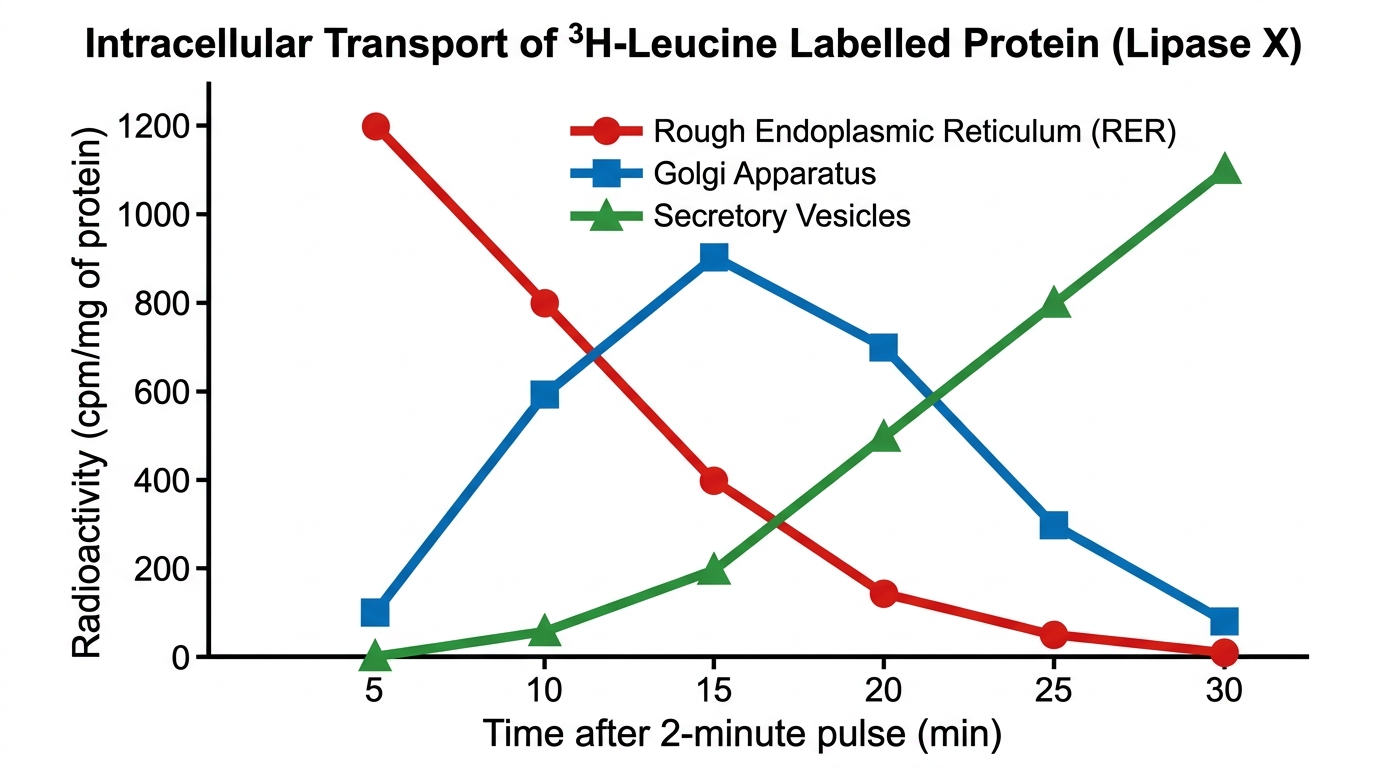
State the time at which radioactivity in the Golgi apparatus is highest.
Calculate the mean rate of change of radioactivity in the rough ER between 5 and 10 minutes.
Explain how Lipase X moves from the rough ER to secretory vesicles, and what happens to it on the way.
Evaluate the use of pulse-chase experiments for studying the route of secreted proteins.
State the organelle in which carbohydrate is added to Lipase X before it is packaged.
Predict how the curves for the Golgi apparatus and the secretory vesicles would change if a drug stopped vesicles leaving the Golgi apparatus. Give a reason.
revisionprep.com
Summary Answer
Not available for this question.
Model Answer
Not available for this question.
Marking Scheme
Not available for this question.
Examiner Insights
Not available for this question.
That's every free question here — 6 of 74.
+68 more questions, plus Mock Papers & Worksheets, are waiting in Premium.