You're viewing 3 free preview questions for Biology SL — subscribe to unlock 201 more, plus the Full Question Bank, Mock Papers & Worksheets.Upgrade
Proteins · Paper 2 — Free Biology SL Practice Questions
1MasterySAQ-SStructure of proteins: Primary to quaternary structure5 marksPaper 2~8 min

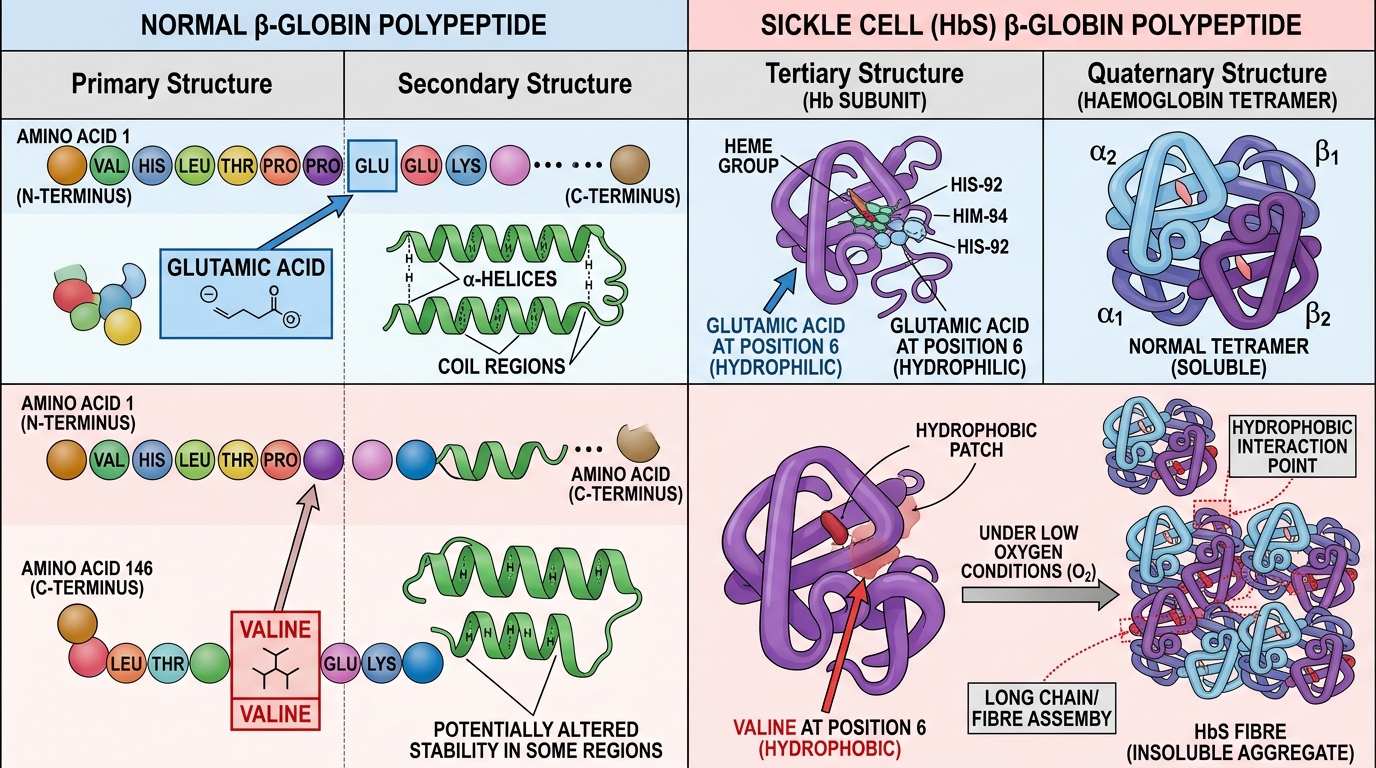
A point mutation in the -globin gene changes the sixth codon from GAG to GTG, substituting glutamic acid (hydrophilic, negatively charged) with valine (hydrophobic, non-polar) in the -globin polypeptide. Individuals homozygous for this allele develop sickle cell anaemia; heterozygous individuals carry one normal and one mutant allele.
(a)
State the level of protein structure directly altered by this amino acid substitution. [1 mark]
(b)
Describe how the substitution of glutamic acid with valine affects the secondary and tertiary structures of the -globin polypeptide. [2 marks]
(c)
Explain how the altered tertiary structure causes haemoglobin molecules to aggregate under low-oxygen conditions, and evaluate why heterozygous individuals are largely protected from the severe symptoms of sickle cell anaemia. [2 marks]

Solutions
2MasterySAQ-SStructure of proteins: Primary to quaternary structure5 marksPaper 2~8 min
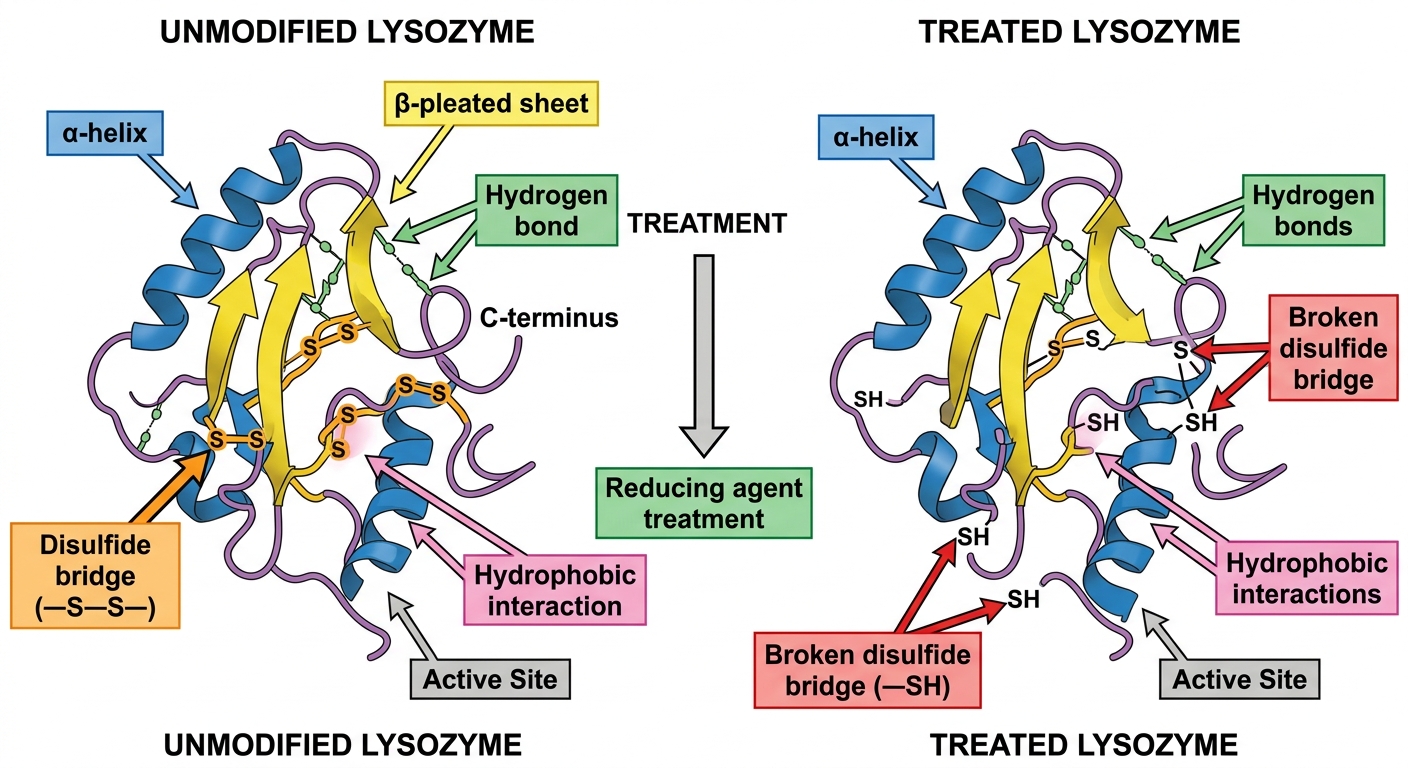
The enzyme lysozyme is a globular protein that hydrolyses bacterial cell walls. Its structure includes regions of -helix and -pleated sheet, stabilised by hydrogen bonds, disulfide bridges, and hydrophobic interactions. A researcher treats lysozyme with a reducing agent that breaks all disulfide bridges (—S—S— bonds) but leaves peptide bonds intact.
(a)
State the level of protein structure that is directly stabilised by disulfide bridges. [1 mark]
(b)
Describe how the loss of disulfide bridges affects the -helices and -pleated sheets of lysozyme. [2 marks]
(c)
Evaluate why breaking disulfide bridges, but not peptide bonds, is sufficient to abolish lysozyme's ability to hydrolyse bacterial cell walls. [2 marks]
Solutions
3ChallengeSAQ-LStructure of proteins: Primary to quaternary structure9 marksPaper 2~14 min
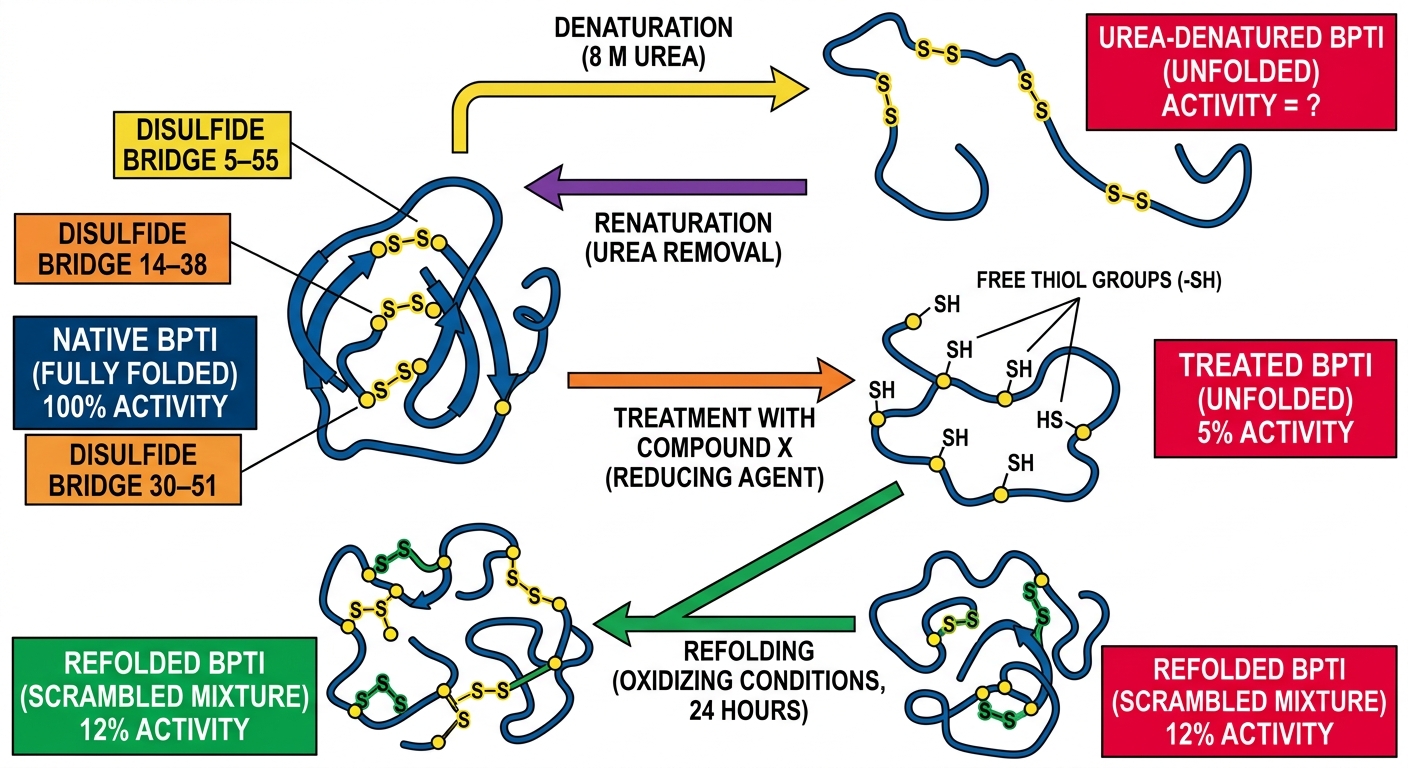
Bovine pancreatic trypsin inhibitor (BPTI) is a protein of 58 amino acids. In its native state it has a well-defined tertiary structure stabilised by three disulfide bridges () between cysteine residues at positions 5–55, 14–38, and 30–51, and it is a potent inhibitor of the enzyme trypsin.
A research team treats native BPTI with Compound X, which specifically reduces disulfide bridges to free thiol groups (). After treatment, trypsin-inhibitory activity falls to of the original value. The treated BPTI is then allowed to refold in the presence of oxygen (which can re-oxidise thiol groups to disulfide bridges); after 24 hours, activity recovers to only of the original value.
In a separate control experiment, native BPTI is denatured with urea — which disrupts hydrogen bonds and hydrophobic interactions but leaves disulfide bridges intact — and then allowed to refold by dialysis to remove the urea. Activity recovers to of the original value.
(a)
State the two levels of protein structure that are directly stabilised by disulfide bridges, and identify which level is primarily disrupted when Compound X is applied. [2 marks]
(b)
Explain why reduction of the disulfide bridges by Compound X causes a loss of trypsin-inhibitory activity in BPTI. [3 marks]
(c)
Evaluate the hypothesis: 'The primary structure of BPTI alone is sufficient to determine its correct tertiary structure and full biological function.' Use all three experimental outcomes in your answer. [4 marks]
Solutions
That's every free question here — 3 of 204.
+201 more questions, plus Mock Papers & Worksheets, are waiting in Premium.