Cell Structure · Paper 1 — Free Biology SL Practice Questions
Free questions
Open in full, with answers, mark scheme and examiner insights.
Prokaryotic vs eukaryotic cells
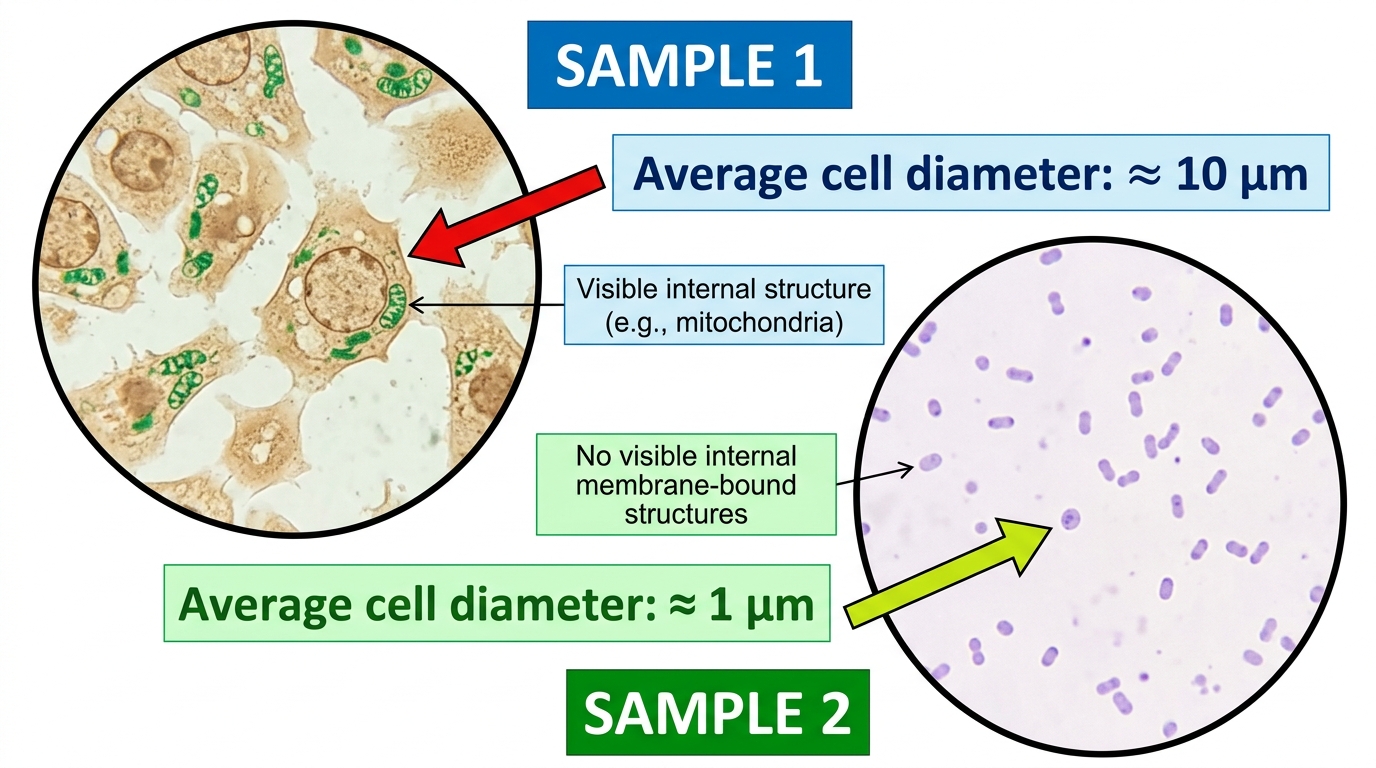
A student examines two cell samples under a microscope. Sample 1 cells are approximately 10 µm in diameter and contain visible mitochondria. Sample 2 cells are approximately 1 µm in diameter and lack visible membrane-bound organelles. Which conclusion is most justified by these observations?
revisionprep.com
Summary Answer
Not available for this question.
Model Answer
Not available for this question.
Marking Scheme
Not available for this question.
Examiner Insights
Not available for this question.
Role of ribosomes, mitochondria, and chloroplasts
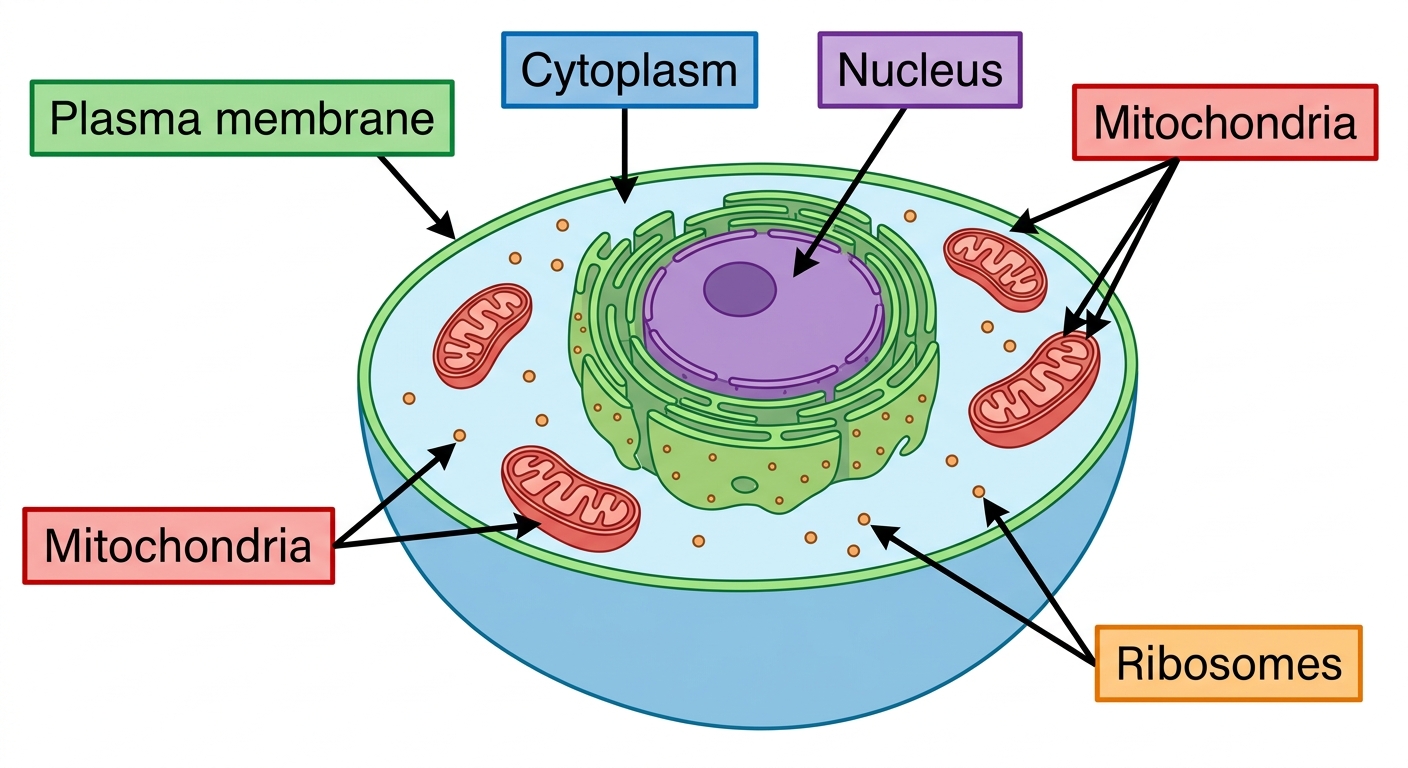
The shows an animal cell. What is the main function of the organelles labelled 'Mitochondria'?
revisionprep.com
Summary Answer
Not available for this question.
Model Answer
Not available for this question.
Marking Scheme
Not available for this question.
Examiner Insights
Not available for this question.
Prokaryotic vs eukaryotic cells
The figure shows an Escherichia coli cell and a yeast cell grown under the same conditions, with the volume and rate of oxygen uptake of each cell.
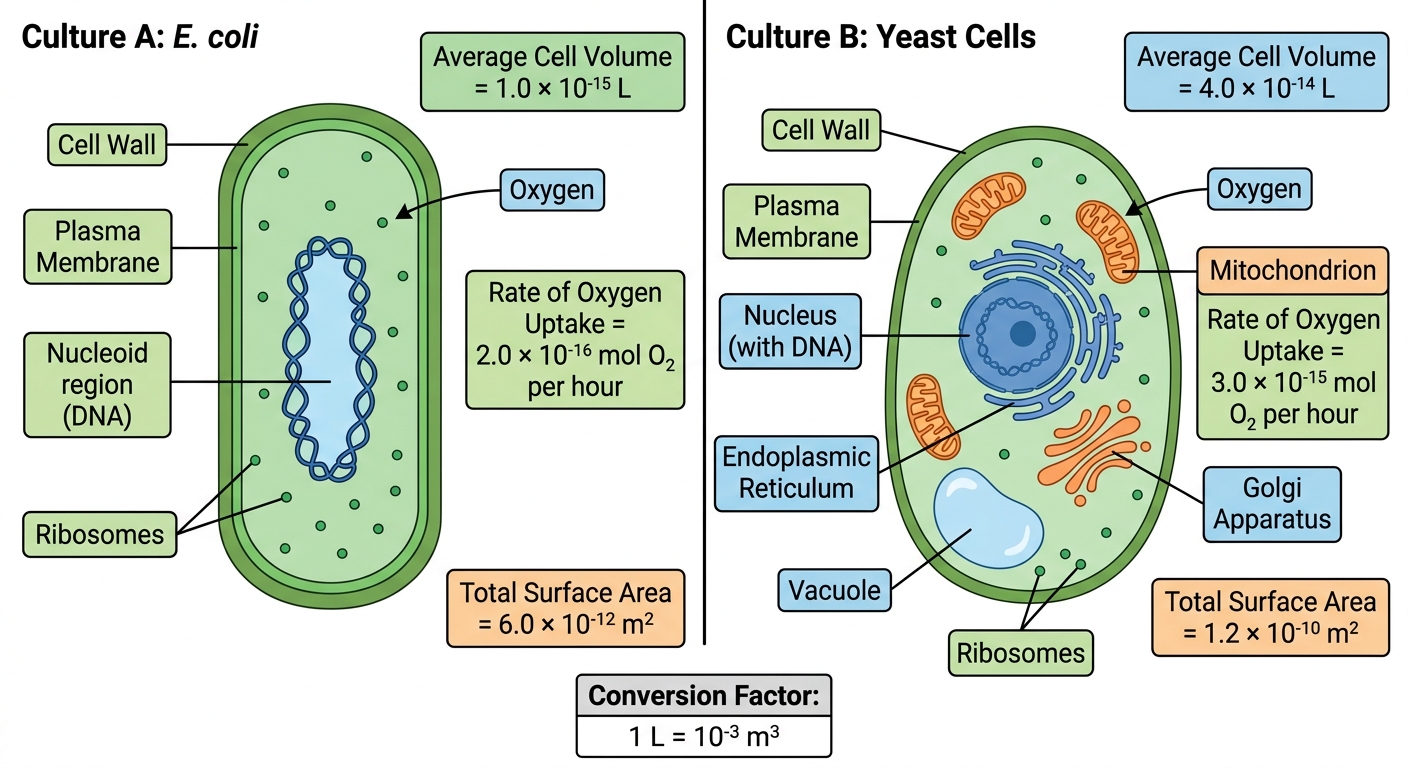
Using the figure, state two structures in the yeast cell that are absent from E. coli.
Calculate how many times greater the volume of the yeast cell is.
Calculate the rate of oxygen uptake per litre of cell volume for each cell, in mol h⁻¹ L⁻¹.
Suggest one reason why the two cells differ in oxygen uptake per unit volume.
Explain where aerobic respiration takes place in E. coli.
revisionprep.com
Summary Answer
Not available for this question.
Model Answer
Not available for this question.
Marking Scheme
Not available for this question.
Examiner Insights
Not available for this question.
Role of ribosomes, mitochondria, and chloroplasts
The numbers of chloroplasts in cells from different layers of a leaf are shown.
The results are shown in Table 1.
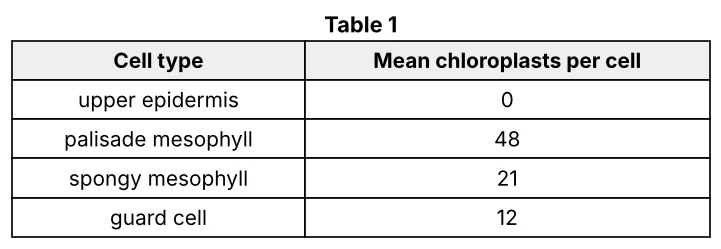
Calculate the percentage difference in chloroplast number between palisade and spongy cells, relative to spongy cells.
Explain why palisade cells contain the most chloroplasts.
Suggest why the upper epidermis cells have no chloroplasts.
Chloroplasts and mitochondria both contain their own membranes. State two other structural features of a chloroplast visible in an electron micrograph.
A 1 mm² area of leaf contains about 3000 palisade cells. Calculate the number of chloroplasts in the palisade cells of this area.
Suggest how the mean number of chloroplasts per cell could be found reliably.
revisionprep.com
Summary Answer
Not available for this question.
Model Answer
Not available for this question.
Marking Scheme
Not available for this question.
Examiner Insights
Not available for this question.
Role of ribosomes, mitochondria, and chloroplasts
'Petite' mutant yeast cells have mitochondria that cannot carry out aerobic respiration. Normal and petite yeast were grown for 24 hours on two food sources.
The results are shown in Table 1.

Explain why petite yeast can grow on glucose but not on ethanol.
Explain why normal yeast grows more on glucose than petite yeast.
Predict the products of glucose breakdown by petite yeast.
Suggest why the mutants are called 'petite'.
Calculate the growth of petite yeast on glucose as a percentage of the growth of normal yeast.
State one variable that must be kept the same for the two types of yeast.
revisionprep.com
Summary Answer
Not available for this question.
Model Answer
Not available for this question.
Marking Scheme
Not available for this question.
Examiner Insights
Not available for this question.
Life processes in unicellular organisms
Paramecium cells are moved from pond water into a more concentrated solution. What change in the contractile vacuoles is expected?
revisionprep.com
Summary Answer
Not available for this question.
Model Answer
Not available for this question.
Marking Scheme
Not available for this question.
Examiner Insights
Not available for this question.
That's every free question here — 6 of 111.
+105 more questions, plus Mock Papers & Worksheets, are waiting in Premium.