Evolution and Speciation · Paper 1 — Free Biology SL Practice Questions
Free questions
Open in full, with answers, mark scheme and examiner insights.
Evidence for evolution: base sequences, selective breeding, homologous structures
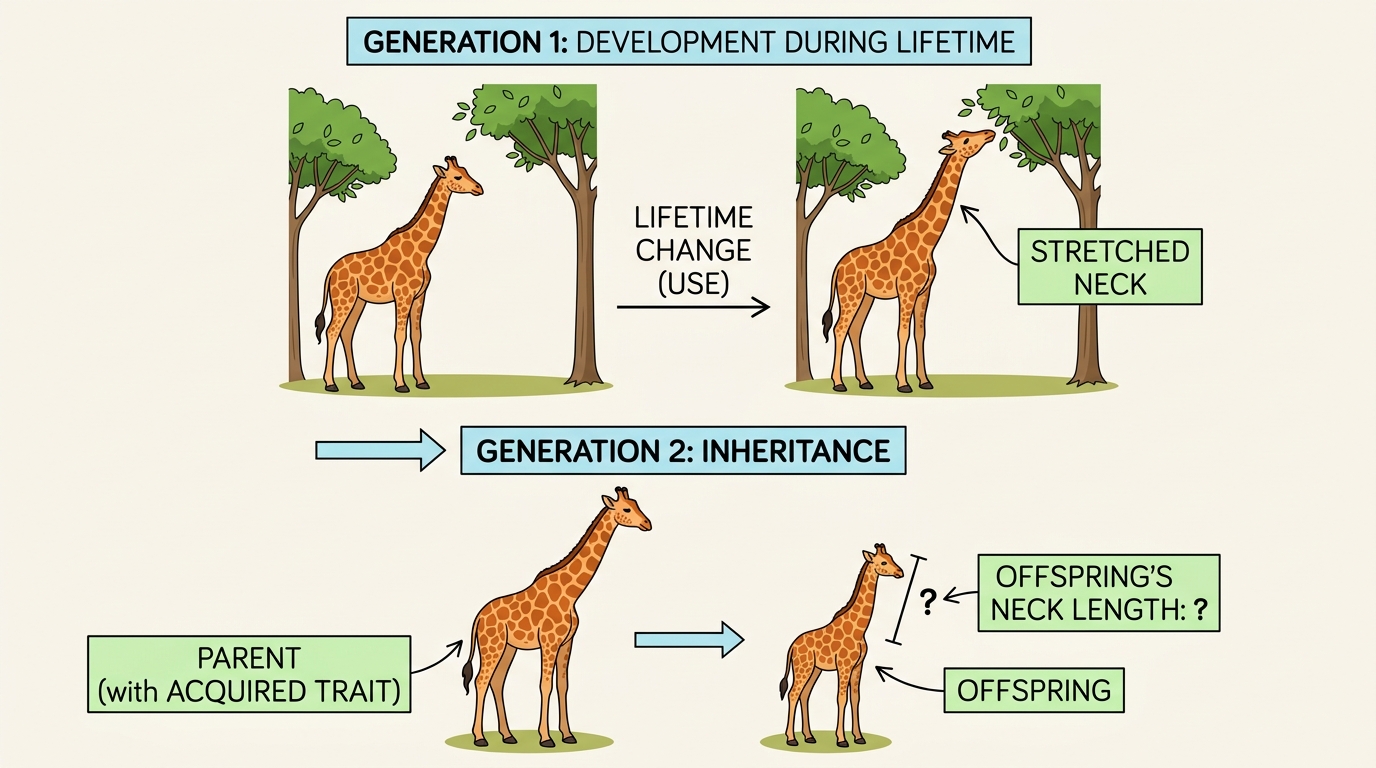
The shows Lamarck's explanation for the long necks of giraffes. If Lamarck's mechanism were correct, which observation would be expected?
revisionprep.com
Summary Answer
Not available for this question.
Model Answer
Not available for this question.
Marking Scheme
Not available for this question.
Examiner Insights
Not available for this question.
Convergent evolution and analogous structures
The hummingbird hawk-moth, an insect, hovers in front of flowers and feeds on nectar through a long tube, just as hummingbirds do with their long beaks. Which term describes how these similar feeding methods arose?
revisionprep.com
Summary Answer
Not available for this question.
Model Answer
Not available for this question.
Marking Scheme
Not available for this question.
Examiner Insights
Not available for this question.
Evidence for evolution: base sequences, selective breeding, homologous structures
The same 20-base section of a gene was sequenced in four species of beetle, W, X, Y and Z. The figure shows the aligned sequences.
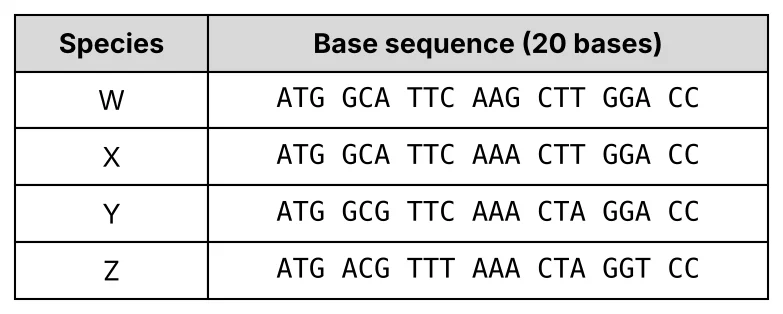
Determine the number of base differences between W and each of the other species.
Deduce which species is most closely related to Y. Give a reason.
Explain why base sequence differences can be used to infer how recently two species shared a common ancestor.
Suggest two reasons why the conclusions from these data are uncertain.
revisionprep.com
Summary Answer
Not available for this question.
Model Answer
Not available for this question.
Marking Scheme
Not available for this question.
Examiner Insights
Not available for this question.
Evidence for evolution: base sequences, selective breeding, homologous structures
Cacti grow in the deserts of the Americas and succulent euphorbias in the deserts of Africa. Both have thick green stems and no leaves. Shoots of equal size were cut from a cactus, a succulent euphorbia and a leafy shrub, and five shoots of each were left in a warm room for 7 days. The figure shows the percentage of mass lost.
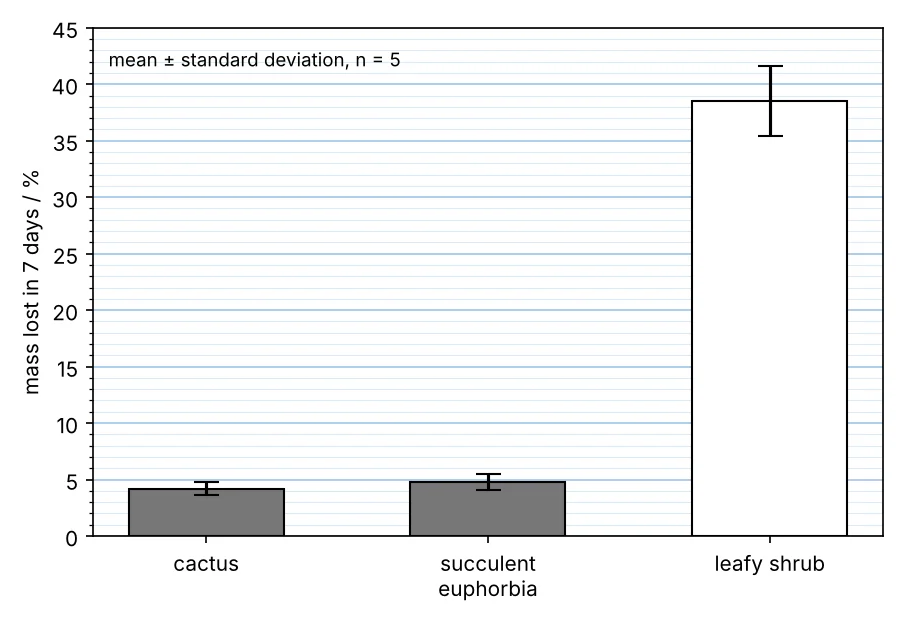
Calculate the mass lost by a 50.0 g shoot of the leafy shrub.
Compare the water loss of the three plants.
Identify two variables that should be kept the same for all the shoots.
Cacti and euphorbias belong to distantly related plant families. Explain how these data support the view that their stems evolved by convergent evolution.
revisionprep.com
Summary Answer
Not available for this question.
Model Answer
Not available for this question.
Marking Scheme
Not available for this question.
Examiner Insights
Not available for this question.
Evidence for evolution: base sequences, selective breeding, homologous structures
Short DNA sequences called SINEs occasionally insert into new positions in a genome. Once inserted, a SINE is inherited by all descendants and is very rarely lost; the chance of the same SINE inserting independently at exactly the same position in two lineages is extremely small. The table shows whether five SINEs (1 to 5) are present (+) or absent (−) at particular positions in five mammals.
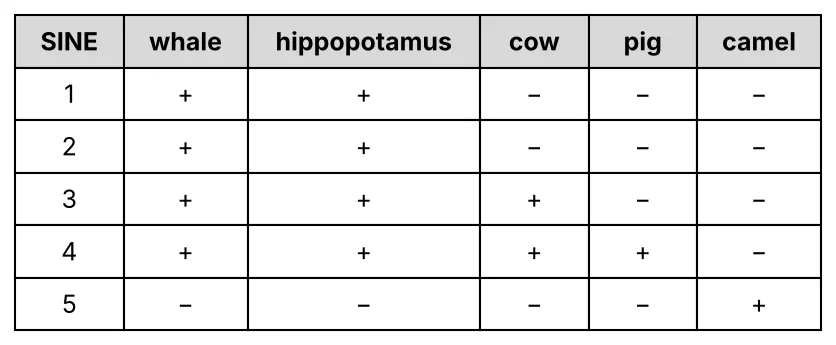
Identify the living mammal most closely related to whales, according to the table.
Deduce the order in which SINEs 1, 3 and 4 were inserted, with a reason.
Explain why a shared SINE at the same position is strong evidence of common ancestry.
Whales have flippers and no hind legs; hippopotamuses have four legs. Explain why this does not contradict the SINE evidence.
revisionprep.com
Summary Answer
Not available for this question.
Model Answer
Not available for this question.
Marking Scheme
Not available for this question.
Examiner Insights
Not available for this question.
Convergent evolution and analogous structures
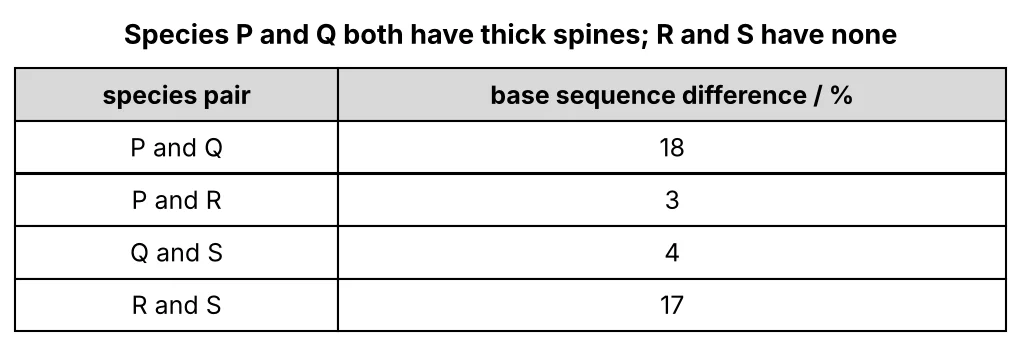
Four desert plant species, P, Q, R and S, were compared. P and Q both have thick spines and swollen water-storing stems; R and S have neither. The table shows the percentage difference in the base sequence of a gene between pairs of species. Which conclusion is best supported?
revisionprep.com
Summary Answer
Not available for this question.
Model Answer
Not available for this question.
Marking Scheme
Not available for this question.
Examiner Insights
Not available for this question.
That's every free question here — 6 of 73.
+67 more questions, plus Mock Papers & Worksheets, are waiting in Premium.