Nucleic Acids · Paper 1 — Free Biology SL Practice Questions
Free questions
Open in full, with answers, mark scheme and examiner insights.
Structure of DNA and RNA
Which statement about genetic material is correct?
revisionprep.com
Summary Answer
Not available for this question.
Model Answer
Not available for this question.
Marking Scheme
Not available for this question.
Examiner Insights
Not available for this question.
Nucleotide structure and the sugar–phosphate backbone
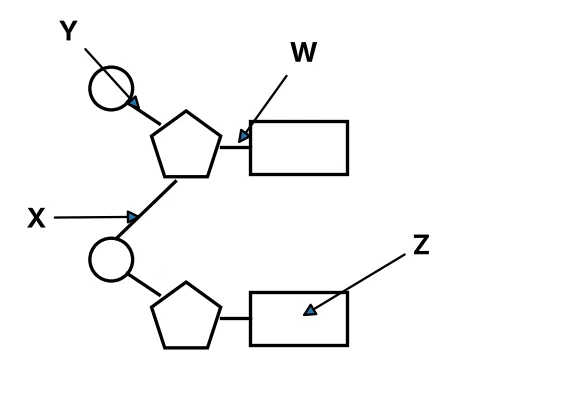
The shows two nucleotides joined together in a strand of a nucleic acid. Which label points to the bond that links one nucleotide to the next?
revisionprep.com
Summary Answer
Not available for this question.
Model Answer
Not available for this question.
Marking Scheme
Not available for this question.
Examiner Insights
Not available for this question.
Structure of DNA and RNA
The diagram shows how a forensic laboratory measured DNA in a blood sample. The absorbance of light at is directly proportional to the concentration of nucleic acid in the solution.
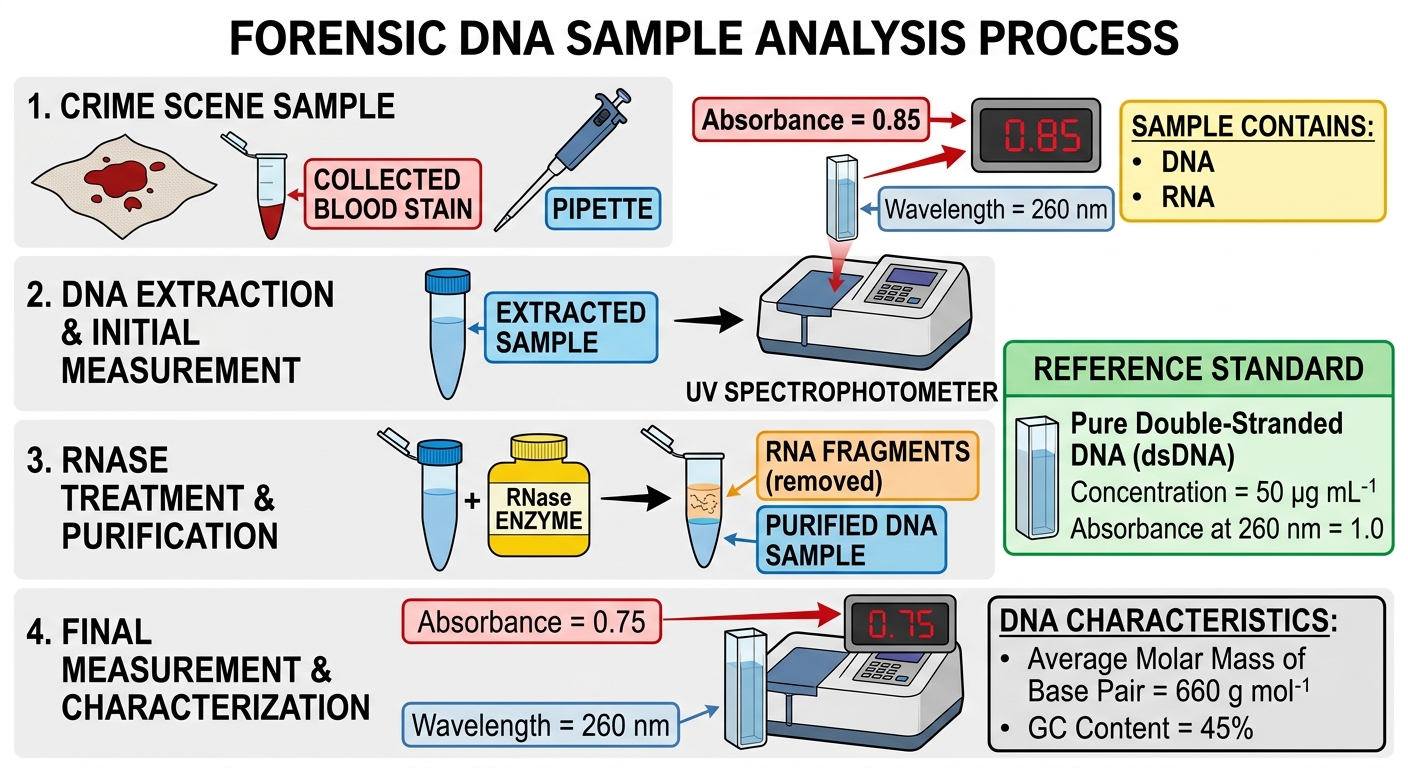
Calculate the concentration of DNA in the purified sample.
Calculate the percentage of the first absorbance reading that was due to RNA.
Explain why the RNase enzyme removed the RNA but not the DNA.
Using the GC content shown, determine the percentage of adenine in the DNA.
Suggest why the sample was treated with RNase before the DNA concentration was calculated.
Explain why this method cannot show whose blood the DNA came from.
revisionprep.com
Summary Answer
Not available for this question.
Model Answer
Not available for this question.
Marking Scheme
Not available for this question.
Examiner Insights
Not available for this question.
DNA double helix and complementary base pairing
Table 1 shows the number of each type of nucleotide in one strand of a DNA molecule of 800 base pairs. A–T and A–U base pairs are held by two hydrogen bonds and G–C base pairs by three.
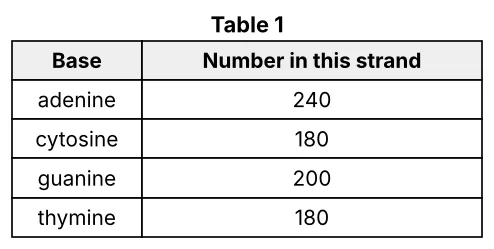
State the number of thymine nucleotides in the complementary strand.
Calculate the total number of hydrogen bonds holding the two strands together.
Calculate the percentage of guanine in the whole double-stranded molecule.
revisionprep.com
Summary Answer
Not available for this question.
Model Answer
Not available for this question.
Marking Scheme
Not available for this question.
Examiner Insights
Not available for this question.
DNA double helix and complementary base pairing
A research team investigates the relationship between DNA base composition and thermal stability in two bacterial species: Thermus aquaticus (optimal growth at ) and Escherichia coli (optimal growth at ). DNA isolated from each species was found to be linear and double-stranded.
Table 1 shows the GC content of the DNA of each species. A–T and A–U base pairs are held by two hydrogen bonds and G–C base pairs by three.

Calculate the number of hydrogen bonds per 100 base pairs in the DNA of T. aquaticus.
State the percentage of adenine bases in T. aquaticus DNA and identify the rule that allows this to be determined.
Explain how a higher GC content contributes to thermal stability of DNA.
Evaluate the hypothesis that the higher GC content of T. aquaticus DNA is the sole reason for its ability to withstand higher temperatures, using the data provided and your knowledge of DNA structure.
revisionprep.com
Summary Answer
Not available for this question.
Model Answer
Not available for this question.
Marking Scheme
Not available for this question.
Examiner Insights
Not available for this question.
Differences between DNA and RNA
A virus has a single-stranded RNA genome of nucleotides. Table 1 shows the results of a partial analysis of its bases. Inside a host cell the virus first makes a complementary RNA strand, which is then used as the template for new genomes.
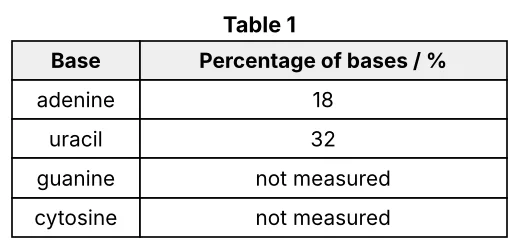
State why this virus is not evidence that RNA is the genetic material of living organisms.
Calculate the total number of guanine and cytosine nucleotides in the genome.
Explain why the number of guanine nucleotides alone cannot be calculated from these data.
Deduce the percentages of adenine and of uracil in the complementary RNA strand.
revisionprep.com
Summary Answer
Not available for this question.
Model Answer
Not available for this question.
Marking Scheme
Not available for this question.
Examiner Insights
Not available for this question.
That's every free question here — 6 of 88.
+82 more questions, plus Mock Papers & Worksheets, are waiting in Premium.