You're viewing 3 free preview questions for Biology SL — subscribe to unlock 208 more, plus the Full Question Bank, Mock Papers & Worksheets.Upgrade
Cell Structure · Paper 2 — Free Biology SL Practice Questions
1MasterySAQ-SRole of ribosomes, mitochondria, and chloroplasts7 marksPaper 2~11 min

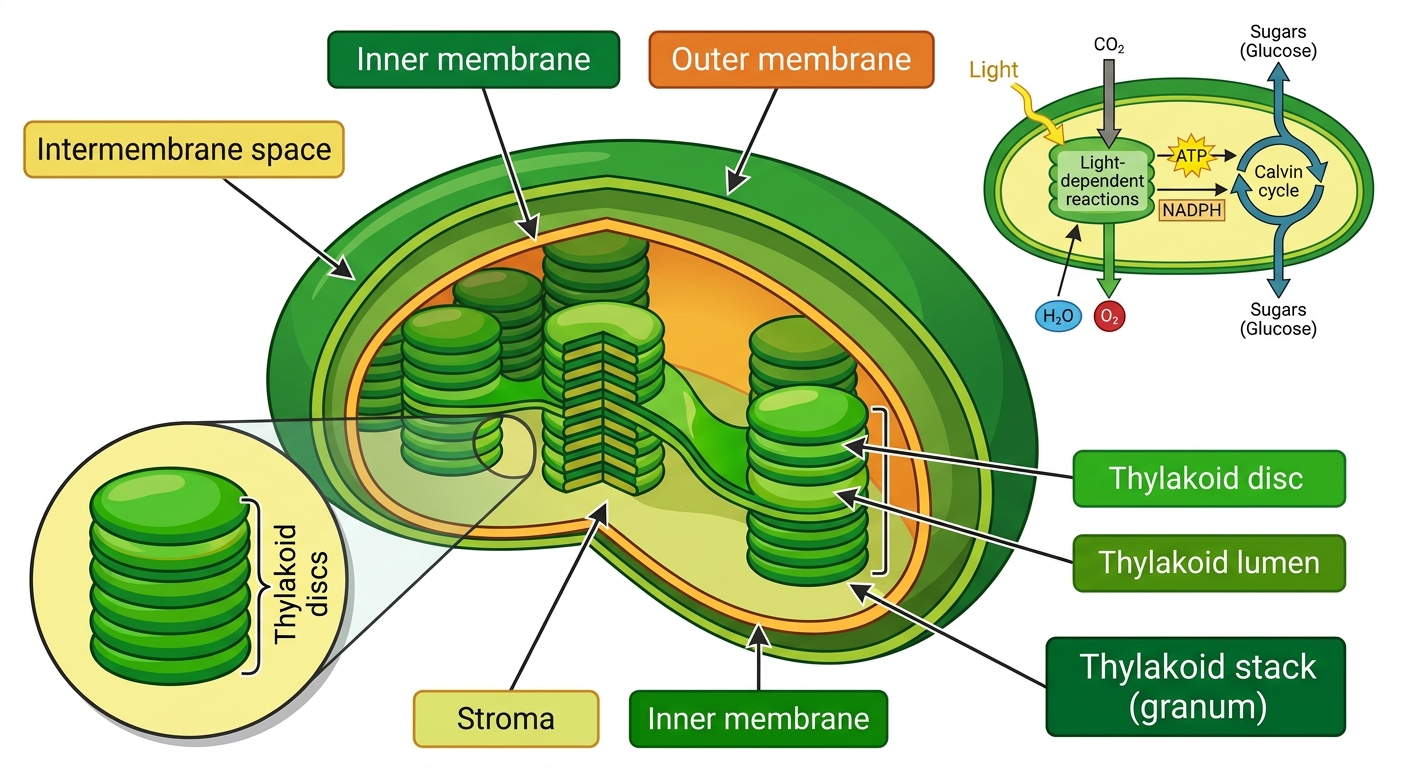
A plant cell chloroplast carries out photosynthesis. Under high light intensity, a single chloroplast produces of glucose per second. The chloroplast contains 200 thylakoid stacks (grana), each with an average of 50 thylakoid discs.
(a)
State where the light-dependent reactions of photosynthesis occur in the chloroplast. [1 mark]
(b)
Explain how the products of the light-dependent reactions are used in the Calvin cycle. [2 marks]
(c)
Calculate the rate of glucose production per thylakoid disc in . Give your answer in standard form to 2 significant figures. [2 marks]
(d)
A student claims that doubling the number of thylakoid discs per granum would double the rate of glucose production by the chloroplast. Evaluate this claim. [2 marks]

Solutions
2MasterySAQ-SRole of ribosomes, mitochondria, and chloroplasts5 marksPaper 2~8 min
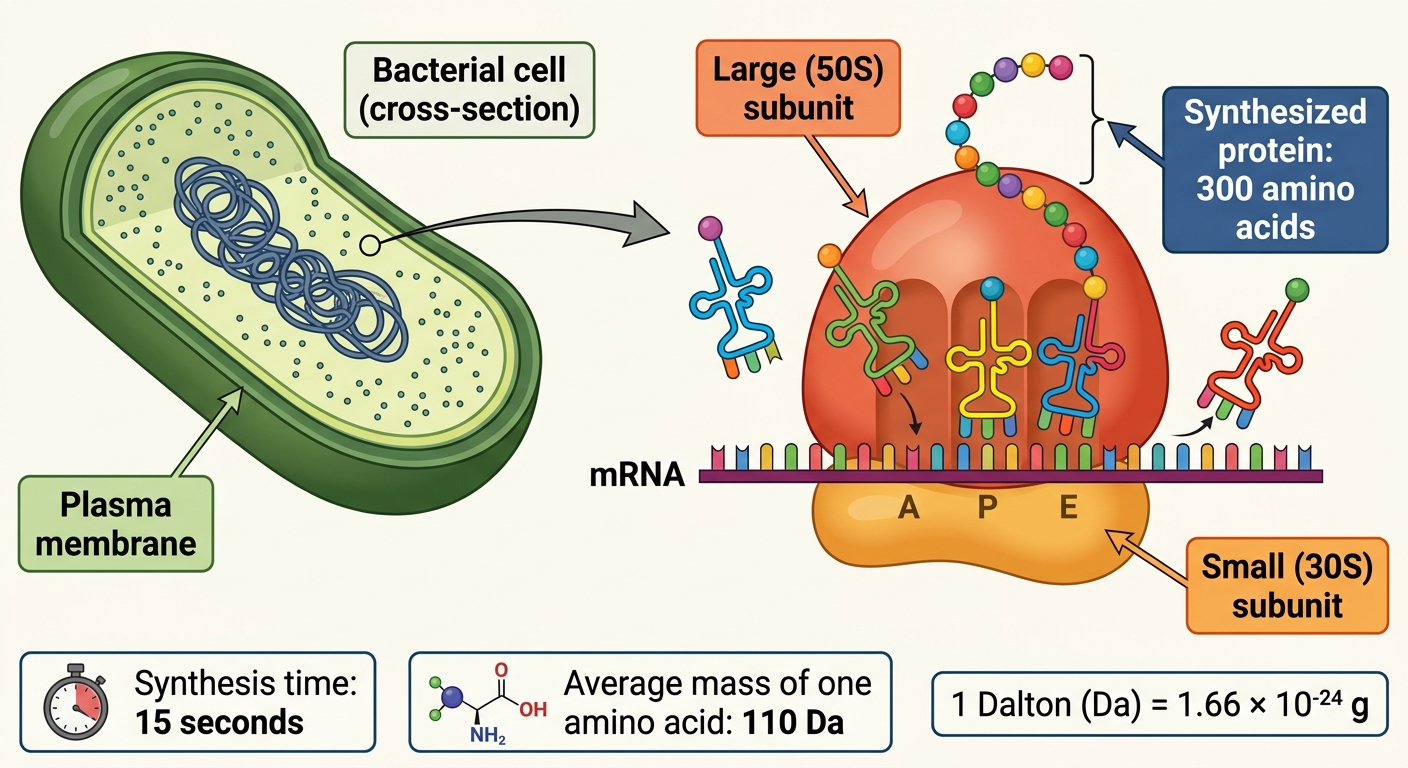
A bacterial culture is grown under optimal conditions. Each ribosome synthesizes a polypeptide of 300 amino acids in . The average mass of an amino acid is , where .
(a)
State the sizes of the large and small subunits of a bacterial ribosome. [1 mark]
(b)
Explain how the structure of a ribosome enables peptide bond formation during translation. [2 marks]
(c)
Calculate the rate of protein synthesis, in , for one ribosome. Give your answer in standard form to 2 significant figures. [2 marks]
Solutions
3ChallengeSAQ-LMembrane structure and fluid mosaic model7 marksPaper 2~11 min
Data
- Average width of a phospholipid bilayer:
- Diameter of a single cholesterol molecule:
- Ratio of cholesterol to phospholipid molecules in a typical mammalian cell membrane:
- Lateral diffusion coefficient () of a phospholipid molecule at :
- Mean square displacement in two dimensions:
-
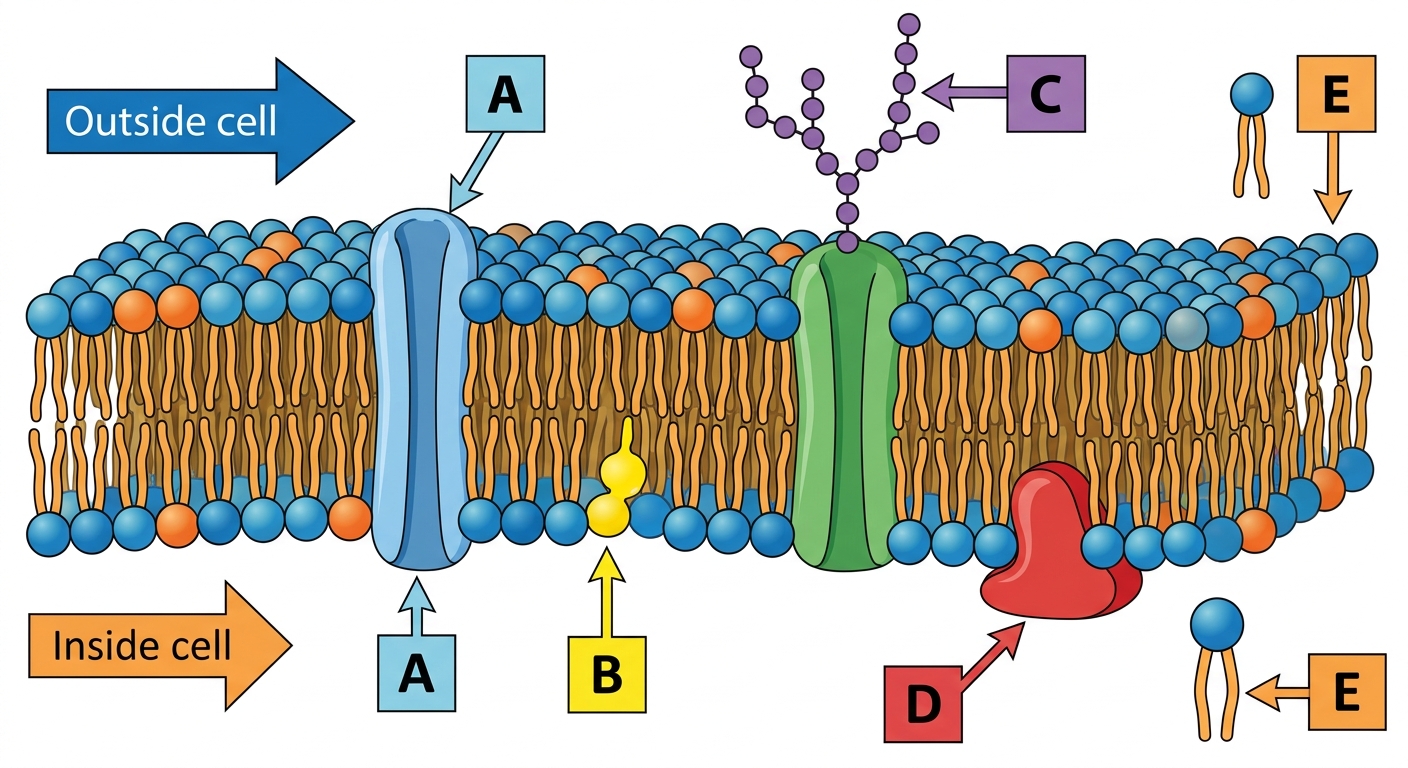
The fluid mosaic model describes the dynamic structure of cell membranes. The below shows a representation of a plasma membrane with various components labelled A to E.
(a)
Calculate the mean time, in seconds, for a phospholipid molecule to diffuse laterally a root-mean-square distance of (the length of a typical bacterial cell). Show all working. [3 marks]
(b)
Explain how cholesterol (component B), present at the ratio given, affects membrane fluidity at and at . [2 marks]
(c)
The fluid mosaic model proposes that membrane proteins and lipids undergo free lateral diffusion. Evaluate this claim by referring to membrane rafts and explaining how their molecular composition restricts the lateral diffusion of associated proteins. [2 marks]
Solutions
That's every free question here — 3 of 211.
+208 more questions, plus Mock Papers & Worksheets, are waiting in Premium.