Evolution and Speciation · Paper 2 — Free Biology SL Practice Questions
Free questions
Open in full, with answers, mark scheme and examiner insights.
Evidence for evolution: base sequences, selective breeding, homologous structures
Wild cabbage, Brassica oleracea, grows on sea cliffs in western Europe. Over about 2500 years farmers bred crops from it, each by choosing plants with one exaggerated feature. The table shows the feature selected in four of the crops.
All of these crops can still be cross-pollinated with each other and with wild cabbage, producing fertile offspring.
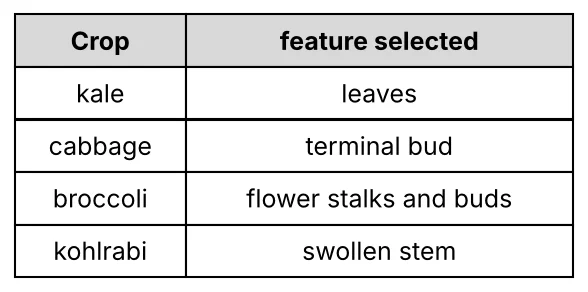
State the name given to evolution driven by humans choosing which individuals reproduce.
Outline how farmers could have produced broccoli from wild cabbage.
Explain why the variety of crops bred from B. oleracea is evidence for evolution.
Deduce, with a reason, whether these crops are separate species.
revisionprep.com
Summary Answer
Not available for this question.
Model Answer
Not available for this question.
Marking Scheme
Not available for this question.
Examiner Insights
Not available for this question.
Convergent evolution and analogous structures
Sharks (cartilaginous fish), ichthyosaurs (extinct marine reptiles) and dolphins (mammals) all have a streamlined body, a dorsal fin and a powerful tail. DNA and skeletal evidence shows that dolphins are more closely related to cows and hippopotamuses than to sharks.
State the term for structures with a similar function and appearance that evolved independently in different lineages.
Explain how natural selection could produce similar body shapes in sharks and dolphins.
Outline evidence, other than DNA, that a dolphin is a mammal rather than a fish.
Explain why body shape alone would give a misleading picture of how dolphins, sharks and ichthyosaurs are related.
revisionprep.com
Summary Answer
Not available for this question.
Model Answer
Not available for this question.
Marking Scheme
Not available for this question.
Examiner Insights
Not available for this question.
Evidence for evolution: base sequences, selective breeding, homologous structures
The table shows the bones in the forelimb of four mammals.
The forelimbs are used for grasping, flying, swimming and running.

State the name given to structures like these forelimbs, which share a basic plan but have different functions.
Outline the pattern of bones that all four forelimbs share.
Explain how these forelimbs provide evidence for evolution.
The horse has only one functional digit. Suggest why this does not weaken the evidence from the horse forelimb.
revisionprep.com
Summary Answer
Not available for this question.
Model Answer
Not available for this question.
Marking Scheme
Not available for this question.
Examiner Insights
Not available for this question.
Convergent evolution and analogous structures
Kangaroo rats live in the deserts of North America; jerboas live in the deserts of Africa and Asia. Both are small rodents that move by hopping on very long hind legs. The figure shows hind-foot length as a percentage of head-and-body length in these two rodents and in two rodents that do not hop. The percentage differences in the base sequence of a gene between pairs of species are listed below. Values are approximate.
kangaroo rat and pocket gopher: 9% kangaroo rat and jerboa: 21% jerboa and house mouse: 14%
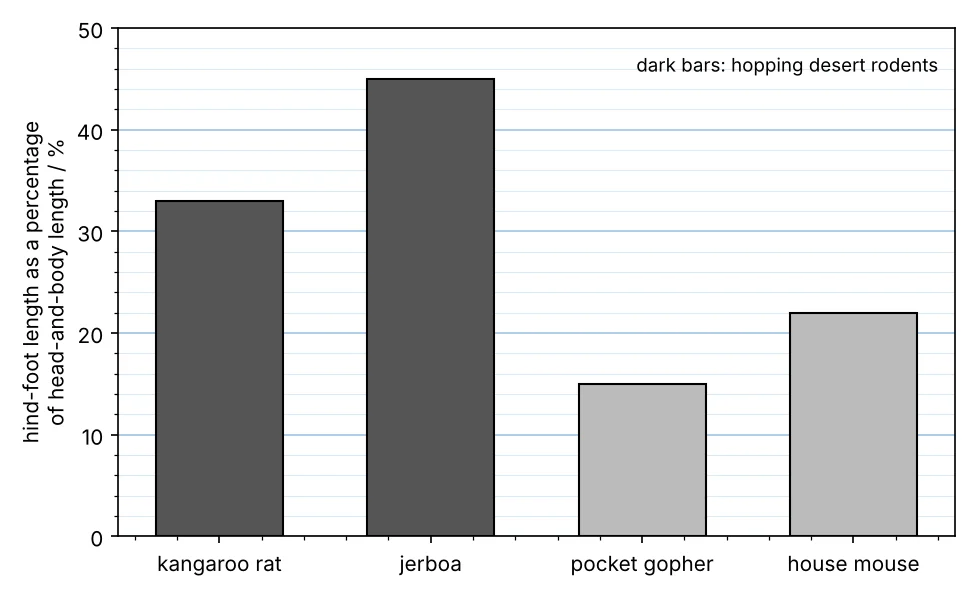
Using the figure, state the hind-foot length of the jerboa as a percentage of its head-and-body length.
Calculate how many times greater this percentage is in the kangaroo rat than in the pocket gopher.
Identify the closest relative of the kangaroo rat among the species in the list.
Explain why the long hind legs of kangaroo rats and jerboas are analogous as hopping legs, even though they are homologous as limbs.
Suggest two selection pressures in deserts that could favour hopping on long hind legs.
Explain why body form alone would give a misleading picture of how these rodents are related, using the data.
revisionprep.com
Summary Answer
Not available for this question.
Model Answer
Not available for this question.
Marking Scheme
Not available for this question.
Examiner Insights
Not available for this question.
Evidence for evolution: base sequences, selective breeding, homologous structures
Charles Darwin bred pigeons and joined pigeon-breeding clubs. All domestic pigeon breeds, from fantails with 30 or more tail feathers to pouters with an inflated crop, are descended from the wild rock dove. In On the Origin of Species, Darwin opened with a chapter on variation under domestication before discussing natural selection.
Outline how the fantail breed could have been produced from rock doves.
Suggest why Darwin began his book with selective breeding.
A critic argues that selective breeding is not evidence for evolution in nature, because humans direct it. Evaluate this argument.
revisionprep.com
Summary Answer
Not available for this question.
Model Answer
Not available for this question.
Marking Scheme
Not available for this question.
Examiner Insights
Not available for this question.
Speciation by splitting: reproductive isolation and differential selection
The Hawaiian Islands are volcanic and formed one after another; each rose from the sea with no life on it. Approximate ages are: Kauai 5.1 million years, Oahu 3.7 million years, Maui 1.3 million years and Hawaii 0.5 million years. Many species of Drosophila fruit fly live only on one island. Base sequence data show that, in most cases, the closest relative of a species on a younger island is a species on the next older island.
Outline why the flies on each island must descend from flies that arrived from elsewhere.
Deduce the most likely order in which the islands were colonised by the flies, with a reason.
Explain how the colonisation of a new island can lead to the formation of a new species.
Evaluate the claim that the base sequence data alone show the order in which the islands were colonised.
revisionprep.com
Summary Answer
Not available for this question.
Model Answer
Not available for this question.
Marking Scheme
Not available for this question.
Examiner Insights
Not available for this question.
That's every free question here — 6 of 66.
+60 more questions, plus Mock Papers & Worksheets, are waiting in Premium.