You're viewing 3 free preview questions for Biology SL — subscribe to unlock 242 more, plus the Full Question Bank, Mock Papers & Worksheets.Upgrade
Nucleic Acids · Paper 2 — Free Biology SL Practice Questions
1MasterySAQ-SDNA replication and transcription5 marksPaper 2~8 min

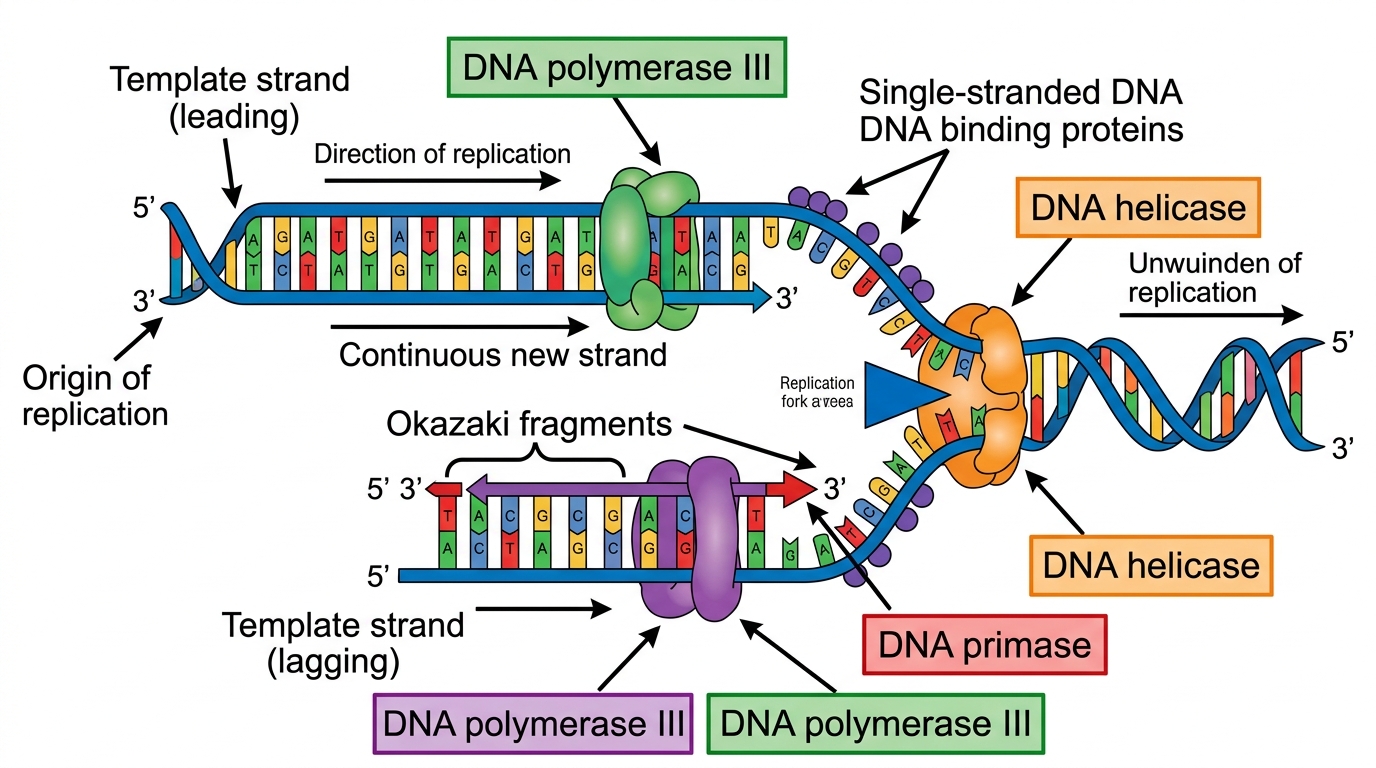
A replication fork forms during DNA replication in a bacterium.
- Rate of DNA polymerase III: nucleotides per second
- Length of the bacterial chromosome: base pairs
- Energy required to add one nucleotide to a growing strand:
(a)
State the role of DNA helicase in DNA replication. [1 mark]
(b)
Calculate the minimum time, in seconds, required to replicate the entire bacterial chromosome. Assume replication begins at a single origin of replication and proceeds bidirectionally. [2 marks]
(c)
The total energy consumed during replication of the bacterial chromosome is . Explain why the total number of nucleotides added during replication is , and not . [2 marks]

Solutions
2MasterySAQ-SDNA replication and transcription5 marksPaper 2~8 min
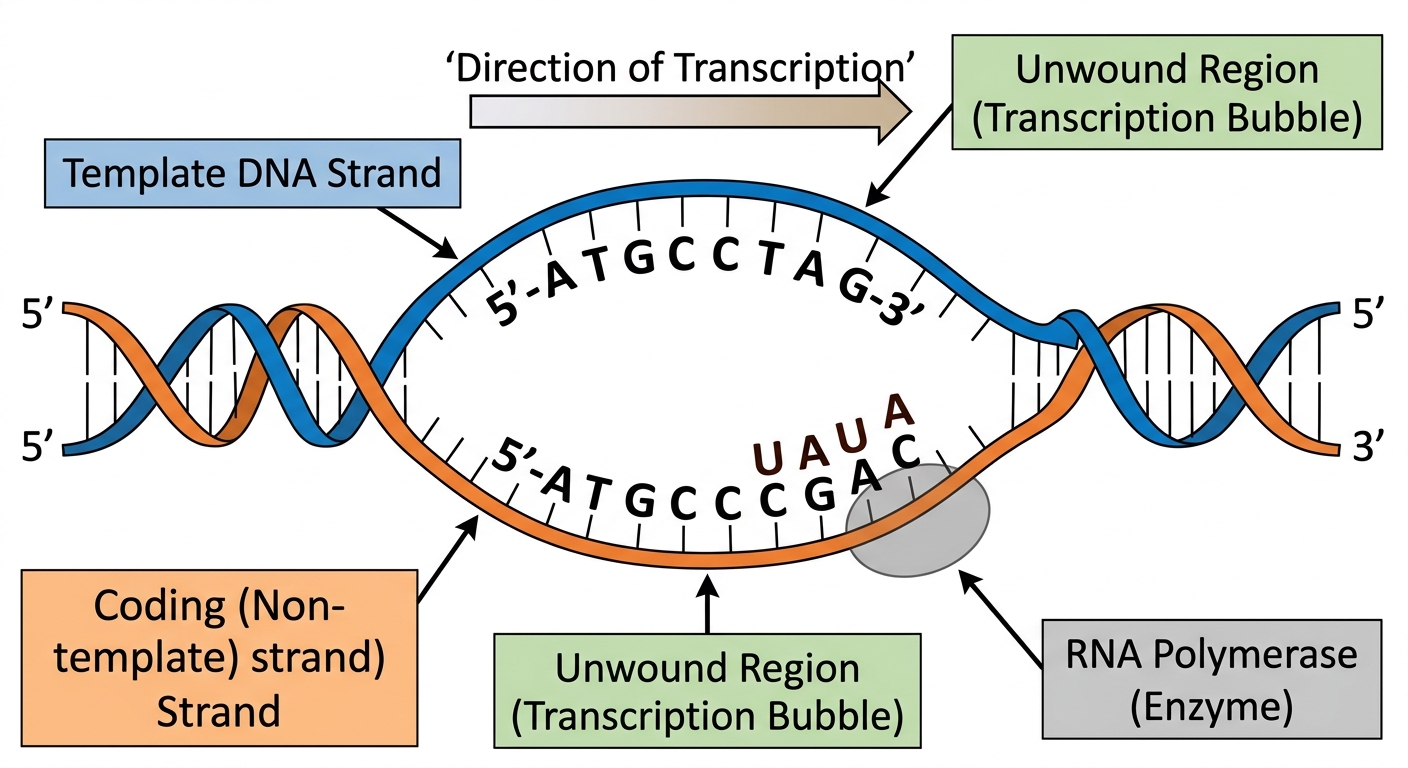
A segment of double-stranded DNA has the following sequence:
(a)
State the direction in which RNA polymerase synthesizes mRNA. [1 mark]
(b)
State one way in which the base composition of mRNA differs from that of the DNA template strand. [1 mark]
(c)
Write the complete mRNA sequence transcribed from the template strand, clearly labelling the and ends. Show your working. [3 marks]
Solutions
3ChallengeSAQ-LGene expression regulation7 marksPaper 2~11 min
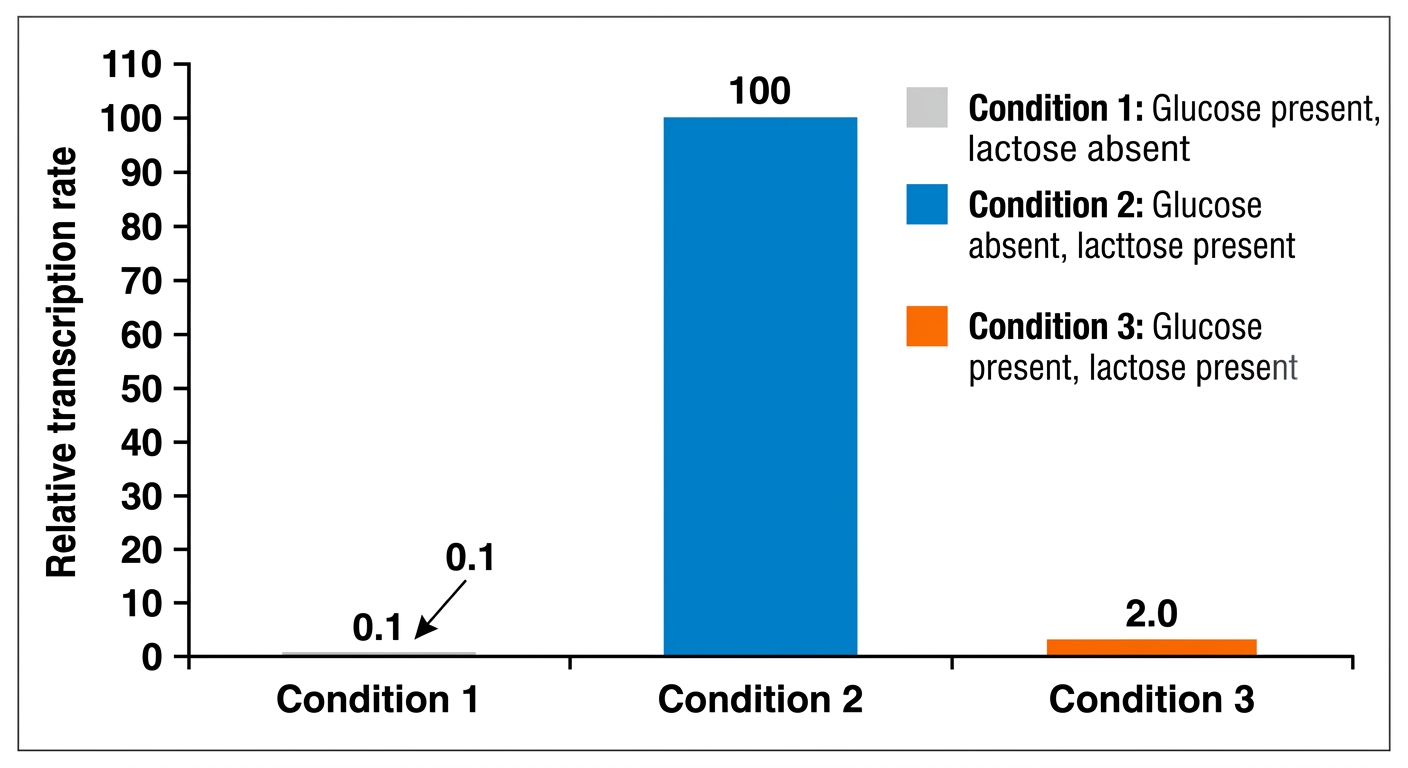
A research team investigates regulation of the lac operon in E. coli under different environmental conditions. The relative rate of transcription of the lacZ gene (encoding -galactosidase) is measured under three conditions, normalised so that Condition 1 = .
Condition — Glucose — Lactose — Relative transcription rate
1 — present — absent —
2 — absent — present —
3 — present —
(a)
State which condition produces the lowest transcription rate of lacZ and identify the molecule responsible for repressing transcription under that condition. [1 mark]
(b)
Calculate the fold-change in transcription rate between Condition 1 and Condition 2. [2 marks]
(c)
Explain the molecular mechanism that accounts for the difference in transcription rates between Condition 1 and Condition 2. [2 marks]
(d)
Evaluate the biological significance of the transcription rate observed in Condition 3 compared to Condition 2, with reference to catabolite repression and the efficiency of energy use in E. coli. [2 marks]
Solutions
That's every free question here — 3 of 245.
+242 more questions, plus Mock Papers & Worksheets, are waiting in Premium.