You're viewing free preview questions. Upgrade to access more Biology SL questions.Upgrade
Water · Paper 2 — Free Biology SL Practice Questions
1MasterySAQ-SWater potential in plants5 marksPaper 2~8 min

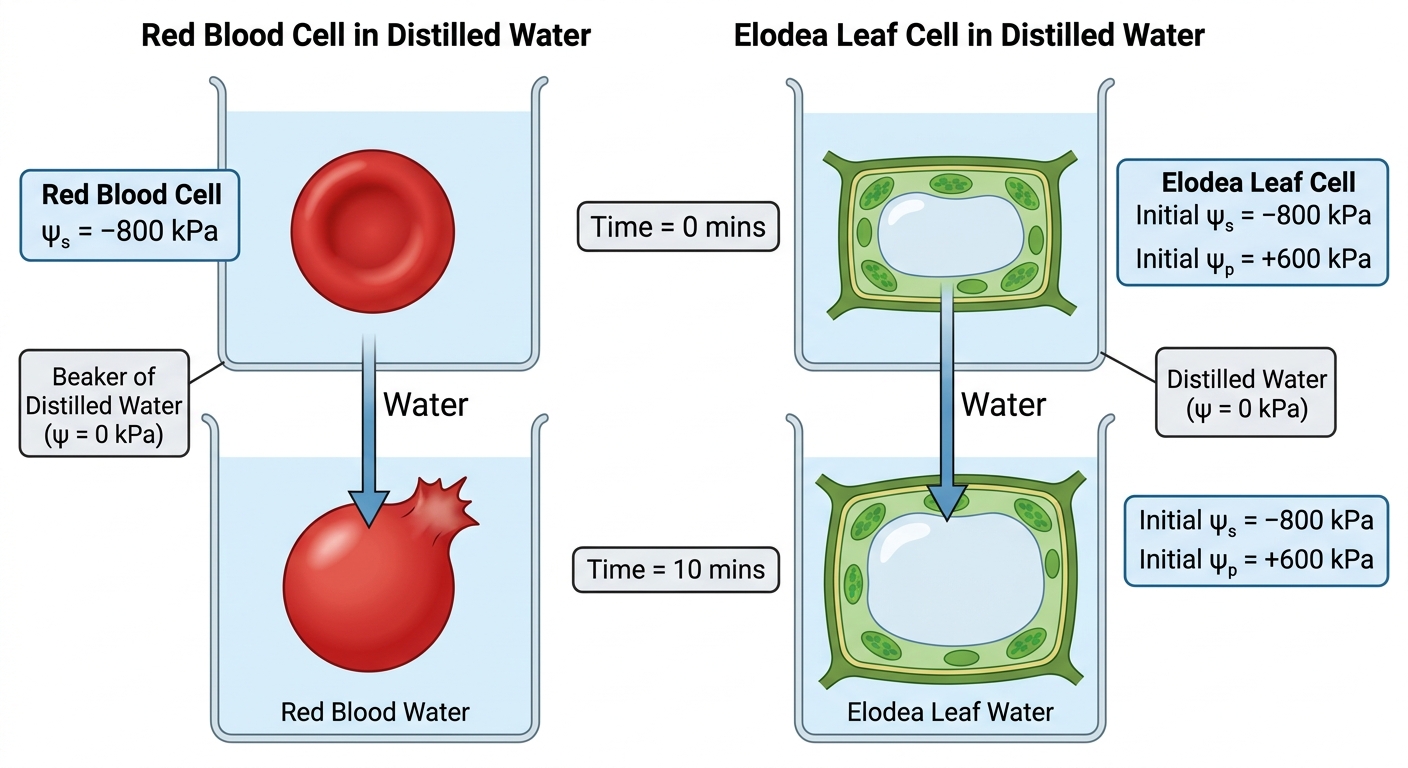
A student places a red blood cell and an Elodea leaf cell into separate beakers of distilled water (). The cells are observed under a microscope after 10 minutes.
(a)
Calculate the initial water potential of the Elodea leaf cell before it is placed in distilled water. [1 mark]
(b)
Describe the difference in the appearance of the red blood cell and the Elodea cell after 10 minutes in distilled water. [2 marks]
(c)
Explain, using water potential values, why the Elodea cell reaches equilibrium with the distilled water without bursting, while the red blood cell does not. [2 marks]

Solutions
2MasterySAQ-SWater’s role in temperature regulation5 marksPaper 2~8 min
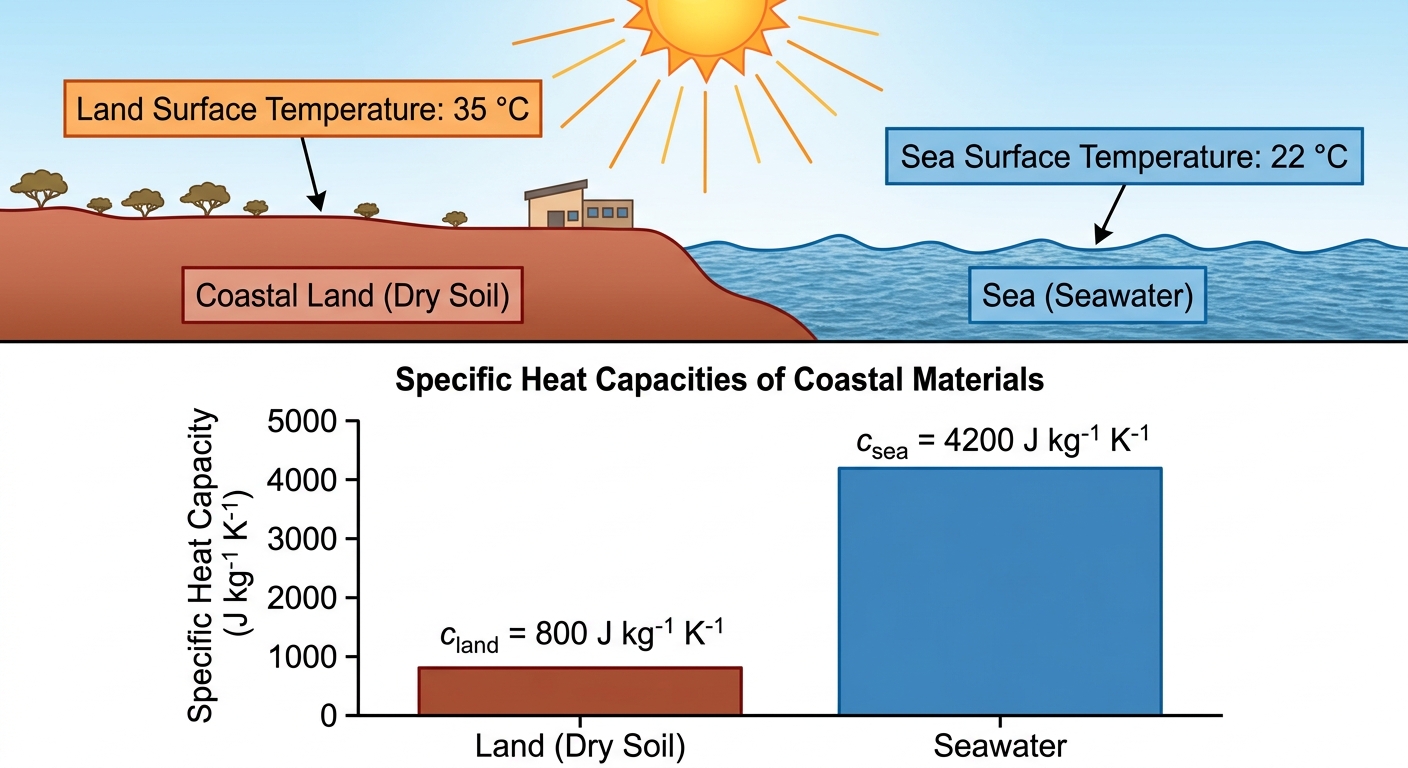
A coastal city experiences a sea breeze during the day. The land surface heats to , while the sea surface remains at . The specific heat capacity of dry soil is and the specific heat capacity of seawater is .
(a)
State what is meant by specific heat capacity. [1 mark]
(b)
A sample of dry soil and a sample of seawater each absorb of solar energy. Calculate the temperature increase of each sample. [2 marks]
(c)
Using your answers from (b), explain how the difference in specific heat capacities between land sea leads to the formation of a sea breeze during the day. [2 marks]
Solutions
3MasterySAQ-SProperties of water5 marksPaper 2~8 min
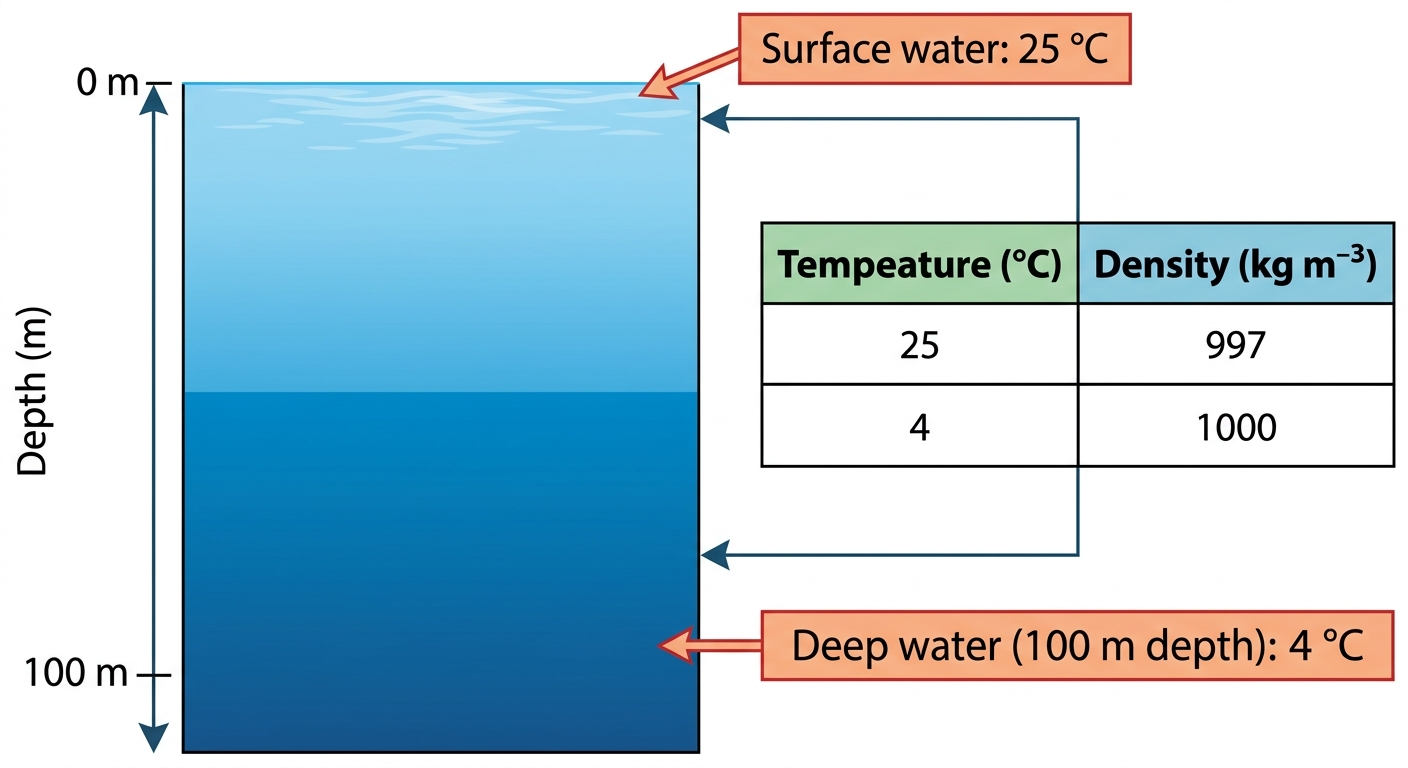
A marine biologist measures the temperature of ocean water at the surface and at depth. Surface water is at and deep water is at . Water reaches its maximum density at .
Temperature — Density
—
—
(a)
State what happens to the density of water as it cools from to . [1 mark]
(b)
Explain why, in a lake cooling during autumn, water at sinks to the bottom while warmer surface water remains above it. [2 marks]
(c)
Discuss how the density properties of water allow aquatic organisms to survive when air temperatures fall well below in winter. [2 marks]
Solutions
4MasterySAQ-SProperties of water5 marksPaper 2~8 min
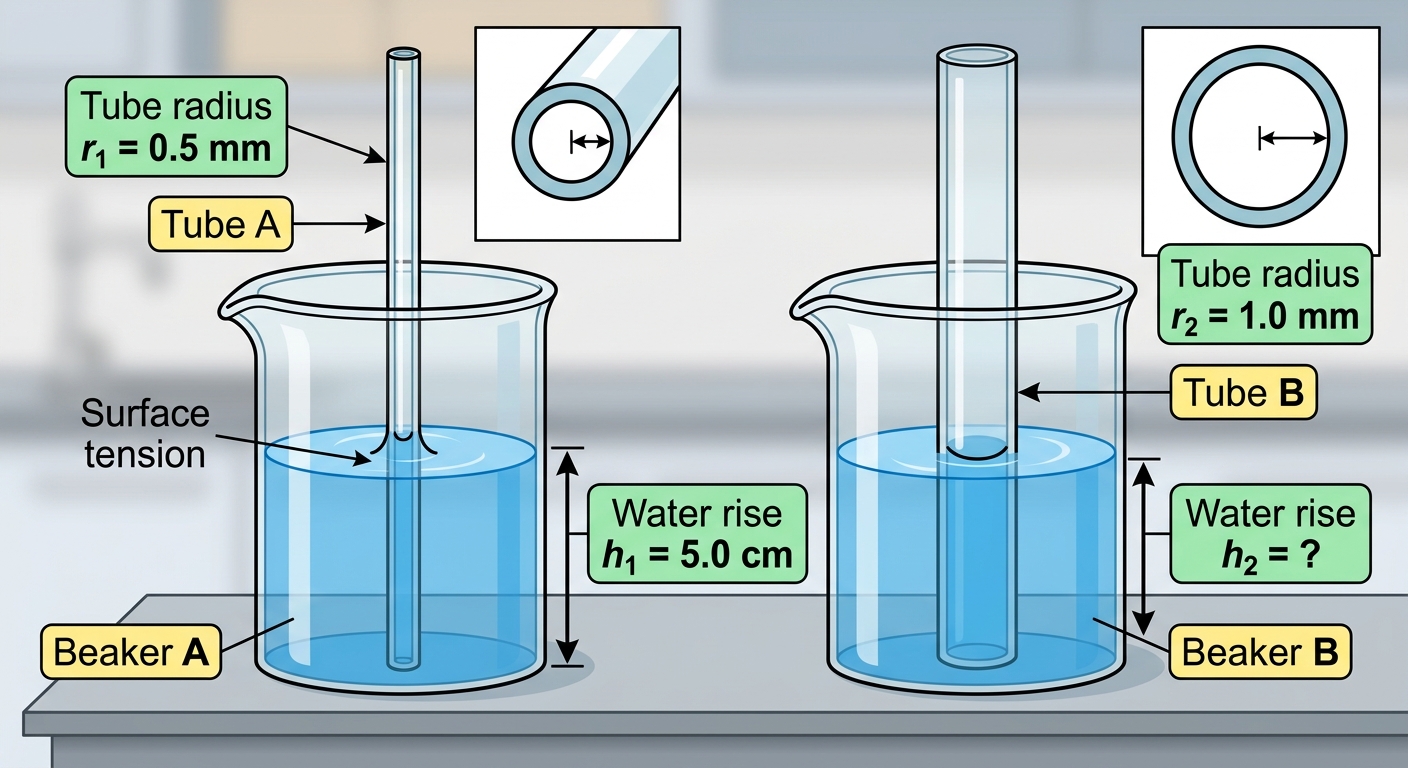
Capillary action contributes to water transport in plants. In a glass tube of radius , water rises to a height of . Xylem vessels in a herbaceous plant have an average radius of .
(a)
State the relationship between the radius of a tube and the height to which water rises by capillary action. [1 mark]
(b)
Calculate the expected height to which water would rise by capillary action alone in the xylem vessels of this plant. [2 marks]
(c)
Evaluate the extent to which capillary action alone can account for water transport to the leaves of a tall tree, and identify one additional mechanism that compensates for any limitation. [2 marks]
Solutions
5MasterySAQ-SProperties of water5 marksPaper 2~8 min
A student investigates osmosis in potato tissue. Cylinders of potato are placed into sucrose solutions of different concentrations. The table shows results after 60 minutes.
Sucrose concentration — Initial mass — Final mass
— —
— —
— —
— —
— —
(a)
State the role of hydrogen bonds in the movement of water molecules across a partially permeable membrane. [1 mark]
(b)
Calculate the percentage change in mass of the potato cylinder placed in sucrose solution. [2 marks]
(c)
The student claims the water potential of the potato tissue is equivalent to a sucrose concentration of approximately . Using the data in the table, evaluate this claim. [2 marks]
Solutions
6MasterySAQ-SProperties of water5 marksPaper 2~8 min
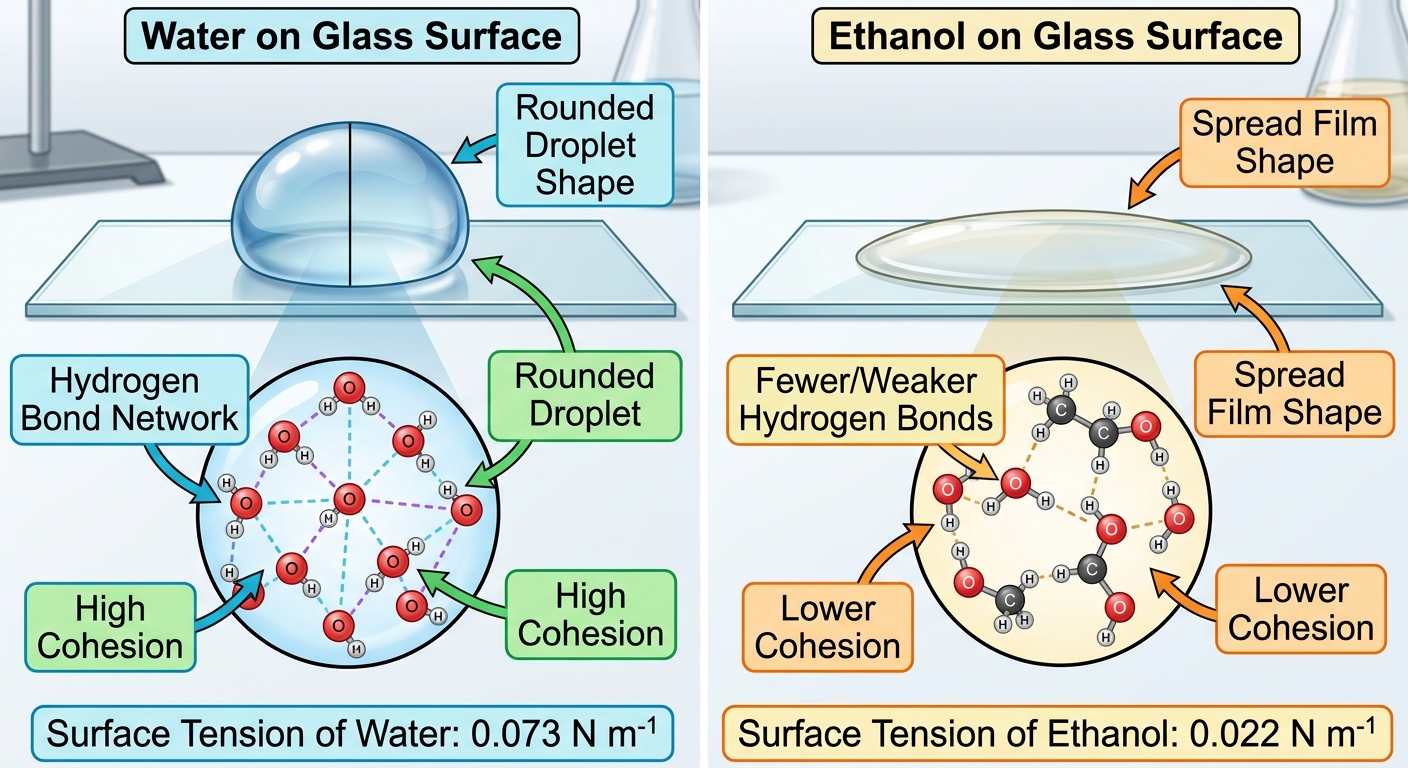
A student places a drop of water on a clean glass surface and observes that it forms a rounded droplet. A second student places a drop of ethanol on the same surface and it spreads into a thin film.
- Surface tension of water:
- Surface tension of ethanol:
(a)
Describe how hydrogen bonding between water molecules contributes to the rounded shape of the water droplet. [2 marks]
(b)
State one structural difference between water and ethanol molecules that accounts for water's greater capacity to form hydrogen bonds. [1 mark]
(c)
Water striders are insects that move across the surface of ponds. Explain, using the surface tension values given, why water striders can walk on water but would sink on ethanol. [2 marks]
Solutions
7MasterySAQ-SWater potential in plants4 marksPaper 2~6 min
A plant physiologist measures the water potential of a soil sample and finds it to be . She then measures the water potential of the root cells of a plant growing in the soil and finds it to be .
(a)
State the direction of water movement between the soil and the root cells. [1 mark]
(b)
Calculate the water potential gradient between the soil and the root cells. [1 mark]
(c)
The plant is watered, and the soil water potential becomes . The root cells maintain their water potential at .
(i) Calculate the new water potential gradient between the soil and the root cells. [1]
(ii) Explain how the rate of water uptake by the roots would change compared to the original conditions. [2 marks]
(ii) Explain how the rate of water uptake by the roots would change compared to the original conditions. [2 marks]
Solutions
8MasterySAQ-SProperties of water6 marksPaper 2~9 min
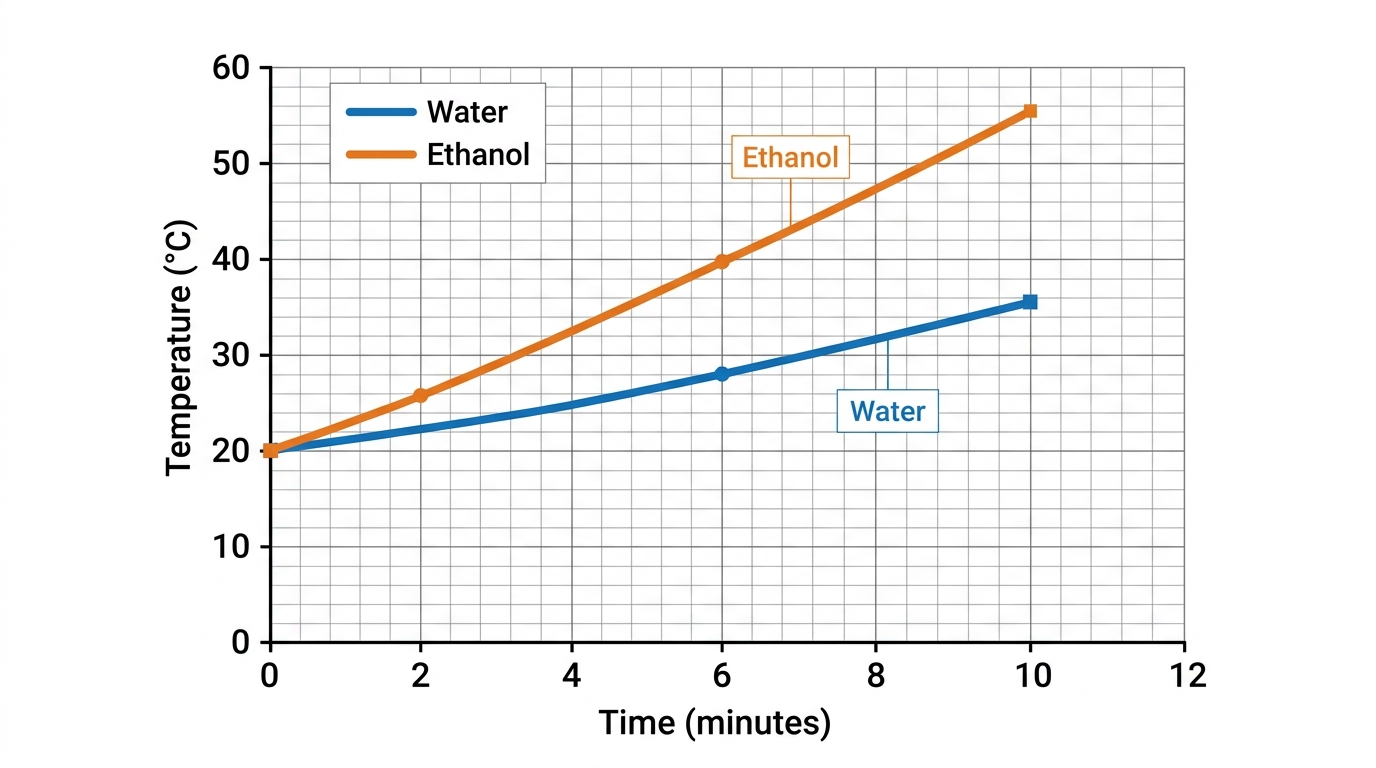
The graph below shows the temperature change over time when equal masses of water and ethanol are heated with identical heaters.
[INSERT GRAPH: Two curves. Water curve rises from to over 10 minutes. Ethanol curve rises from to over 10 minutes. Axes: Temperature () vs Time (minutes)]
(a)
State the property of water that causes it to heat more slowly than ethanol. [1 mark]
(b)
The specific heat capacity of water is and of ethanol is . Using , calculate the difference in energy absorbed between of water (temperature change ) and of ethanol (temperature change ) when heated for the same time. [3 marks]
(c)
Explain how the molecular structure of water gives rise to the property stated in (a), and evaluate why this property is important for organisms that use water as a medium for biochemical reactions. [4]
Wait — rechecking mark totals: original is 5 marks. (a)[1] + (b)[3] + (c)[4] = 8. Must keep total = 5.
Recalibrating: (a)[1] + (b)[2] + (c)[2] = 5, but (c) must be AO3. Keeping (b)[2] and splitting (c) into explanation[2] + evaluation[2] exceeds total. Correct allocation: (a)[1] + (b)[2] + (c)[2] = 5, with (c) rewritten to include a genuine AO3 discriminator within 2 marks.
(a) State the property of water that causes it to heat more slowly than ethanol. [1]
(b) Using , where and , calculate the energy absorbed by of water (temperature change ) and by of ethanol (temperature change ). [2]
(c) Explain how hydrogen bonding between water molecules gives rise to the property stated in (a), and deduce one consequence of this property for temperature regulation in living organisms. [2 marks]
Solutions
9MasterySAQ-SWater potential in plants5 marksPaper 2~8 min
A plant cell has a solute potential () of and a pressure potential () of . The cell is placed in Solution A, which has a water potential of .
A second solution, Solution B, has a solute potential of and a pressure potential of .
(a)
State the water potential of the plant cell at the moment is placed in Solution A. [1 mark]
(b)
Calculate the water potential of Solution B. [2 marks]
(c)
Explain the expected change in the pressure potential of the plant cell over time after it is placed in Solution A. [2 marks]
Solutions
10MasterySAQ-SWater potential in plants5 marksPaper 2~8 min
A biologist studies water relations in a salt-tolerant plant (Spartina alterniflora) growing in a coastal marsh. The root cells have a solute potential () of and a pressure potential () of . The surrounding soil water has a water potential of .
(a)
State the water potential of the root cells. [1 mark]
(b)
The plant is exposed to increased soil salinity, raising the soil water potential to . Calculate the solute potential () the root cells would need to achieve a total water potential of , assuming remains . [2 marks]
(c)
Evaluate whether water would move into or out of the root cells under the new conditions described in (b), and explain the physiological significance of the change in for Spartina survival in high-salinity environments. [2 marks]
Solutions
11MasterySAQ-SProperties of water10 marksPaper 2~15 min
A gardener notices that on a cold autumn night, a shallow pond freezes over while the deeper part of the same pond remains liquid. The density of ice is and the density of liquid water at is .
(a)
Describe how the molecular structure of water results in ice being less dense than liquid water. [2 marks]
(b)
Calculate the volume of of ice. [2 marks]
(c)
Explain how the property of ice floating on water benefits aquatic organisms during winter. [2]
Total: [6 marks]
Solutions
12MasterySAQ-SWater’s role in temperature regulation5 marksPaper 2~8 min
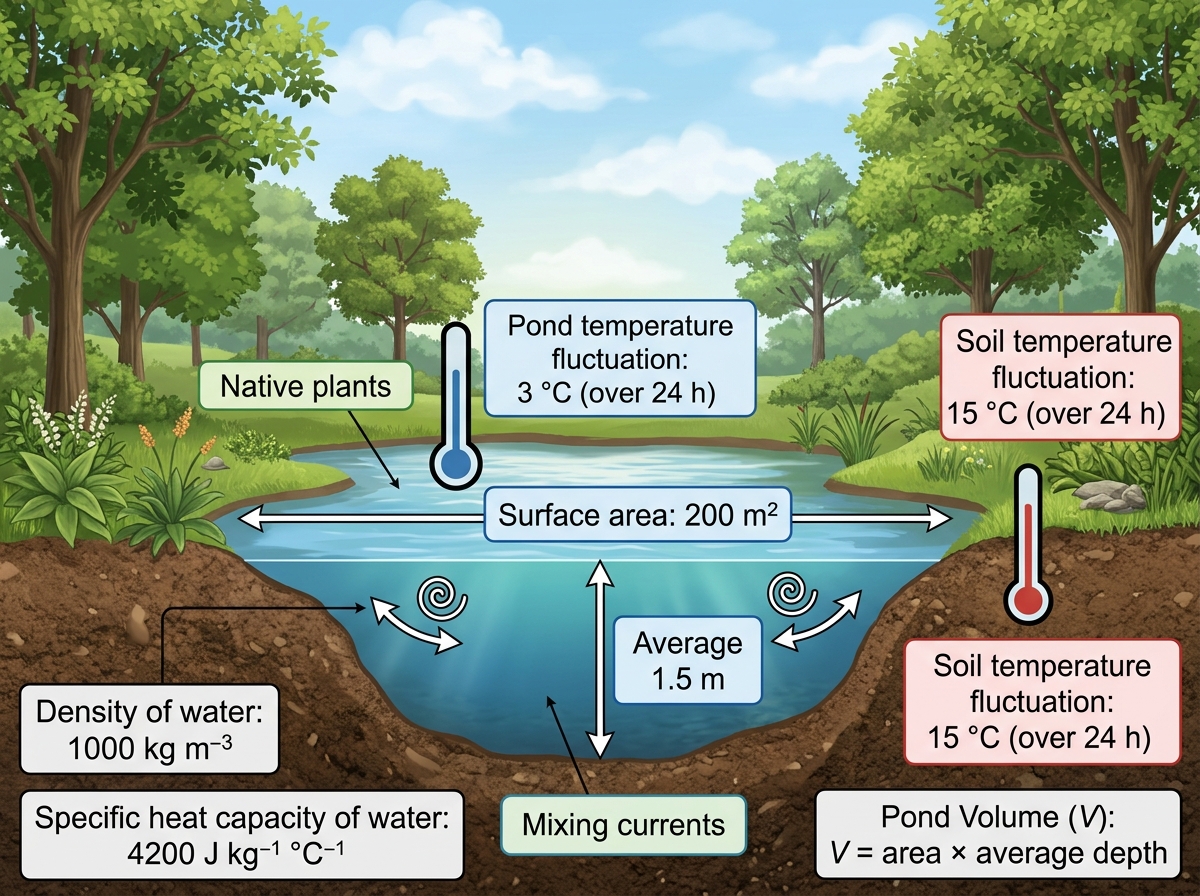
A biologist monitors the temperature of a small pond in a temperate forest over 24 hours. The surrounding soil temperature fluctuates by during the same period, while the pond temperature fluctuates by only .
- Surface area of pond:
- Average depth of pond:
- Density of water:
- Specific heat capacity of water:
-
(a)
State one physical property of water responsible for its resistance to temperature change. [1 mark]
(b)
Explain why the large volume of water in the pond results in a smaller temperature fluctuation than the surrounding soil. [2 marks]
(c)
Calculate thermal energy released by the pond water as it cools by overnight. Show your working. [2 marks]
Solutions
13MasterySAQ-SWater potential in plants5 marksPaper 2~8 min
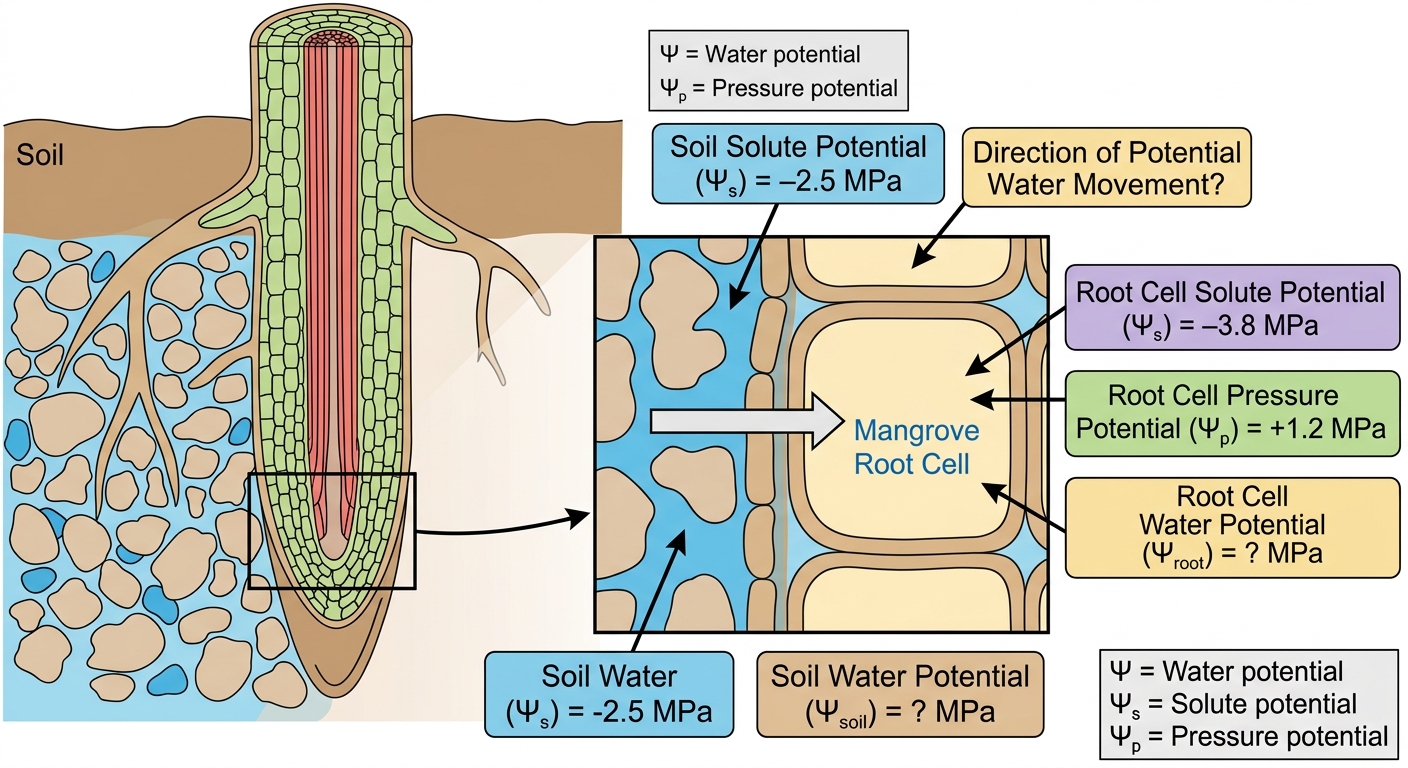
A marine biologist studies the water relations of a mangrove tree (Avicennia germinans) growing in a saltwater estuary. The soil water has a solute potential of and a pressure potential of . The root cells of the mangrove have a solute potential of and a pressure potential of .
Water potential:
(a)
State the water potential of the soil water. [1 mark]
(b)
Calculate the water potential of the mangrove root cells. [1 mark]
(c)
Explain whether water will move from the soil into the root cells, and identify the process by which this movement occurs. [3 marks]
Solutions
14MasterySAQ-SProperties of water5 marksPaper 2~8 min
A marine biologist observes that coastal waters cool down more slowly at night than the surrounding land. Water has a specific heat capacity of , while dry sand has a specific heat capacity of .
(a)
Explain how hydrogen bonding between water molecules causes water to have a higher specific heat capacity than sand. [1 mark]
(b)
Calculate the energy released when of water cools from to . [2 marks]
(c)
Explain one advantage of the slow cooling of coastal water for marine organisms. [2 marks]
Solutions
15MasterySAQ-SWater’s role in temperature regulation7 marksPaper 2~11 min
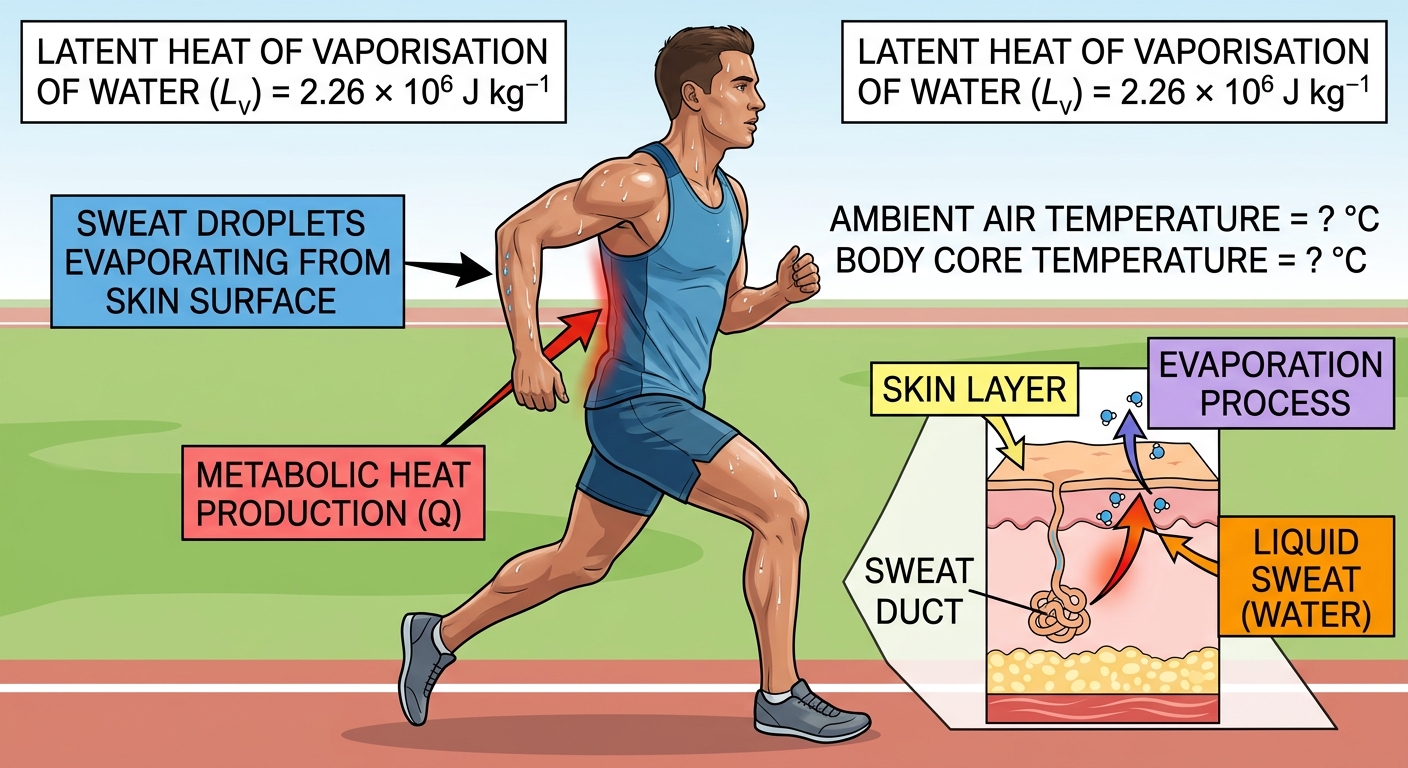
During exercise, a human athlete produces excess metabolic heat. The body uses evaporative cooling through sweating to regulate temperature. The enthalpy of vaporisation of water is .
(a)
State what is meant by the term latent heat of vaporisation of a substance. [1 mark]
(b)
Explain how the high latent heat of vaporisation of water makes sweating an effective cooling mechanism. [2 marks]
(c)
Calculate the mass of sweat that must evaporate to remove of heat from the athlete's body. [2 marks]
(d)
The athlete's sweat rate is . Not all sweat evaporates; some drips off the skin without evaporating. Evaluate the effectiveness of sweating as a thermoregulatory mechanism under conditions of high humidity, where only of sweat produced actually evaporates. [2 marks]
Solutions
16MasterySAQ-SWater as a solvent7 marksPaper 2~11 min
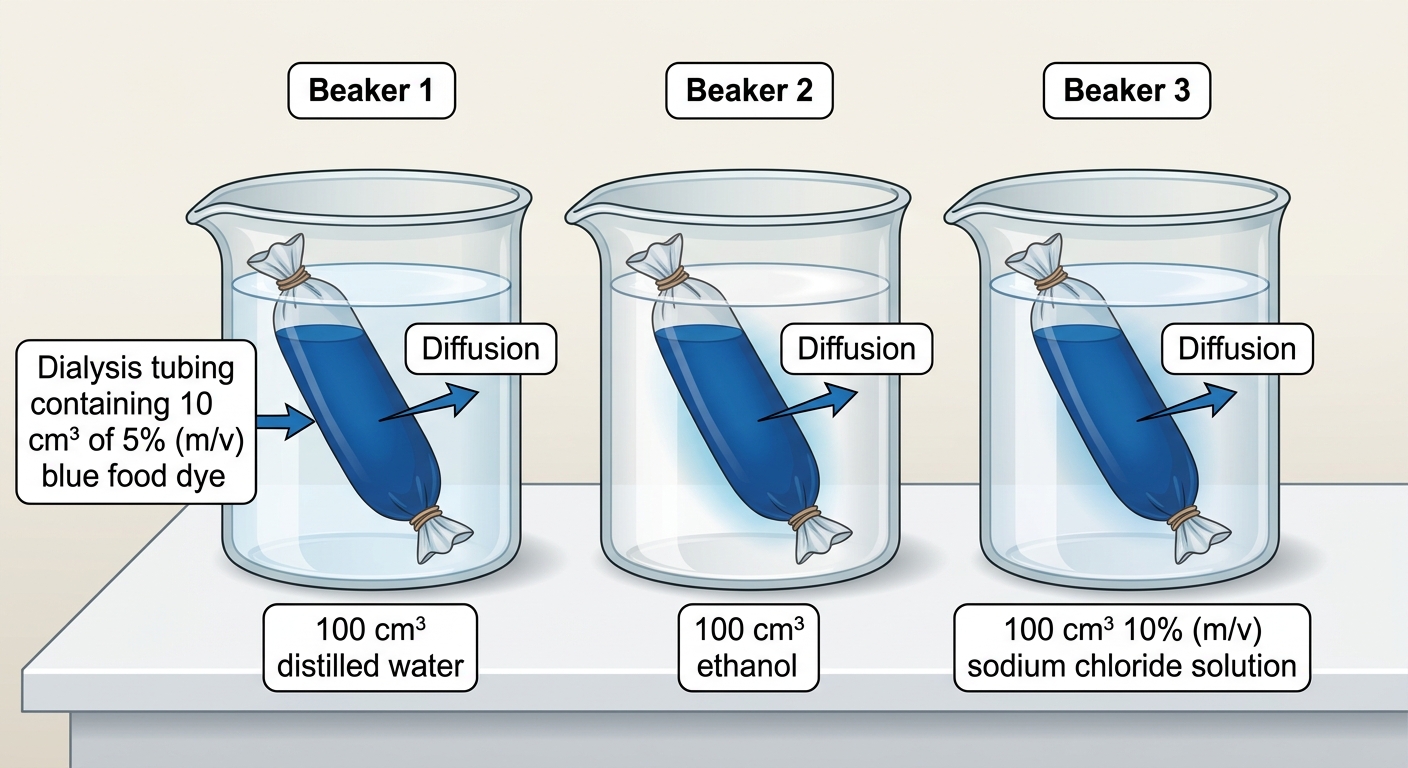
A student investigates the effect of different solvents on the rate of diffusion of a dye through a semi-permeable membrane. Three identical sections of dialysis tubing, each containing of a (mass/volume) solution of blue food dye, are placed into three separate beakers. Beaker 1 contains of distilled water. Beaker 2 contains of ethanol (). Beaker 3 contains of a (mass/volume) sodium chloride (NaCl) solution. The student measures the absorbance of the liquid outside the tubing at after 10 minutes. Higher absorbance indicates more dye has diffused out of the tubing.
Beaker — Contents of beaker — Absorbance at
1 — Distilled water —
2 — Ethanol —
3 — NaCl solution —
(a)
State the property of water that allows it to dissolve the polar blue food dye. [1 mark]
(b)
Calculate the percentage difference in absorbance between Beaker 1 and Beaker 3, using:
[2 marks]
(c)
Explain why the absorbance in Beaker 2 is significantly lower than in Beaker 1, with reference to the molecular structures of ethanol and water. [2 marks]
(d)
The student claims that the difference in absorbance between Beaker 1 and Beaker 3 is due solely to osmosis reducing the concentration gradient of dye across the membrane in Beaker 3. Evaluate this claim. [2 marks]
Solutions
17MasterySAQ-SWater as a solvent5 marksPaper 2~8 min
A student investigates the effect of temperature on the rate of starch digestion by the enzyme amylase. Equal volumes of starch solution and amylase solution are mixed at and at . Iodine solution is added at regular intervals to test for the presence of starch. At , the starch is fully digested after 12 minutes; at , full digestion occurs after 4 minutes.
(a)
State the relationship between temperature and the rate of starch digestion shown by these results. [1 mark]
(b)
Calculate the percentage decrease in digestion time when temperature is increased from to . [2 marks]
(c)
Explain, using your knowledge of enzyme structure and molecular kinetics, why the rate of starch digestion is greater at than at . [2 marks]
Solutions
18MasterySAQ-SWater as a solvent5 marksPaper 2~8 min
Blood plasma is approximately water by mass. A patient's blood test shows a plasma calcium concentration of .
(a)
State one property of water that allows it to act as a solvent for ionic compounds. [1 mark]
(b)
Explain why ions form stronger interactions with water molecules than ions do. [2 marks]
(c)
Calculate the mass of calcium ions present in of this patient's blood plasma. (Molar mass of calcium ) [2 marks]
Solutions
19MasterySAQ-SWater’s role in temperature regulation5 marksPaper 2~8 min
A biology field study recorded temperatures of a small pond and surrounding soil over hours.
Time — Air temperature / °C — Soil surface temperature / °C — Pond water temperature / °C
Midday — — —
Midnight — — —
(a)
State the property of water that explains why the pond water temperature changed less than the soil temperature over the -hour period. [1 mark]
(b)
Deduce, using data from the table, whether the pond or the soil provides a more stable thermal environment for organisms. [2 marks]
(c)
Evaluate the extent to which thermal property stated in (a) protects aquatic organisms in the pond from the effects of extreme daily temperature fluctuations. [2 marks]
Solutions
20MasterySAQ-SWater’s role in temperature regulation5 marksPaper 2~8 min
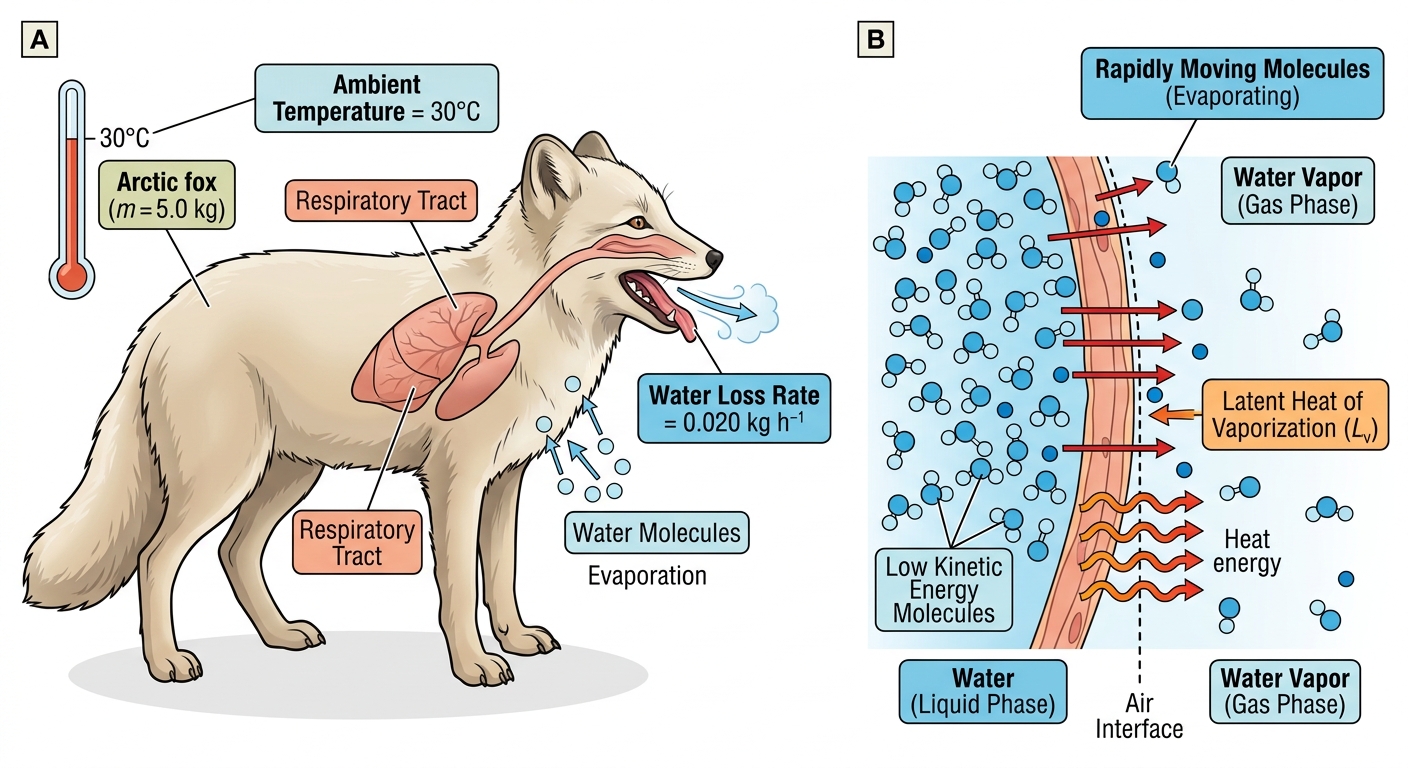
In endothermic mammals like the Arctic fox (Vulpes lagopus), evaporative cooling through panting is a key thermoregulatory mechanism. When ambient temperatures exceed , the fox pants to lose heat via water evaporation. The latent heat of vaporization of water is .
(a)
State the property of water that makes evaporative cooling an effective mechanism for heat loss. [1 mark]
(b)
Explain, at the molecular level, how evaporation of water from the respiratory tract removes thermal energy from the fox's body. [2 marks]
(c)
A Arctic fox loses of water per hour through panting at . Calculate the rate of thermal energy loss, in , due to evaporation. [2 marks]
Solutions
Showing 20 of 253 free questions