How Far? The Extent of Chemical Change · Paper 2 — Free Chemistry HL Practice Questions
Free questions
Open in full, with answers, mark scheme and examiner insights.
The equilibrium constant K: expression and magnitude
Hydrogen iodide decomposes in a sealed flask held at 700 K:
When the system has reached equilibrium, the concentrations are , and .
State two characteristics of a system in dynamic equilibrium.
Deduce the equilibrium constant expression, , for this reaction.
Calculate the value of at 700 K.
Calculate at from your value of () and state what its sign shows about the position of equilibrium.
revisionprep.com
Summary Answer
Not available for this question.
Model Answer
Not available for this question.
Marking Scheme
Not available for this question.
Examiner Insights
Not available for this question.
Reaction quotient Q and equilibrium (ICE) calculations
Hydrogen is made industrially by steam reforming: . At the temperature of a reformer, . A sample of gas taken from the reactor contains , , and .
State the expression for the reaction quotient, .
Calculate for the sample.
Deduce the direction in which the reaction mixture changes and state whether rises or falls as equilibrium is approached.
revisionprep.com
Summary Answer
Not available for this question.
Model Answer
Not available for this question.
Marking Scheme
Not available for this question.
Examiner Insights
Not available for this question.
The equilibrium constant K: expression and magnitude
Carbon monoxide reacts with steam:
Equal amounts of CO and are placed in a sealed vessel at . The graph shows how the concentrations change with time. Use .
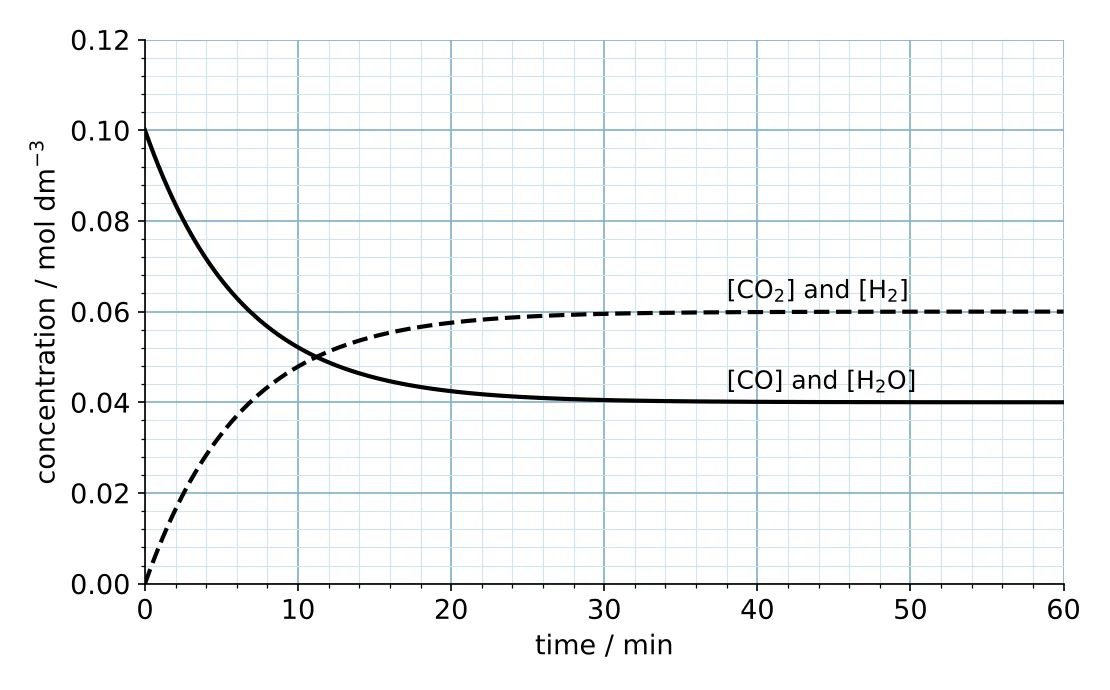
State the time at which equilibrium is first reached, and how the graph shows this.
Determine at .
Calculate at .
The experiment is repeated at with the same starting concentrations. Predict how the two final horizontal lines would differ from those on the graph, giving a reason.
Outline why changing the total pressure would not change the position of this equilibrium.
The process is run in two stages, one at and a second at . Using and your answer to (c), calculate and then at . Explain why the second stage raises the conversion but needs a more active catalyst.
revisionprep.com
Summary Answer
Not available for this question.
Model Answer
Not available for this question.
Marking Scheme
Not available for this question.
Examiner Insights
Not available for this question.
Dynamic equilibrium
A sealed gas syringe at contains a small volume of liquid bromine and red-brown bromine vapour. It is left until the colour of the vapour no longer changes.
Outline two features of this system that show it is at dynamic equilibrium.
The plunger is pushed in quickly and then held still, at . Explain the changes in the colour of the vapour and in the amount of liquid, from the moment of compression until equilibrium is re-established.
The syringe is then warmed to with the plunger held still. Predict, with a reason, the change in the colour of the vapour.
In a related experiment, the equilibrium vapour pressure of bromine is at and at . Calculate the percentage increase in the vapour pressure.
Explain, in terms of the rates of evaporation and condensation, how a new equilibrium is reached after the syringe is warmed to .
revisionprep.com
Summary Answer
Not available for this question.
Model Answer
Not available for this question.
Marking Scheme
Not available for this question.
Examiner Insights
Not available for this question.
Dynamic equilibrium
Propan-2-ol is made by adding hydrogen to propanone vapour over a copper catalyst in a sealed vessel at constant temperature:
Run 1 started with each of propanone and hydrogen. Run 2, at the same temperature, started with of propan-2-ol only. The propanone concentrations are shown in Table 1. In both runs throughout.

State the time at which equilibrium is first reached in run 1.
Explain, in terms of the rates of the forward and reverse reactions, the shape of the data for run 1.
Deduce the equilibrium constant expression and calculate the value of from run 1.
Explain what run 2 shows about the equilibrium.
A student states that after 40 min no propanone molecules react in run 1. Evaluate this statement and outline an experiment with an isotopically labelled compound that would test it.
revisionprep.com
Summary Answer
Not available for this question.
Model Answer
Not available for this question.
Marking Scheme
Not available for this question.
Examiner Insights
Not available for this question.
Chemical equilibrium and Le Chatelier’s Principle
Methanol is made from synthesis gas:
Pilot-plant data for equilibrium mixtures from a 1 : 2 feed of CO and are shown.
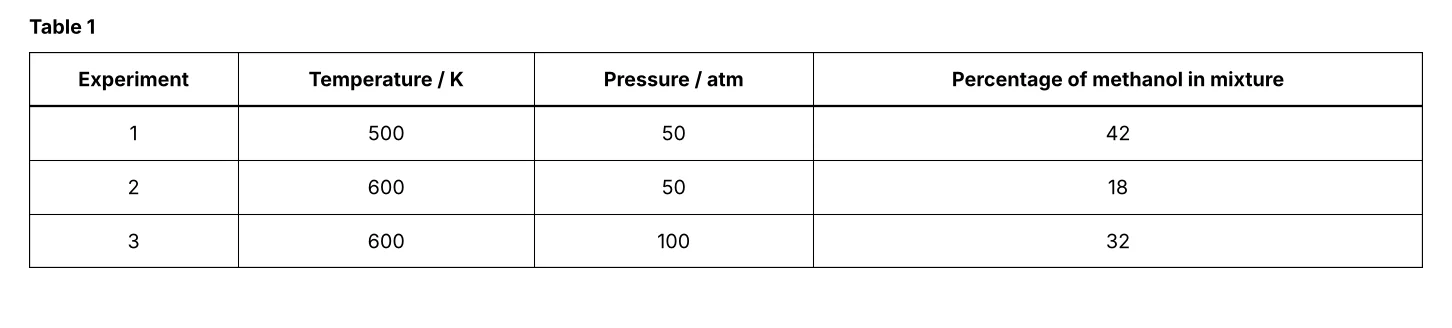
Using experiments 1 and 2, explain the effect of temperature on the percentage of methanol.
Using experiments 2 and 3, explain the effect of pressure on the percentage of methanol.
Explain why the plant may run at even though the yield is lower than at .
Helium is added to the equilibrium mixture at constant volume. Explain why the position of equilibrium does not change.
The same amount of helium is instead added at constant total pressure, so the volume increases. Predict and explain the direction of shift, using the reaction quotient.
revisionprep.com
Summary Answer
Not available for this question.
Model Answer
Not available for this question.
Marking Scheme
Not available for this question.
Examiner Insights
Not available for this question.
That's every free question here — 6 of 179.
+173 more questions, plus Mock Papers & Worksheets, are waiting in Premium.