How Fast? The Rate of Chemical Change · Paper 2 — Free Chemistry HL Practice Questions
Free questions
Open in full, with answers, mark scheme and examiner insights.
Factors affecting reaction rates: Concentration, temperature, surface area, catalysts
A student adds of manganese(IV) oxide powder to of hydrogen peroxide and measures the volume of oxygen produced over time.
In a second experiment the same mass of manganese(IV) oxide is used as large lumps instead of powder. All other conditions are the same.
State the effect of manganese(IV) oxide on the activation energy of the reaction.
With the powder, of oxygen is collected in the first . Calculate the average rate of oxygen production, in , over this time.
Explain why oxygen is produced faster with the powder than with the lumps.
Describe how a graph of volume of oxygen against time for the lumps differs from one for the powder.
revisionprep.com
Summary Answer
Not available for this question.
Model Answer
Not available for this question.
Marking Scheme
Not available for this question.
Examiner Insights
Not available for this question.
Rate law and order of reactions
A student times how long a strip of magnesium ribbon takes to disappear in of sulfuric acid at four temperatures (hypothetical data).
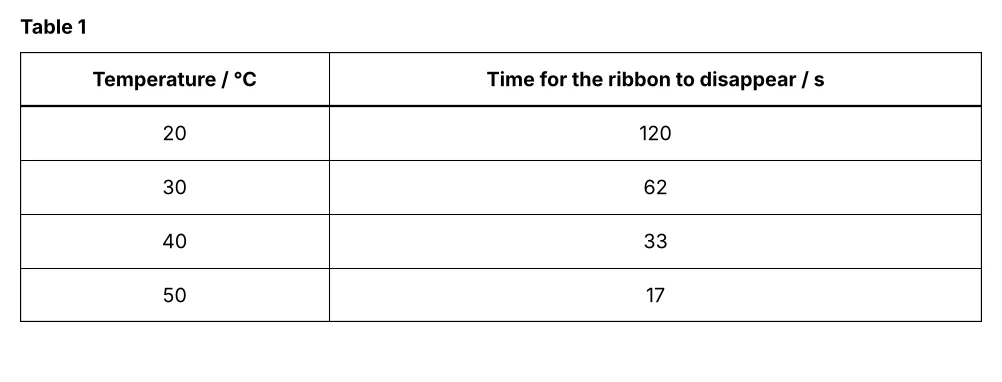
Calculate at and at .
Calculate the factor by which the rate increases from to , and comment on the result.
Explain, using collision theory, why the rate increases with temperature.
State two variables that must be controlled for a fair comparison.
revisionprep.com
Summary Answer
Not available for this question.
Model Answer
Not available for this question.
Marking Scheme
Not available for this question.
Examiner Insights
Not available for this question.
Rate law and order of reactions
The decomposition of dinitrogen pentoxide () in the gas phase is studied kinetically:
Experimental initial-rate data at :
The rate constant at is .
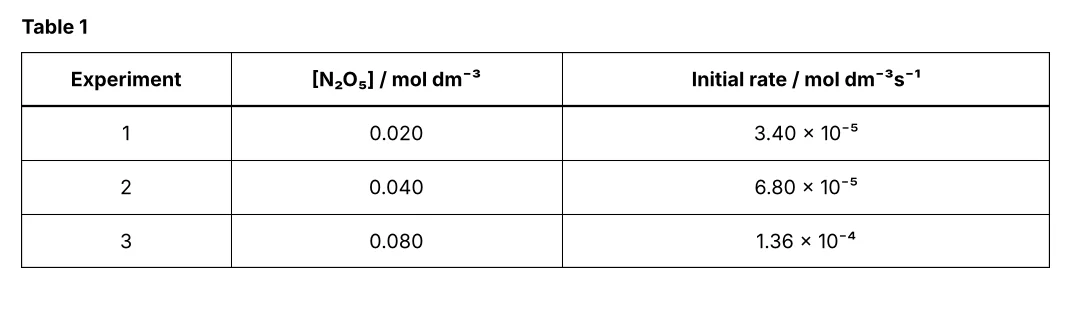
State the order of reaction with respect to . Use the data to support your answer.
Calculate the initial rate of decomposition of when at .
The reaction proceeds via the following three-step mechanism:
Explain why the experimentally determined rate law is consistent with Step 1 being the rate-determining step. Your answer must refer to the role of intermediates.
The activation energy for this reaction is . Using the Arrhenius equation, determine the ratio , where and are the rate constants at and respectively.
Sketch an energy profile for the three-step mechanism, showing the intermediates and the activation energy of the rate-determining step.
Calculate the rate constant at from at and .
Suggest why agreement between a proposed mechanism and the experimental rate equation is not enough to prove that the mechanism is correct, and state one further type of evidence.
revisionprep.com
Summary Answer
Not available for this question.
Model Answer
Not available for this question.
Marking Scheme
Not available for this question.
Examiner Insights
Not available for this question.
Rate-determining step and reaction mechanisms
The reaction proceeds in two elementary steps through an intermediate. Table 1 gives the energies of the species and transition states relative to the reactants.
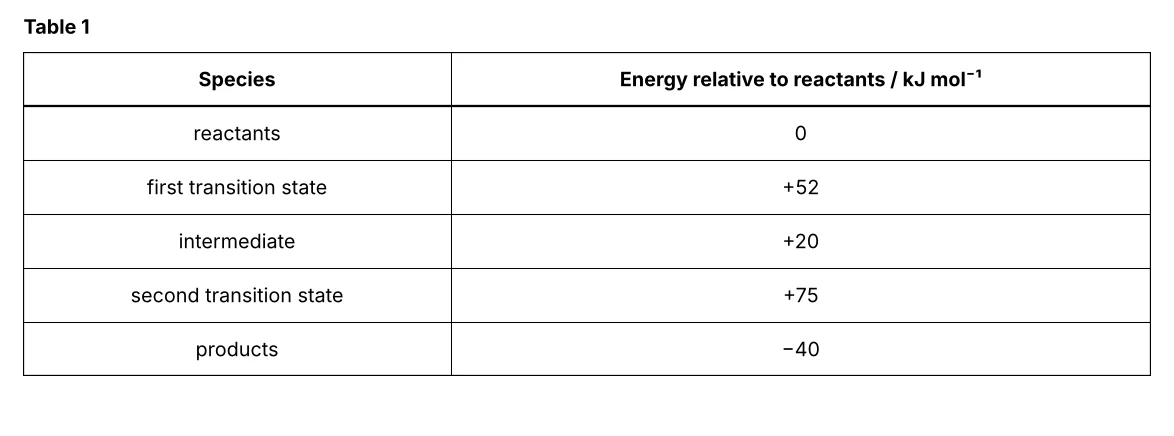
Calculate the activation energy of each step, and identify the rate-determining step.
State the enthalpy change of the overall reaction, with its sign.
Calculate the activation energy of the reverse of step 2.
revisionprep.com
Summary Answer
Not available for this question.
Model Answer
Not available for this question.
Marking Scheme
Not available for this question.
Examiner Insights
Not available for this question.
Rate law and order of reactions
The reaction between peroxodisulfate ions and iodide ions is studied as a clock reaction:
The same volumes and concentrations are used in each experiment.
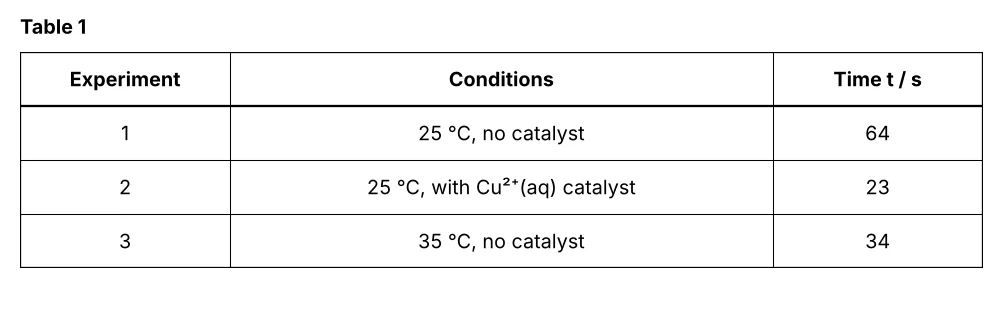
Calculate how many times faster experiment 2 is than experiment 1.
Explain how the catalyst increases the rate.
Compare how the catalyst and the rise in temperature each increase the proportion of successful collisions, with reference to the Maxwell-Boltzmann distribution.
State the effect of the catalyst on and on the total amount of iodine formed when the reaction is complete.
revisionprep.com
Summary Answer
Not available for this question.
Model Answer
Not available for this question.
Marking Scheme
Not available for this question.
Examiner Insights
Not available for this question.
Arrhenius equation
Dinitrogen monoxide decomposes in the gas phase:
The rate-determining step is .
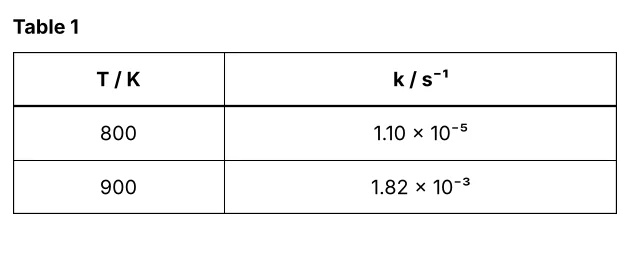
State what is meant by and by in the Arrhenius equation, .
Calculate in .
Explain why the units of are .
A platinum surface catalyses the reaction. State its effect on and identify the bond broken in the rate-determining step.
A student claims that a catalyst must lower by the same factor as it raises , so that is unchanged. Evaluate this claim.
Calculate the factor by which increases when the temperature is raised from to .
revisionprep.com
Summary Answer
Not available for this question.
Model Answer
Not available for this question.
Marking Scheme
Not available for this question.
Examiner Insights
Not available for this question.
That's every free question here — 6 of 212.
+206 more questions, plus Mock Papers & Worksheets, are waiting in Premium.