Electron Transfer Reactions · Paper 1 — Free Chemistry HL Practice Questions
Free questions
Open in full, with answers, mark scheme and examiner insights.
Redox reactions and electron transfer
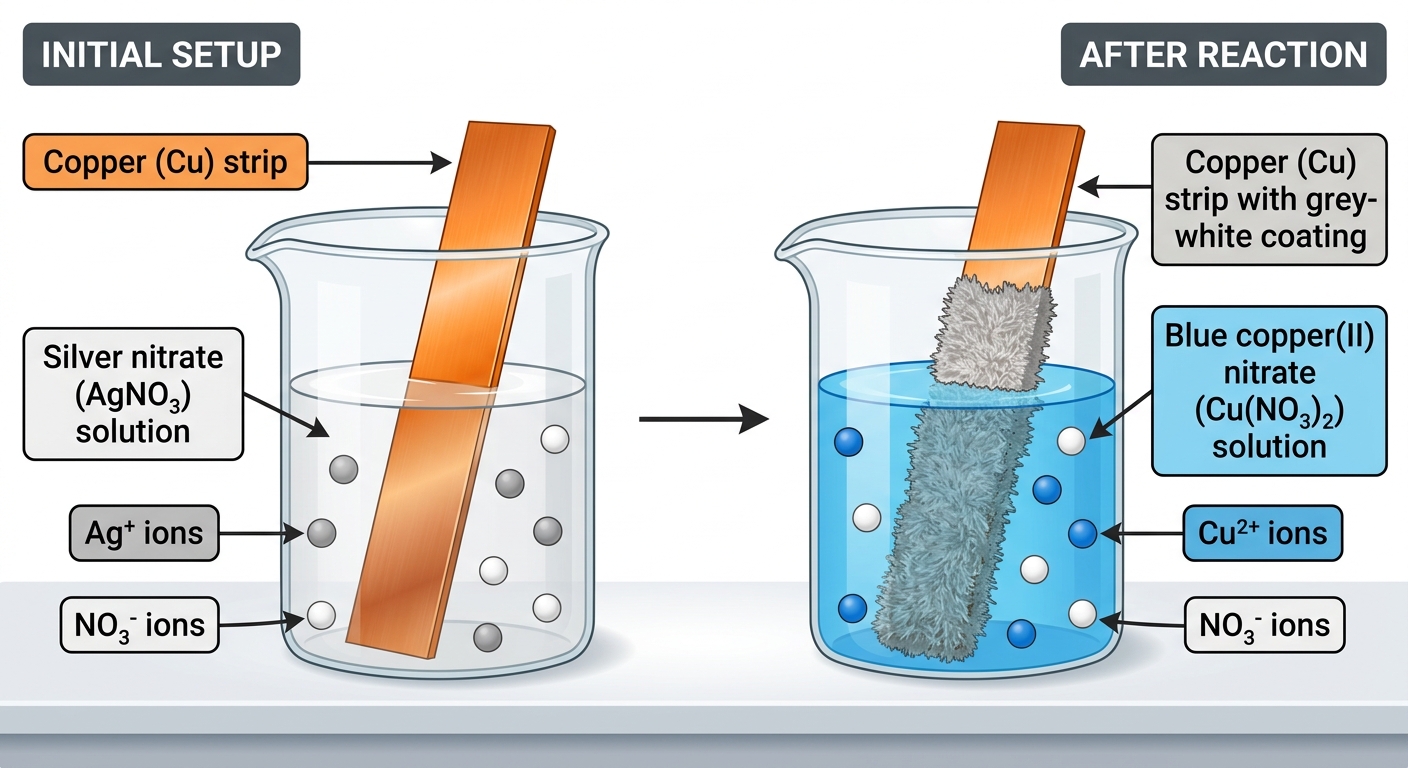
When copper metal is placed into silver nitrate solution, the copper becomes coated with a grey solid and the solution turns blue. Which balanced net ionic equation correctly represents this reaction?
revisionprep.com
Summary Answer
Not available for this question.
Model Answer
Not available for this question.
Marking Scheme
Not available for this question.
Examiner Insights
Not available for this question.
Oxidizing and reducing agents
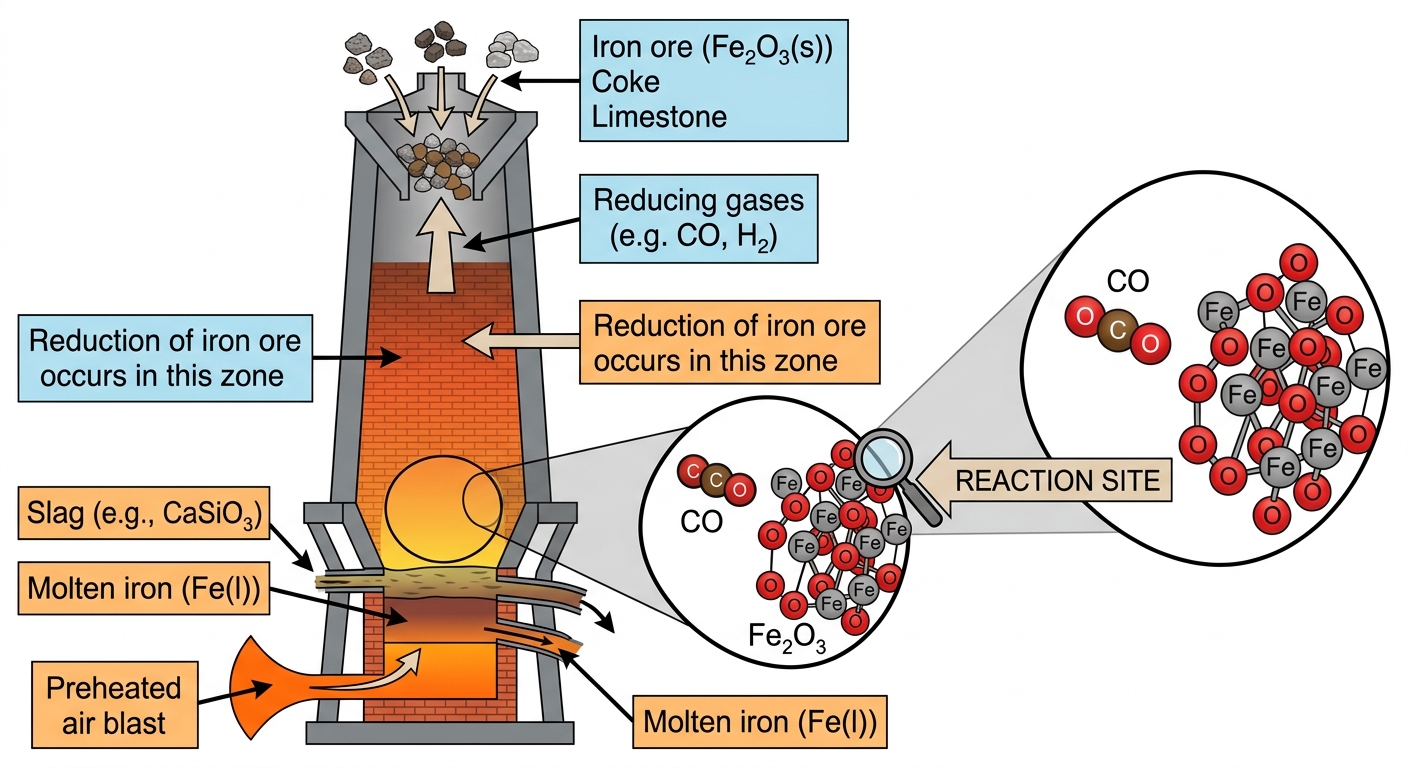
In the blast furnace extraction of iron, iron(III) oxide is reduced to molten iron according to the equation:
Which species undergoes oxidation in this reaction?
revisionprep.com
Summary Answer
Not available for this question.
Model Answer
Not available for this question.
Marking Scheme
Not available for this question.
Examiner Insights
Not available for this question.
Redox reactions and electron transfer
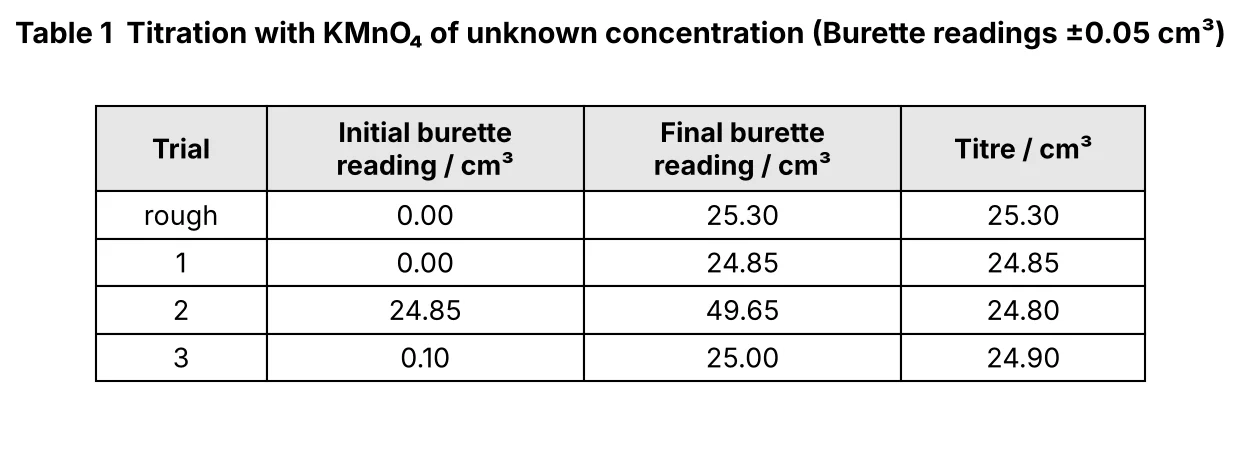
Potassium manganate(VII) solution slowly decomposes, so its concentration is checked against sodium ethanedioate, . A student dissolves of in water and makes the solution up to . Portions of are acidified, warmed and titrated with the solution. The results are shown in Table 1. .
State the oxidation state of carbon in and in .
Formulate the half-equation for the oxidation of ethanedioate ions to carbon dioxide.
Calculate the mean titre, using only concordant results.
Calculate the concentration, in , of the solution.
Explain why no separate indicator is needed in this titration.
Calculate the percentage uncertainty in the mean titre.
revisionprep.com
Summary Answer
Not available for this question.
Model Answer
Not available for this question.
Marking Scheme
Not available for this question.
Examiner Insights
Not available for this question.
Oxidizing and reducing agents
A student finds the concentration of an iron(II) sulfate solution by titrating portions with acidified potassium manganate(VII) from a burette, using the equation . The titres are in Table 1; each burette reading has an uncertainty of .
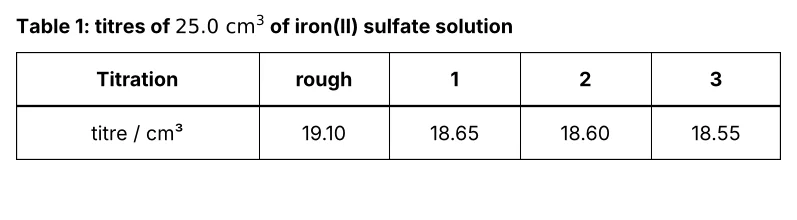
Calculate the mean of the concordant titres, and explain why the rough titre is not used.
Calculate the concentration of in the solution.
Each titre needs two burette readings. Calculate the percentage uncertainty in the mean titre.
revisionprep.com
Summary Answer
Not available for this question.
Model Answer
Not available for this question.
Marking Scheme
Not available for this question.
Examiner Insights
Not available for this question.
Redox reactions and electron transfer
A student investigates the corrosion of iron. Cleaned iron nails are left for seven days in tubes of aerated salt water: Tube A: nail alone Tube B: nail wrapped in magnesium ribbon Tube C: nail wrapped in copper wire Tube D: nail alone, in boiled water covered with a layer of oil
Each nail is then dried, the rust is scraped off, and the loss in mass of the nail is recorded. The results are shown in the table. The balance reads to g.
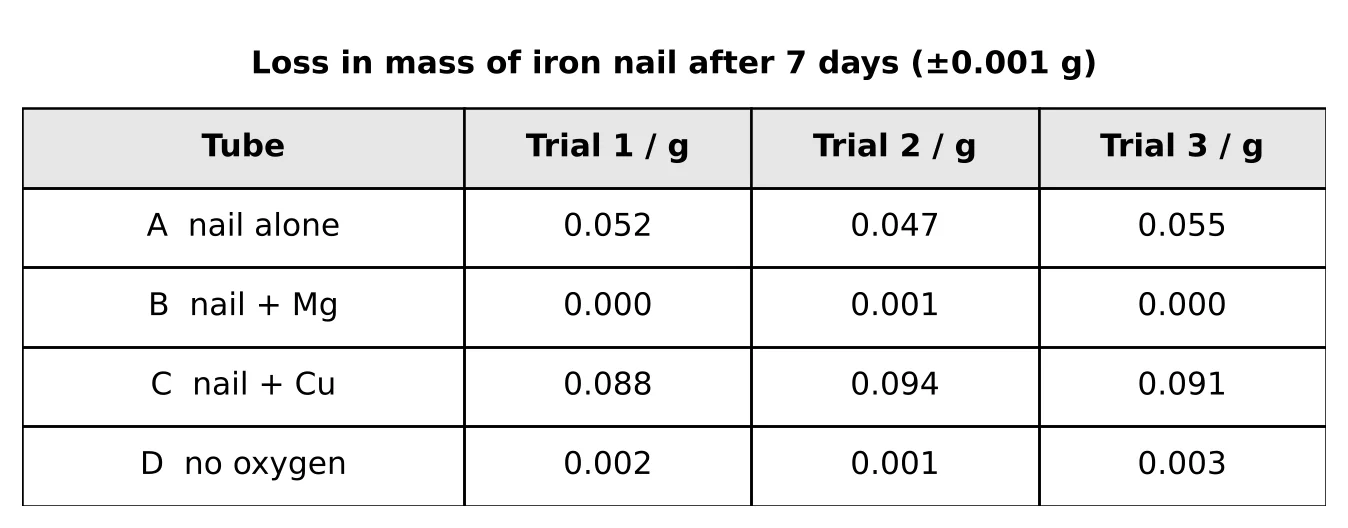
Calculate the mean loss in mass for tube C and its percentage increase compared with the mean for tube A.
Deduce the half-equations for the oxidation of iron and for the reduction of oxygen in tube A.
Explain the result for tube B, using values.
Explain why the nail in tube C corrodes faster than the nail in tube A.
Evaluate whether the result for tube D supports the hypothesis that oxygen is needed for iron to corrode. Refer to the precision of the balance.
revisionprep.com
Summary Answer
Not available for this question.
Model Answer
Not available for this question.
Marking Scheme
Not available for this question.
Examiner Insights
Not available for this question.
Oxidizing and reducing agents
A student adds g of each metal powder (an excess) to of solutions of metal sulfates in a polystyrene cup and records the maximum temperature rise, . Each temperature reading has an uncertainty of . The results are shown in the table.
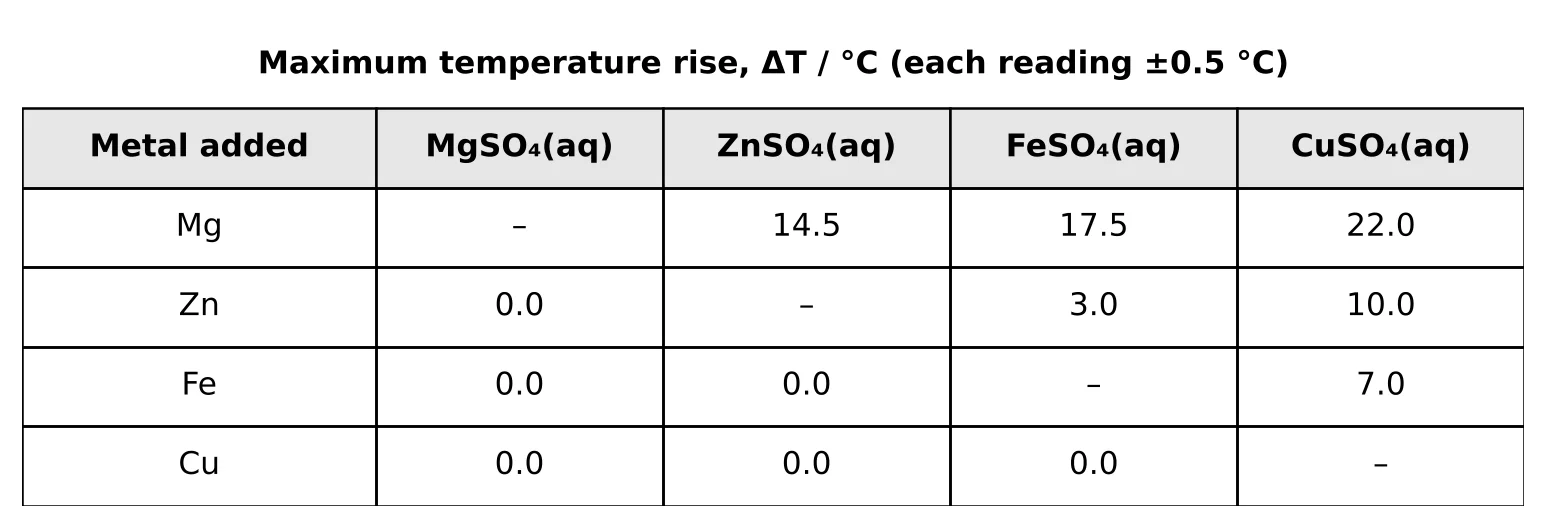
Deduce the order of reducing strength of the four metals from the data.
Deduce the ionic equation for the reaction of zinc with iron(II) sulfate solution and identify the oxidising agent.
Calculate the percentage uncertainty in for zinc with iron(II) sulfate.
A student suggests that is proportional to . Evaluate this suggestion using the data.
Suggest one change to the method that would reduce the percentage uncertainty in (c).
revisionprep.com
Summary Answer
Not available for this question.
Model Answer
Not available for this question.
Marking Scheme
Not available for this question.
Examiner Insights
Not available for this question.
That's every free question here — 6 of 133.
+127 more questions, plus Mock Papers & Worksheets, are waiting in Premium.