You're viewing 1 free preview question for Chemistry HL — subscribe to unlock 127 more, plus the Full Question Bank, Mock Papers & Worksheets.Upgrade
Electron-Pair Sharing Reactions · Paper 2 — Free Chemistry HL Practice Questions
1ChallengeSAQ-LCoordinate covalent bonding7 marksPaper 2~11 min

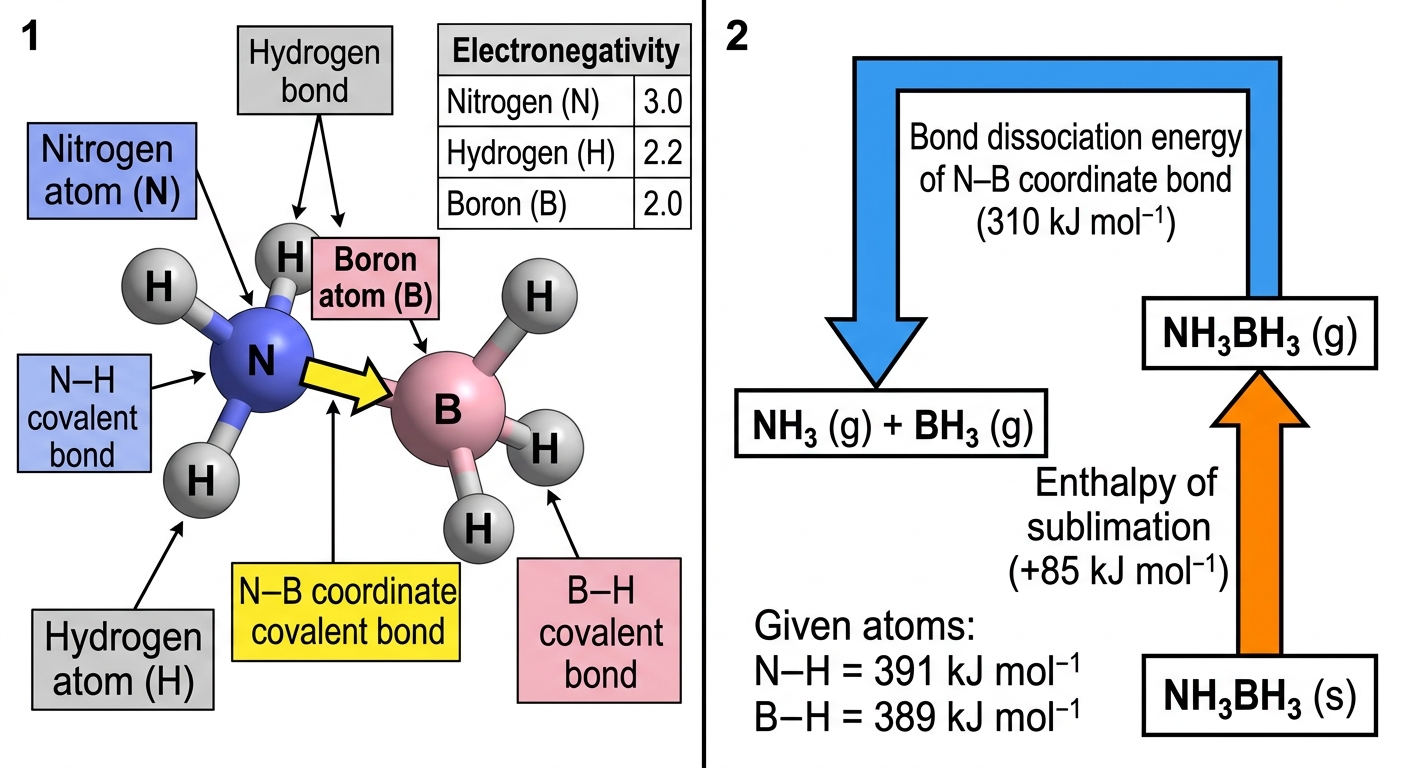
Data
- Electronegativity values: , ,
- Bond dissociation energies: ; ;
- Enthalpy of sublimation of :
Ammonium borane () is a stable white crystalline solid at room temperature. It decomposes at around rather than melting. The molecule contains a coordinate covalent (dative) bond between the nitrogen and boron atoms.
(a)
Calculate the enthalpy change, , for the gas-phase reaction:
State the type of bond formed and identify which atom donates both electrons. [3 marks]
(b)
Using the electronegativity data provided, explain why the N–B coordinate bond has a lower bond dissociation energy than the N–H covalent bond. [2 marks]
(c)
Evaluate the claim: "The existence of a stable solid such as shows that coordinate covalent bonds are stronger than ordinary covalent bonds."
In your answer, use both the bond energy data and the enthalpy of sublimation to support your evaluation. [2 marks]

Solutions
That's every free question here — 1 of 128.
+127 more questions, plus Mock Papers & Worksheets, are waiting in Premium.