Electron Transfer Reactions · Paper 2 — Free Chemistry HL Practice Questions
Free questions
Open in full, with answers, mark scheme and examiner insights.
Redox reactions and electron transfer
Respiration releases energy from glucose in the overall reaction .
Deduce the average oxidation state of carbon in glucose and in carbon dioxide.
Identify the oxidising agent and justify your answer.
Deduce the number of electrons transferred when one molecule of glucose reacts.
revisionprep.com
Summary Answer
Not available for this question.
Model Answer
Not available for this question.
Marking Scheme
Not available for this question.
Examiner Insights
Not available for this question.
Oxidizing and reducing agents
Two unlabelled bottles each contain a colourless liquid with the formula . One is propanal, , and the other is propanone, .
Describe how warm acidified potassium dichromate(VI) can be used to tell the two liquids apart, giving the result for each.
Write an equation for the reaction of propanal in (a), using [O] to represent the oxidizing agent.
Name the organic product formed when each liquid is reduced by sodium borohydride, .
State why the reaction with is described as a reduction.
revisionprep.com
Summary Answer
Not available for this question.
Model Answer
Not available for this question.
Marking Scheme
Not available for this question.
Examiner Insights
Not available for this question.
Oxidizing and reducing agents
Metal M forms ions. A student records these observations:
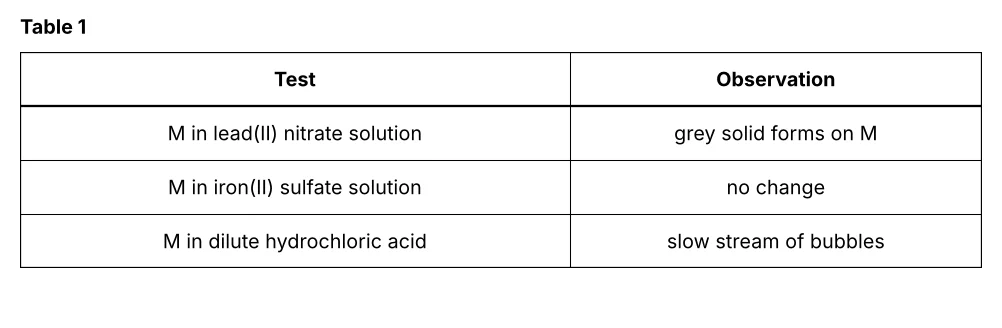
Formulate the ionic equation for the reaction of M with lead(II) nitrate solution.
Identify the oxidizing agent and the species oxidized in this reaction.
Deduce how compares with and , giving a reason for each.
Predict, with a reason, what would be observed when M is placed in copper(II) sulfate solution.
of M reacts completely with excess dilute hydrochloric acid, forming ions and of hydrogen at SATP. Calculate the relative atomic mass of M. Molar volume of a gas at SATP .
Suggest, with reasons, the identity of M.
Formulate the ionic equation for the reaction of M with dilute hydrochloric acid.
revisionprep.com
Summary Answer
Not available for this question.
Model Answer
Not available for this question.
Marking Scheme
Not available for this question.
Examiner Insights
Not available for this question.
Primary, secondary and electrolytic cells
The diagram shows a hydrogen–oxygen fuel cell with a proton exchange membrane that allows only ions to pass. , .
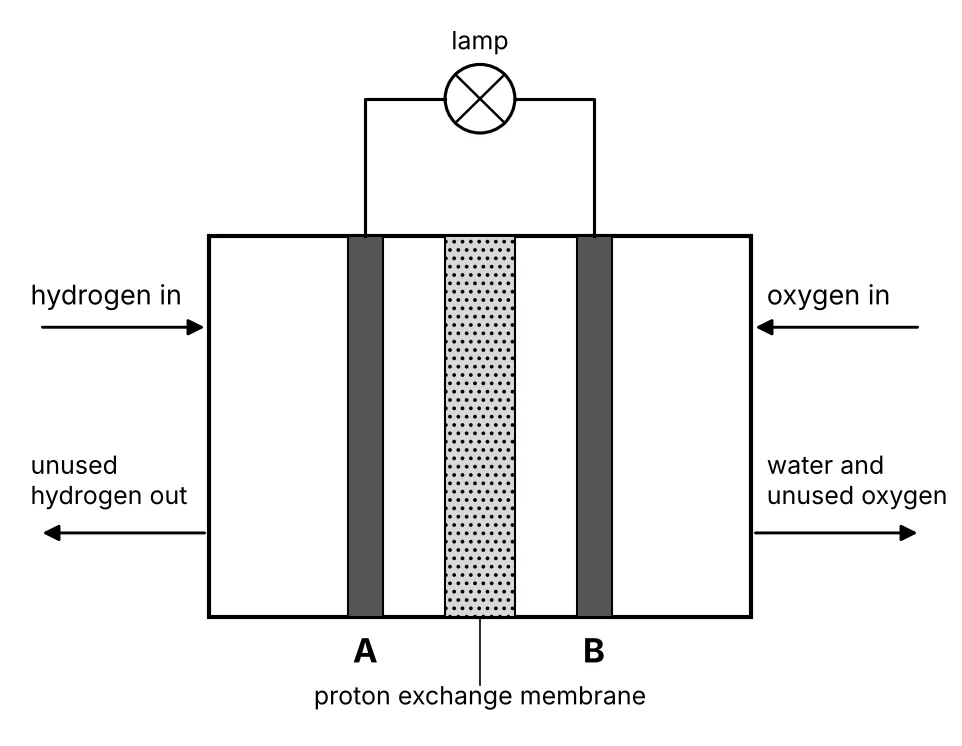
Write the half-equation for the reaction at electrode A.
Write the half-equation for the reaction at electrode B.
State the direction of electron flow in the external circuit and the direction of movement through the membrane.
Calculate the mass of water, in kg, formed when of hydrogen is used.
Outline one advantage of using hydrogen in this fuel cell rather than burning it in an engine, and one disadvantage of hydrogen as a fuel for vehicles.
revisionprep.com
Summary Answer
Not available for this question.
Model Answer
Not available for this question.
Marking Scheme
Not available for this question.
Examiner Insights
Not available for this question.
Electrochemical cells and half-reactions
The diagram shows two electrolysis cells, each containing copper(II) sulfate solution. Cell X has graphite electrodes; cell Y has copper electrodes.
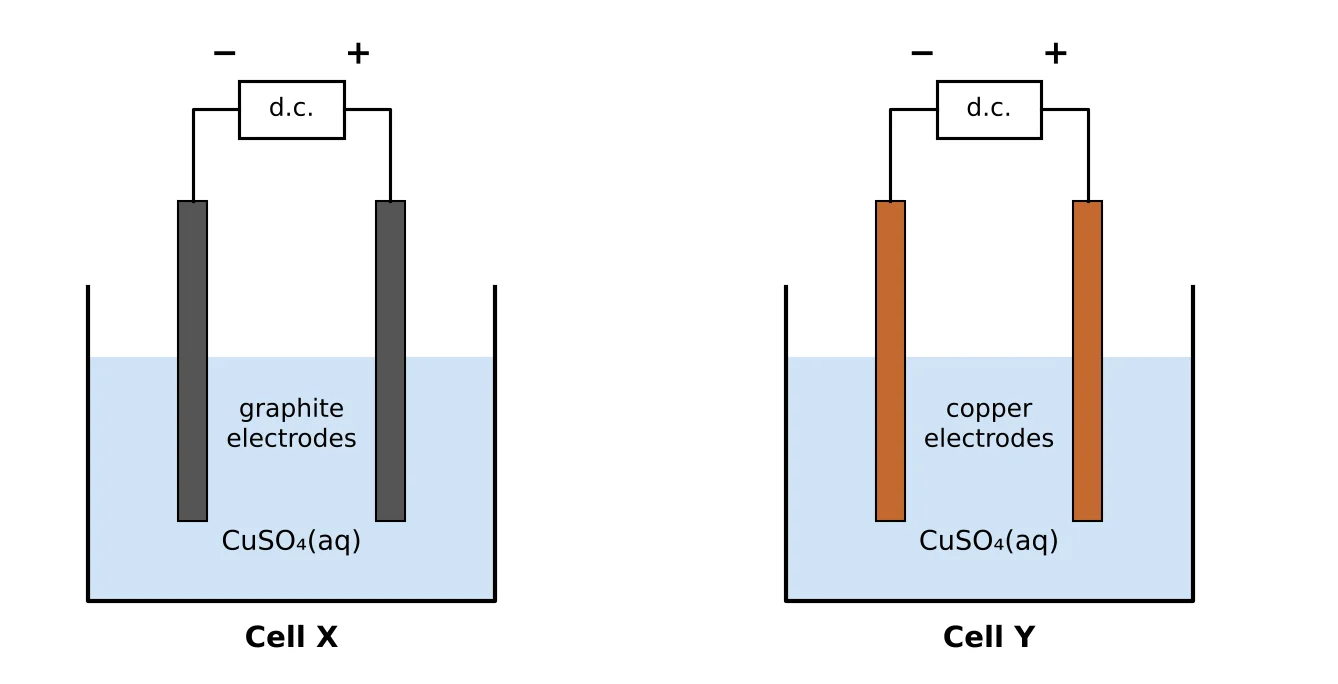
Deduce the half-equation at the cathode in cell X, and justify it using values.
Deduce the half-equation at the anode in cell X, and explain why sulfate ions are not oxidised.
Explain two changes in the electrolyte of cell X as electrolysis continues, and state what the electrolyte becomes when all the copper(II) ions have been removed.
Calculate the minimum voltage, from values, needed to electrolyse the solution in cell X.
Deduce the half-equation at the anode in cell Y, and explain why the colour of the electrolyte in cell Y does not change.
Cell Y is adapted to copper-plate a steel key. State which electrode the key must be, and one condition that helps give an even coating.
During one run the copper anode in cell Y loses g. Determine the amount, in mol, of electrons transferred and the mass of copper deposited.
revisionprep.com
Summary Answer
Not available for this question.
Model Answer
Not available for this question.
Marking Scheme
Not available for this question.
Examiner Insights
Not available for this question.
Electrolysis of aqueous solutions and electroplating
Copper for electrical wiring is purified by electrolysis. The anode is a block of impure copper that contains zinc, iron, silver and gold, the cathode is a thin sheet of pure copper, and the electrolyte is acidified aqueous copper(II) sulfate.
;
Use the standard electrode potentials to explain what happens to the zinc, iron, silver and gold impurities at the anode.
Write the half-equation at the anode and at the cathode for copper.
Deduce for the copper refining reaction and explain why a small voltage must still be applied.
Calculate the charge needed to deposit of copper.
A refinery cell runs at a constant current of . Calculate the time, in hours, to deposit of copper.
The cell operates at . Calculate the electrical energy, in kWh (), used to deposit of copper.
Evaluate the claim that electrolytic refining is an efficient way to produce pure copper, using your answers to (c) and (f) and the fate of the silver and gold.
revisionprep.com
Summary Answer
Not available for this question.
Model Answer
Not available for this question.
Marking Scheme
Not available for this question.
Examiner Insights
Not available for this question.
That's every free question here — 6 of 129.
+123 more questions, plus Mock Papers & Worksheets, are waiting in Premium.