Proton Transfer Reactions · Paper 2 — Free Chemistry HL Practice Questions
Free questions
Open in full, with answers, mark scheme and examiner insights.
Acid-base reactions: Bronsted-Lowry theory
Liquid ammonia, like water, ionizes very slightly by proton transfer between two of its own molecules: .
State what is meant by an amphiprotic species and explain why ammonia is amphiprotic in this reaction.
Identify the two conjugate acid–base pairs in the equation.
Deduce the ion that behaves in liquid ammonia in the same way as the hydroxide ion behaves in water.
revisionprep.com
Summary Answer
Not available for this question.
Model Answer
Not available for this question.
Marking Scheme
Not available for this question.
Examiner Insights
Not available for this question.
Kw, neutralisation and pH curves (strong acid-strong base)
A rust remover is a solution of a strong acid with a pH of at .
State the expression for the ionic product of water, , and its value at .
Calculate and in the rust remover.
The rust remover is diluted with water. State how changes.
revisionprep.com
Summary Answer
Not available for this question.
Model Answer
Not available for this question.
Marking Scheme
Not available for this question.
Examiner Insights
Not available for this question.
Strong vs weak acids and bases
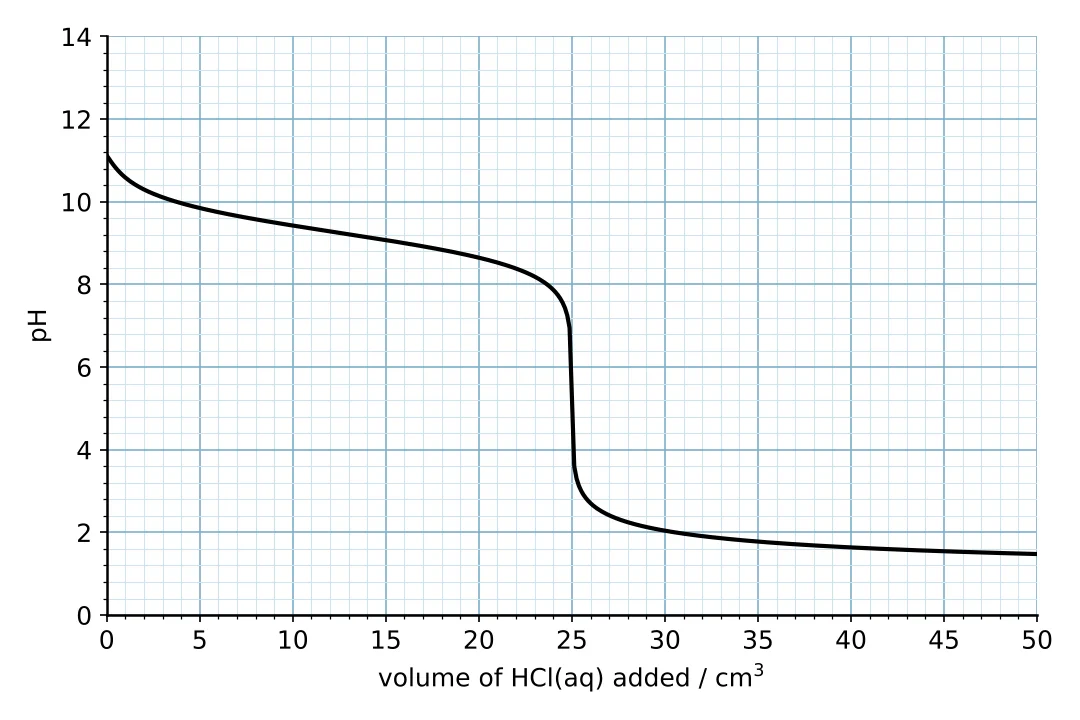
of is titrated with HCl(aq) at . The graph shows how the pH changes.
Methyl red changes colour between pH 4.4 and 6.2; phenolphthalein between pH 8.2 and 10.0.
Write an equation for the reaction.
Use the graph to determine the of ammonia.
Explain, with an equation, why the pH at the equivalence point is below 7.
Identify which indicator should be used and explain why the other is unsuitable.
Outline why the pH falls only slowly between and of acid added.
revisionprep.com
Summary Answer
Not available for this question.
Model Answer
Not available for this question.
Marking Scheme
Not available for this question.
Examiner Insights
Not available for this question.
Ka, Kb, pKa and pKb
A technician studies how temperature affects a solution of aqueous ammonia, . The values of for ammonia and of at two temperatures are given in Table 1.
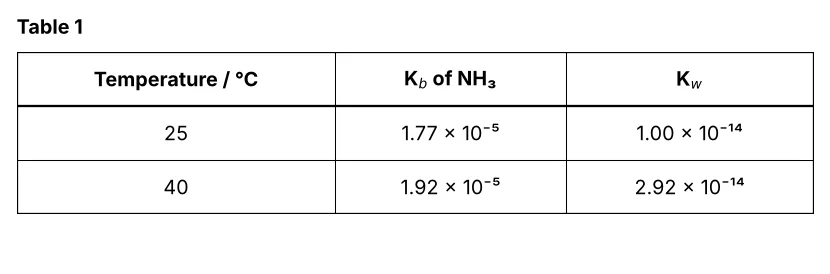
Calculate of ammonia at each temperature.
Calculate the pH of a solution of ammonia at .
Calculate the pH of the same solution at , using .
A student states that the pH of the solution should rise with temperature because increases. Evaluate this claim using your answers.
Calculate the of the ammonium ion at and deduce whether ammonium chloride solution at this temperature is more or less acidic than at at the same concentration.
revisionprep.com
Summary Answer
Not available for this question.
Model Answer
Not available for this question.
Marking Scheme
Not available for this question.
Examiner Insights
Not available for this question.
Acid-base reactions: Bronsted-Lowry theory
Brønsted–Lowry theory does not require water.
Reaction 1:
Liquid ammonia self-ionises: . Take at .
Explain why Reaction 1 is a Brønsted–Lowry acid–base reaction.
Identify the two conjugate acid–base pairs in the self-ionisation of liquid ammonia.
Calculate in pure liquid ammonia at , and state the condition for a solution in liquid ammonia to be neutral.
Ethanoic acid is a weak acid in water but is fully ionised in liquid ammonia. Explain this difference.
revisionprep.com
Summary Answer
Not available for this question.
Model Answer
Not available for this question.
Marking Scheme
Not available for this question.
Examiner Insights
Not available for this question.
pH scale and calculations
Each graph shows the pH when a base is added to of a acid at . The acids are HCl and ; the bases are NaOH and .
Methyl orange changes colour between pH 3.1 and 4.4; phenolphthalein between pH 8.2 and 10.0.
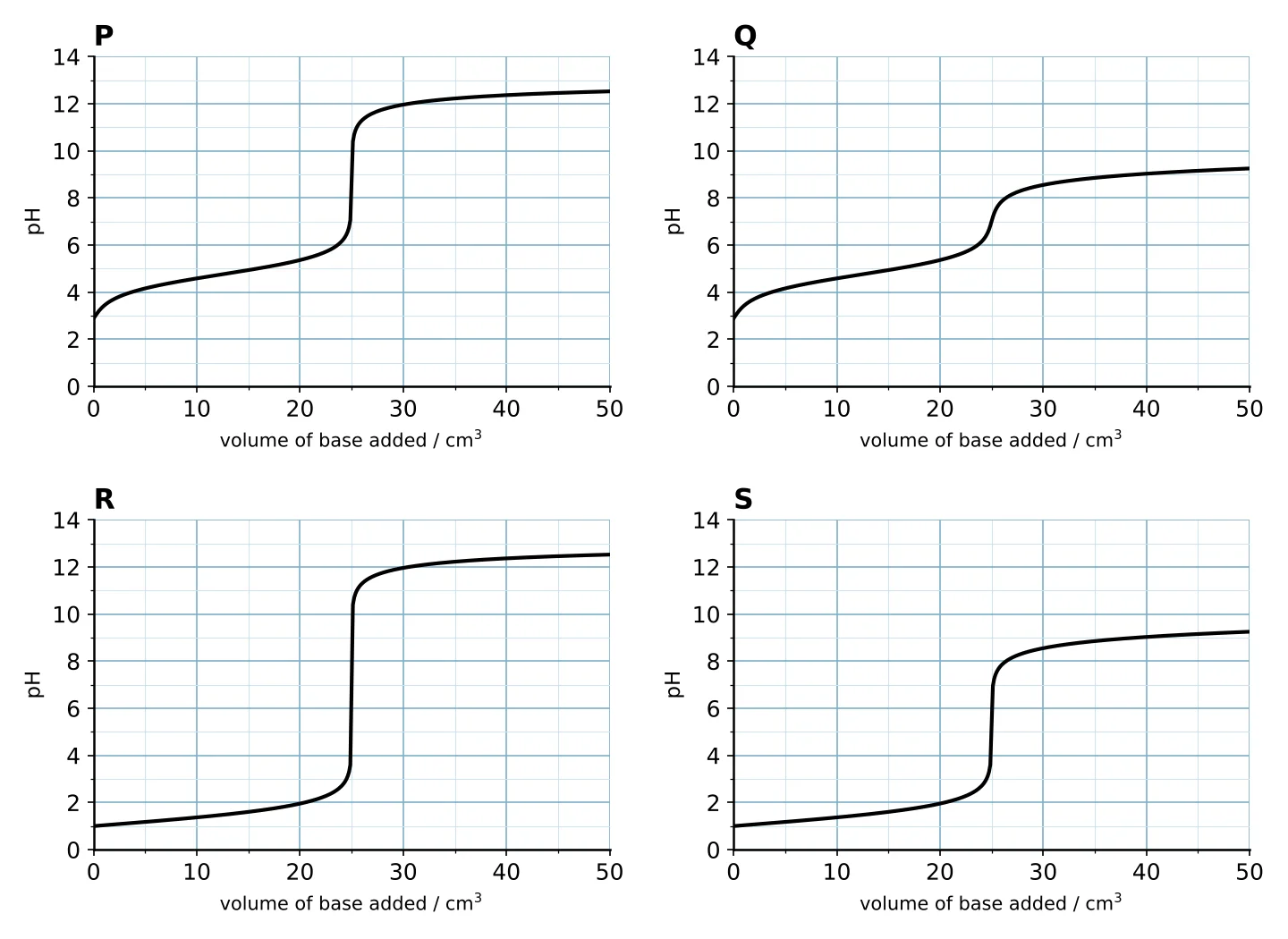
Identify the acid and the base used in each of titrations P, Q, R and S.
Explain, with an equation, why the pH at the equivalence point of P is above 7.
Use graph P to determine the of ethanoic acid.
Identify the more suitable indicator for titration S and explain your choice.
Explain why titration Q cannot be carried out accurately using an indicator.
Outline why the pH in S levels off near 9 after the equivalence point, rather than near 12.5 as in R.
. Calculate the pH of the mixture in titration S after of ammonia has been added.
revisionprep.com
Summary Answer
Not available for this question.
Model Answer
Not available for this question.
Marking Scheme
Not available for this question.
Examiner Insights
Not available for this question.
That's every free question here — 6 of 158.
+152 more questions, plus Mock Papers & Worksheets, are waiting in Premium.