Functional Groups: Classification of Organic Compounds · Paper 1 — Free Chemistry HL Practice Questions
Free questions
Open in full, with answers, mark scheme and examiner insights.
IUPAC naming conventions for organic compounds
A student tests four hydrocarbons, A to D, with bromine water. Table 1 shows the observations.
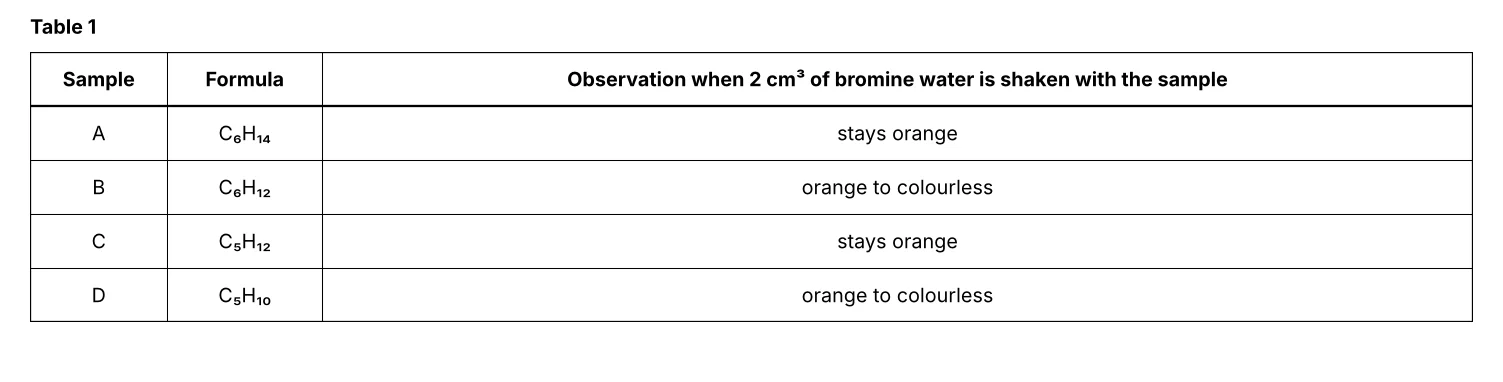
Identify the two samples that are alkenes.
State the general formula of the homologous series of the two samples in (a), and of the other two samples.
Suggest one improvement to the method that makes the comparison between the four samples more valid.
Suggest why the test is repeated for each sample.
revisionprep.com
Summary Answer
Not available for this question.
Model Answer
Not available for this question.
Marking Scheme
Not available for this question.
Examiner Insights
Not available for this question.
Introduction to organic chemistry and functional groups
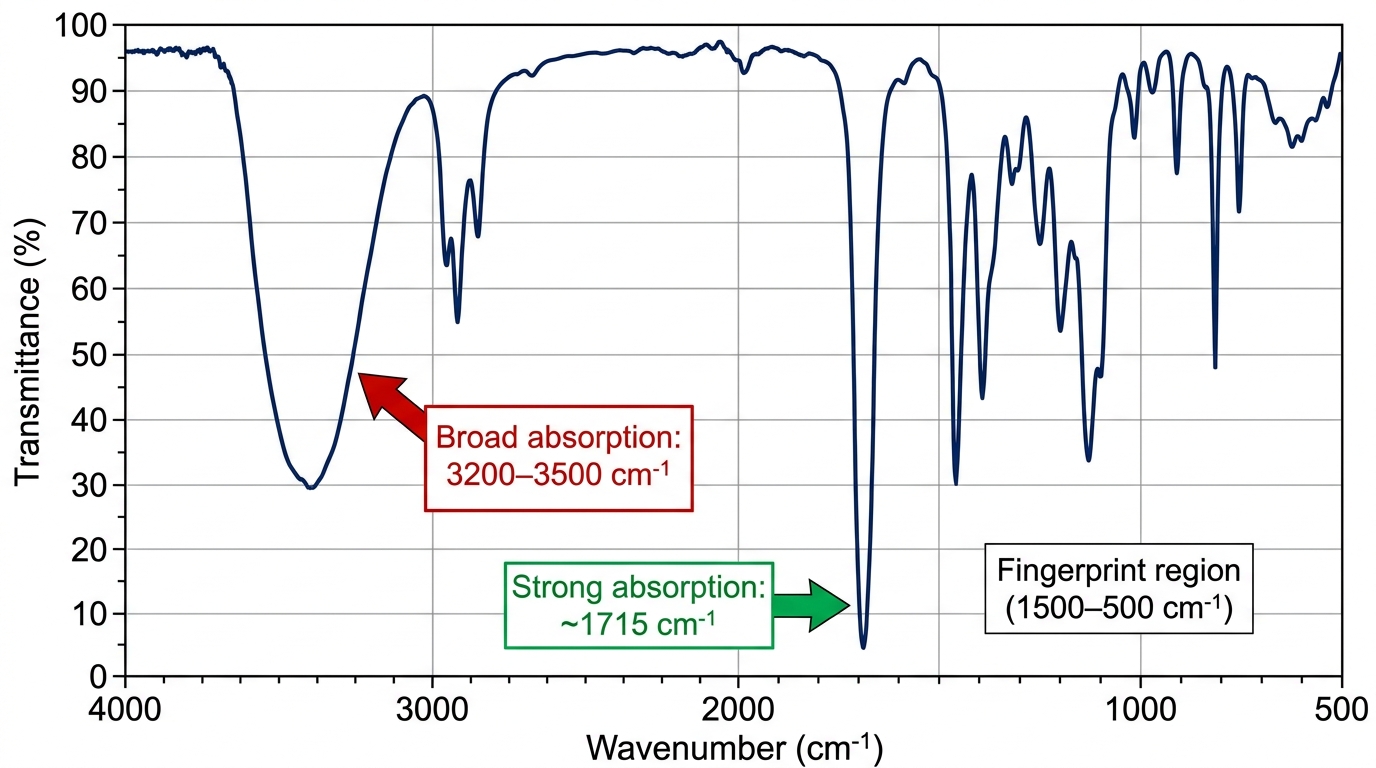
The IR spectrum of an organic compound is shown. Which bonds are responsible for the two labelled absorptions?
revisionprep.com
Summary Answer
Not available for this question.
Model Answer
Not available for this question.
Marking Scheme
Not available for this question.
Examiner Insights
Not available for this question.
IUPAC naming conventions for organic compounds
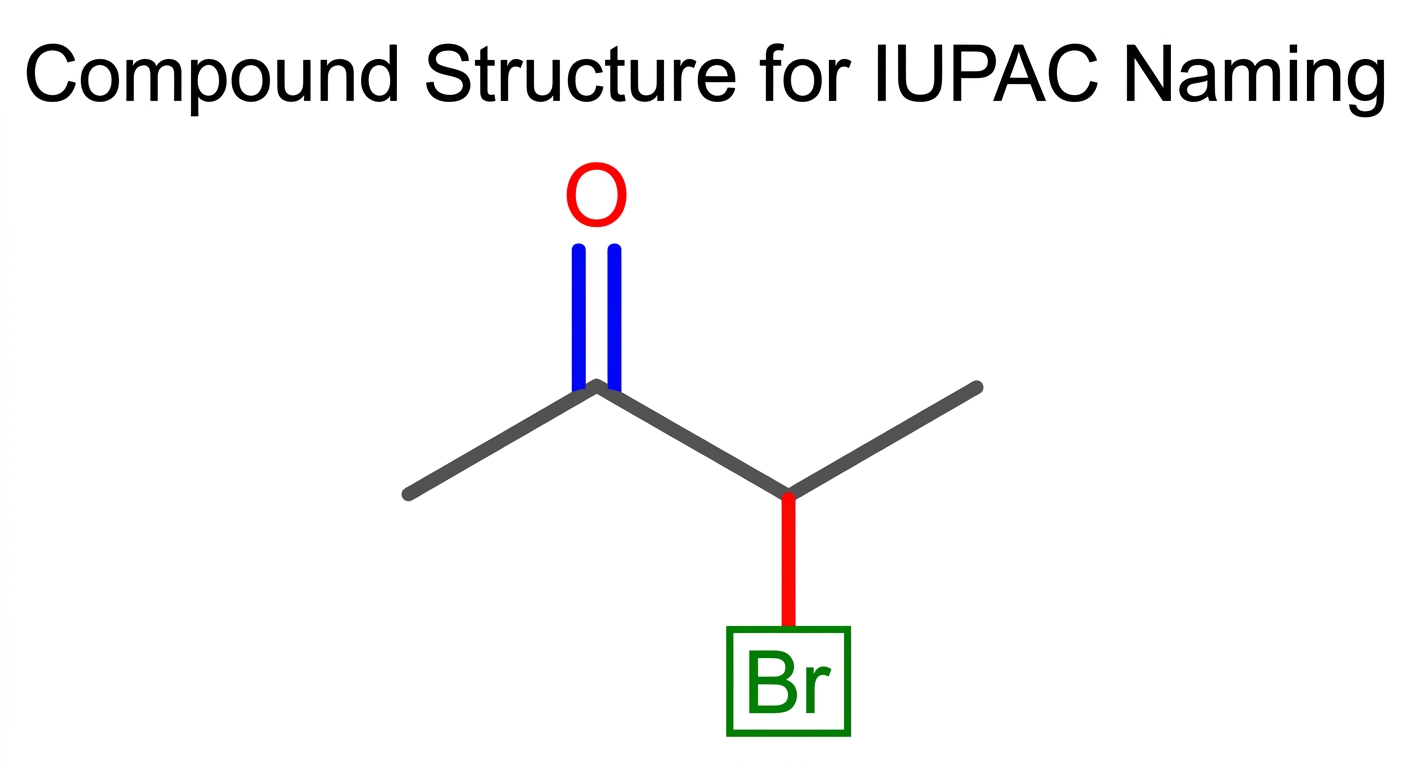
What is the IUPAC name of the compound shown?
revisionprep.com
Summary Answer
Not available for this question.
Model Answer
Not available for this question.
Marking Scheme
Not available for this question.
Examiner Insights
Not available for this question.
Introduction to organic chemistry and functional groups
The mass spectra of propan-1-ol and propan-2-ol are summarised in Table 1.
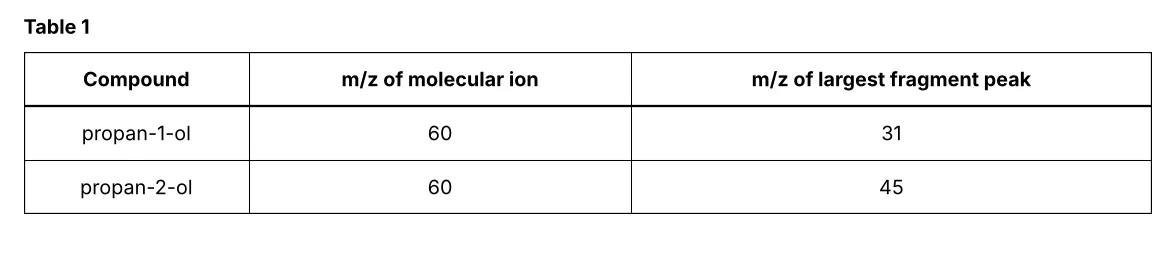
Explain why both spectra show a molecular ion at m/z = 60.
Identify the fragment ions at m/z = 31 and m/z = 45.
Explain how these fragments arise from the structure of each alcohol.
State the type of structural isomerism shown by the two alcohols and suggest one limitation of using the molecular ion peak alone to distinguish them.
revisionprep.com
Summary Answer
Not available for this question.
Model Answer
Not available for this question.
Marking Scheme
Not available for this question.
Examiner Insights
Not available for this question.
IUPAC naming conventions for organic compounds
The mass spectrum of a ketone with molecular formula is shown. The ketone is either pentan-2-one or pentan-3-one.
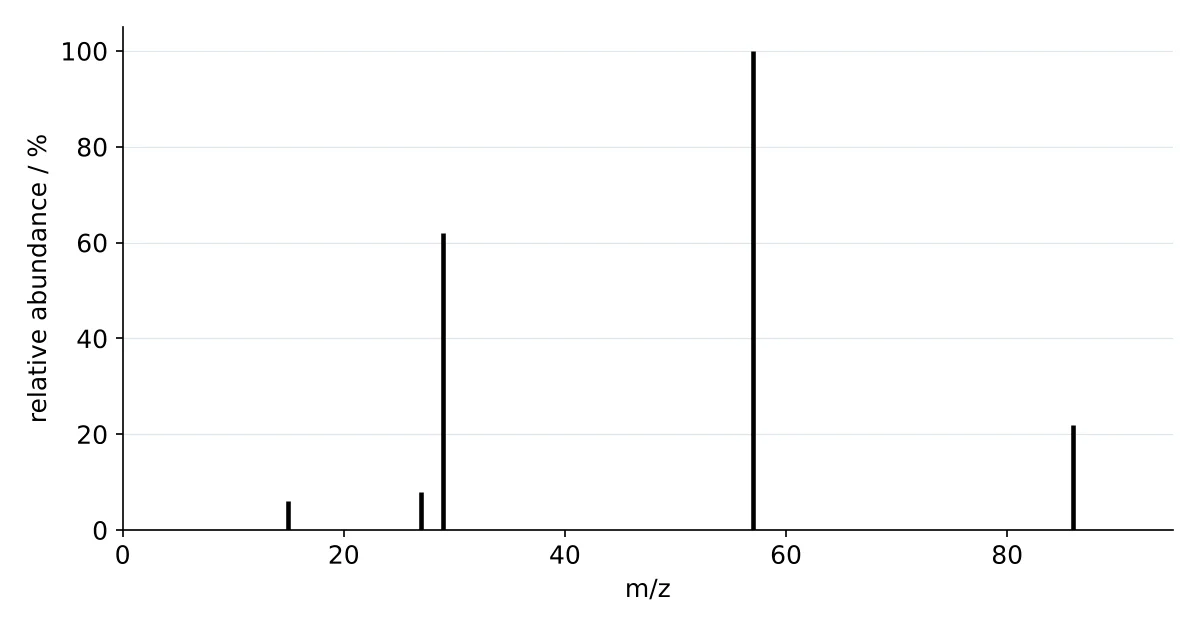
Identify the peak that corresponds to the molecular ion and state its m/z value.
Identify the fragment ions responsible for the peaks at m/z = 57 and m/z = 29.
Deduce which ketone produced the spectrum. Explain your answer with reference to a peak that would be expected for the other ketone.
Suggest a second technique that would improve the confidence of the identification, and state the number of signals it would give for each ketone.
revisionprep.com
Summary Answer
Not available for this question.
Model Answer
Not available for this question.
Marking Scheme
Not available for this question.
Examiner Insights
Not available for this question.
Introduction to organic chemistry and functional groups
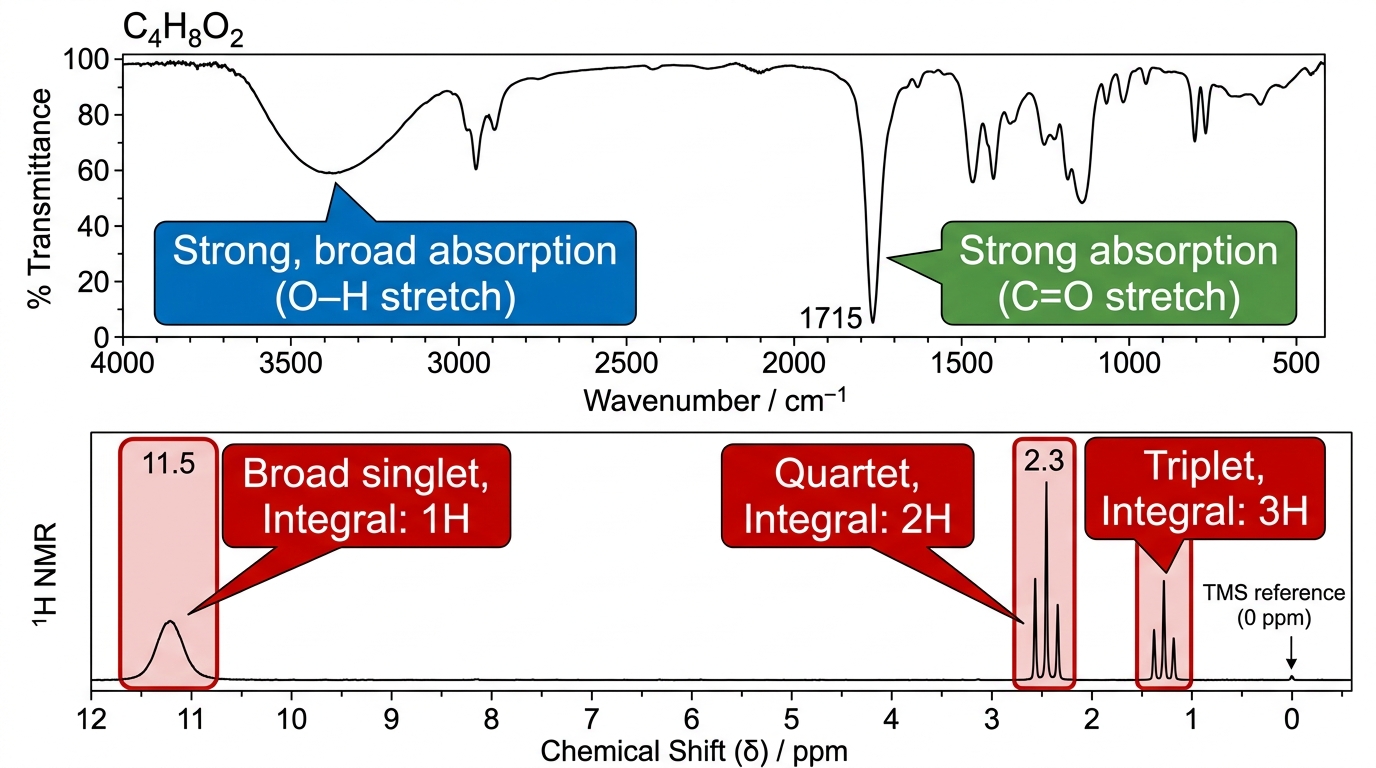
A student labelled the spectra shown as belonging to a compound of formula . Which conclusion is correct?
revisionprep.com
Summary Answer
Not available for this question.
Model Answer
Not available for this question.
Marking Scheme
Not available for this question.
Examiner Insights
Not available for this question.
That's every free question here — 6 of 388.
+382 more questions, plus Mock Papers & Worksheets, are waiting in Premium.