The Periodic Table: Classification of Elements · Paper 1 — Free Chemistry HL Practice Questions
Free questions
Open in full, with answers, mark scheme and examiner insights.
Periodic trends: Atomic radius, ionization energy, electronegativity
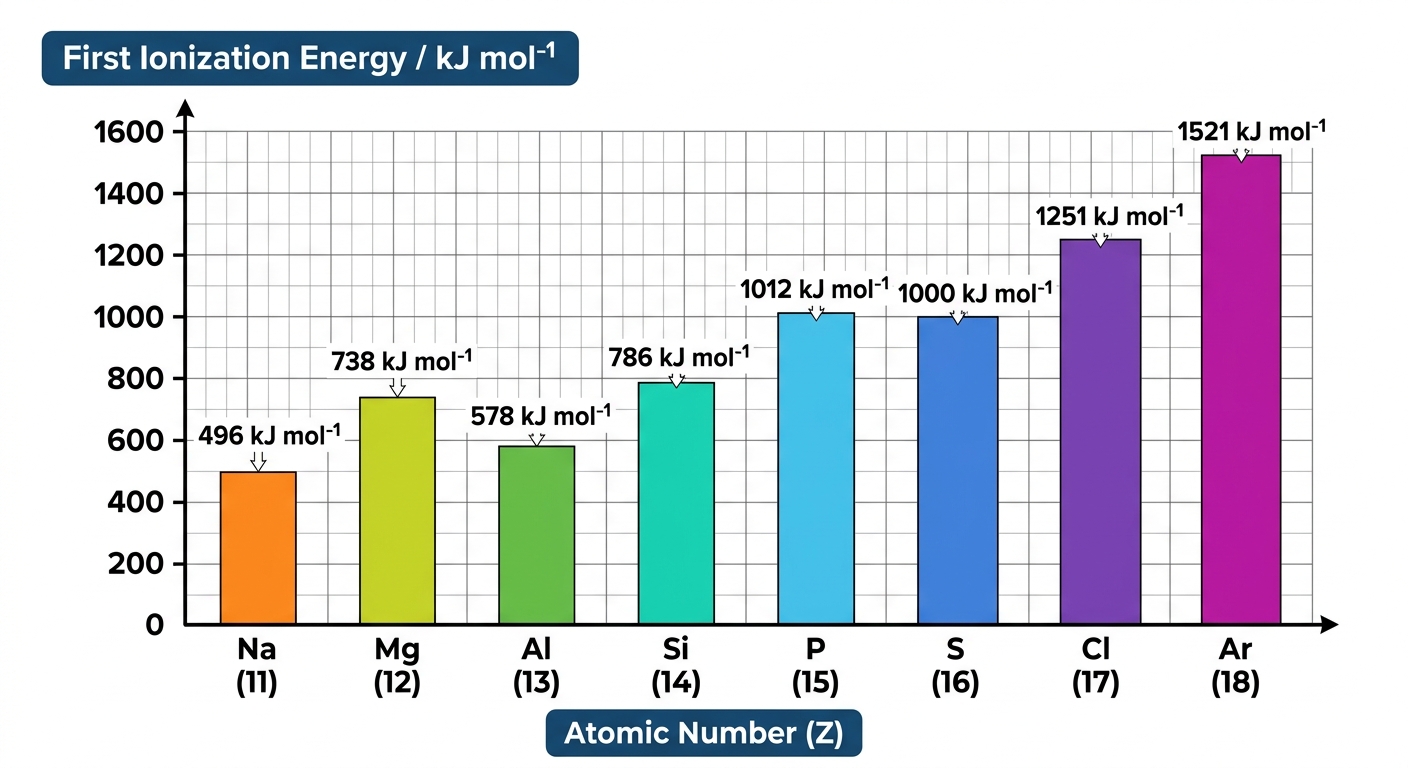
Across period 3 from Na to Ar, the first ionization energy generally increases. Which explanation best accounts for this trend?
revisionprep.com
Summary Answer
Not available for this question.
Model Answer
Not available for this question.
Marking Scheme
Not available for this question.
Examiner Insights
Not available for this question.
Group classification of elements
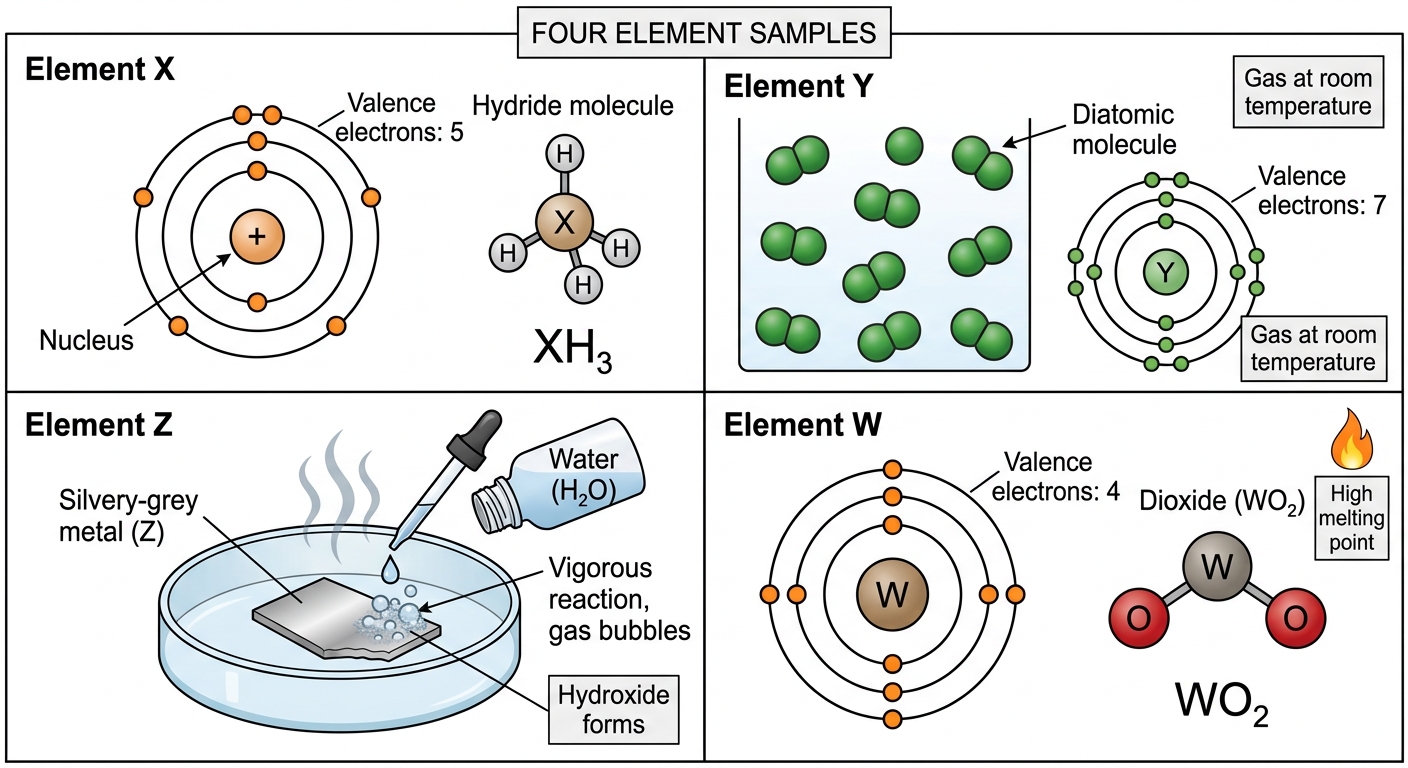
The describes four elements, W, X, Y and Z, that are all in Period 3. Which gives the groups of W, X, Y and Z, in that order?
revisionprep.com
Summary Answer
Not available for this question.
Model Answer
Not available for this question.
Marking Scheme
Not available for this question.
Examiner Insights
Not available for this question.
Periodic trends: Atomic radius, ionization energy, electronegativity
The first ionisation energies of two s-block metals, and of scandium and zinc, which bracket the first row of transition metals, are given below.
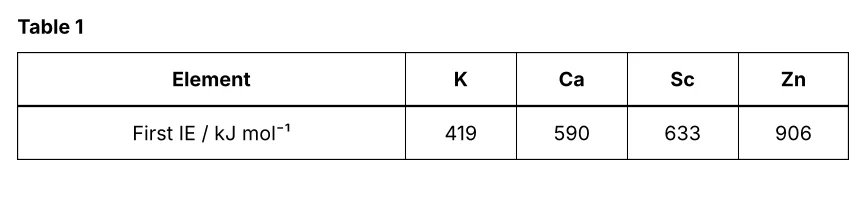
State the equation, with state symbols, for the first ionisation energy of calcium.
Explain why the first ionisation energy of calcium is higher than that of potassium.
Suggest why the first ionisation energy of zinc is much higher than that of scandium.
State which of the four elements has the most metallic character.
Calculate the percentage increase in first ionisation energy from calcium to zinc and state the trend shown by the data.
revisionprep.com
Summary Answer
Not available for this question.
Model Answer
Not available for this question.
Marking Scheme
Not available for this question.
Examiner Insights
Not available for this question.
Group classification of elements
Some Period 4 elements are given by their electron configurations.
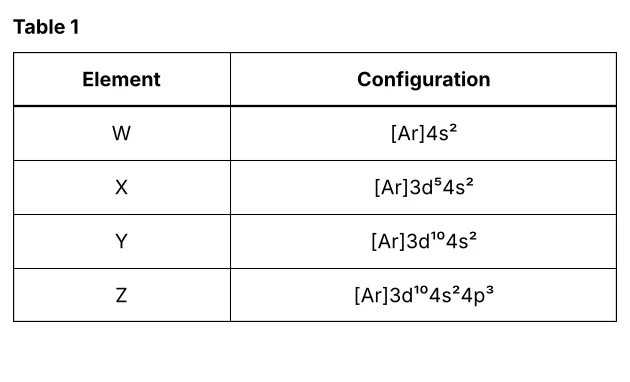
Identify the block of the periodic table to which each of W, X, Y and Z belongs.
State which of the elements is a transition element and justify.
Explain why Y is not a transition element.
State the group number of Z and of W.
Deduce the total number of electrons in an atom of Z.
State one limitation of using the electron configuration of the atom, rather than the ion, to decide whether an element is a transition element.
revisionprep.com
Summary Answer
Not available for this question.
Model Answer
Not available for this question.
Marking Scheme
Not available for this question.
Examiner Insights
Not available for this question.
Periodic trends: Atomic radius, ionization energy, electronegativity
Three elements X, Y and Z are in Period 3. Each is in a different group: Group 1, Group 2 or Group 17. A student collects data from a data book. Table 1 shows the data.
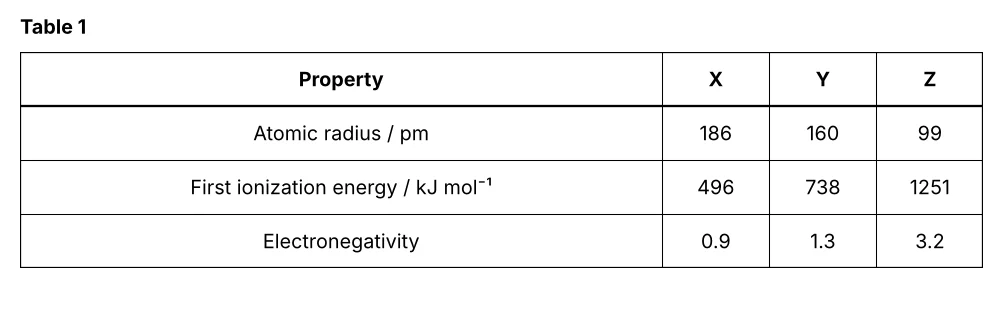
Deduce which element is in Group 17, giving two reasons from the data.
Calculate the ratio of the first ionization energy of Z to that of X.
Explain why Y has a higher first ionization energy than X.
Explain why Z has a higher electronegativity than Y.
Discuss whether data for three elements are enough to establish a periodic trend.
revisionprep.com
Summary Answer
Not available for this question.
Model Answer
Not available for this question.
Marking Scheme
Not available for this question.
Examiner Insights
Not available for this question.
Group classification of elements
A student shakes of each of six Period 3 oxides with of distilled water at and measures the pH. Distilled water has a pH of .
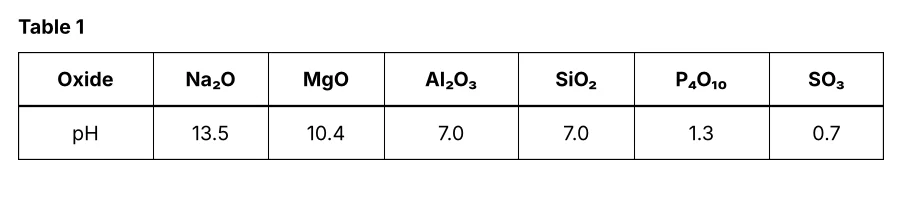
Identify the oxide that forms the most acidic solution and write an equation for its reaction with water.
Deduce, using the data, one similarity and one difference between the behaviour of and of MgO with water.
The pH is for both and . Deduce what this shows about their reaction with water and suggest why behaves in this way.
Predict whether the pH of a solution formed from chlorine(VII) oxide, , will be above or below . Justify your answer.
State one limitation of comparing the pH values of oxides using of each.
revisionprep.com
Summary Answer
Not available for this question.
Model Answer
Not available for this question.
Marking Scheme
Not available for this question.
Examiner Insights
Not available for this question.
That's every free question here — 6 of 310.
+304 more questions, plus Mock Papers & Worksheets, are waiting in Premium.