You're viewing 1 free preview question for Chemistry HL — subscribe to unlock 368 more, plus the Full Question Bank, Mock Papers & Worksheets.Upgrade
Functional Groups: Classification of Organic Compounds · Paper 2 — Free Chemistry HL Practice Questions
1ChallengeSAQ-LIUPAC naming conventions for organic compounds7 marksPaper 2~11 min

Data
Proton environment — Typical / ppm — Multiplicity rule
R–OH — (broad) — exchangeable
— —
— —
— —
— —
Relative atomic masses: , ,
A student attempts to synthesize 3-methylpentan-2-ol via a Grignard reaction. The isolated product is analysed by NMR spectroscopy and mass spectrometry.
Spectral data for the isolated product:
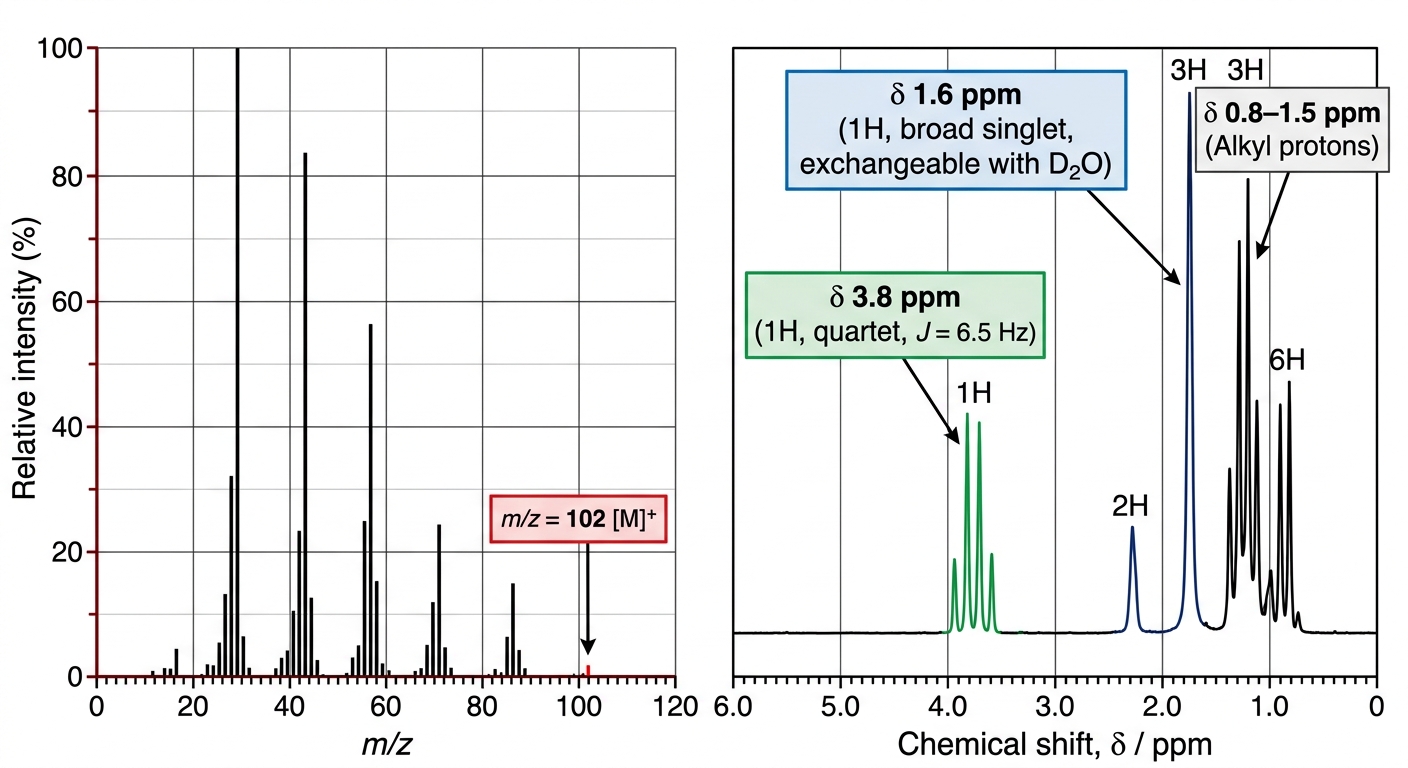
- Mass spectrum: molecular ion at
- NMR: (, triplet); (, doublet); (, multiplet); (, broad singlet, exchangeable with ); (, quartet, )
Reference
(a)
Show that the molecular formula of the isolated product is , and determine the degree of unsaturation. Hence state what the degree of unsaturation indicates about the compound. [3 marks]
(b)
Explain why the NMR data are inconsistent with the proposed structure of 3-methylpentan-2-ol, and deduce the structural fragment directly implied by the signal at . [3 marks]
(c)
Evaluate whether the combination of NMR spectroscopy and mass spectrometry is sufficient to distinguish definitively between all structural isomers of . [1 mark]

Solutions
That's every free question here — 1 of 369.
+368 more questions, plus Mock Papers & Worksheets, are waiting in Premium.