The Periodic Table: Classification of Elements · Paper 2 — Free Chemistry HL Practice Questions
Free questions
Open in full, with answers, mark scheme and examiner insights.
Periodic trends: Atomic radius, ionization energy, electronegativity
The table gives the radii of some atoms and ions.
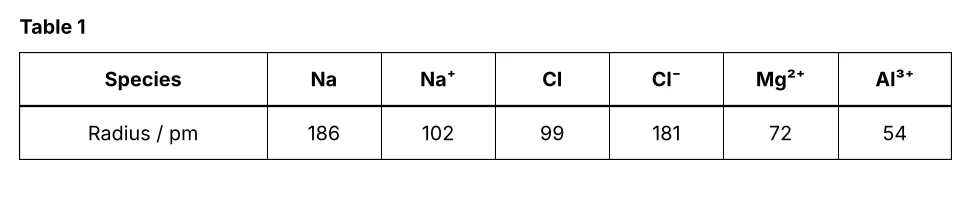
Calculate the percentage decrease in radius when a sodium atom forms a sodium ion.
Explain why the sodium ion is smaller than the sodium atom.
Explain why the chloride ion is larger than the chlorine atom.
The ions , and have the same electron configuration. Explain why their radii decrease in the order .
revisionprep.com
Summary Answer
Not available for this question.
Model Answer
Not available for this question.
Marking Scheme
Not available for this question.
Examiner Insights
Not available for this question.
Oxides of elements and oxidation states
Equal amounts of four Period 3 oxides were added to water and the pH of the mixture was measured.
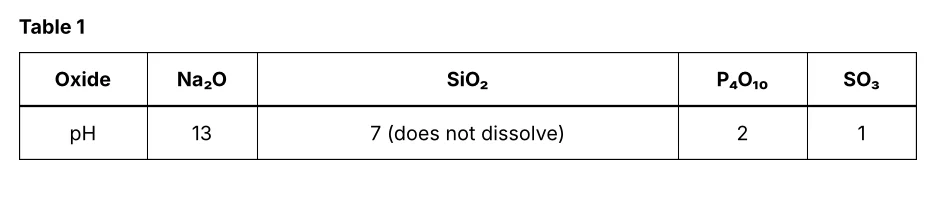
State which oxide in the table is basic.
Construct the equation for the reaction of with water.
Construct the equation for the reaction of with water.
Explain why does not dissolve in water, whereas does, by referring to structure and bonding.
Describe how the bonding and the acid-base character of the oxides change across Period 3 from sodium to sulfur.
State the formula of the acid formed when reacts with water.
revisionprep.com
Summary Answer
Not available for this question.
Model Answer
Not available for this question.
Marking Scheme
Not available for this question.
Examiner Insights
Not available for this question.
Periodic trends: Atomic radius, ionization energy, electronegativity
The graph shows the first four ionization energies of gallium, Ga, a Group 13 element in Period 4.
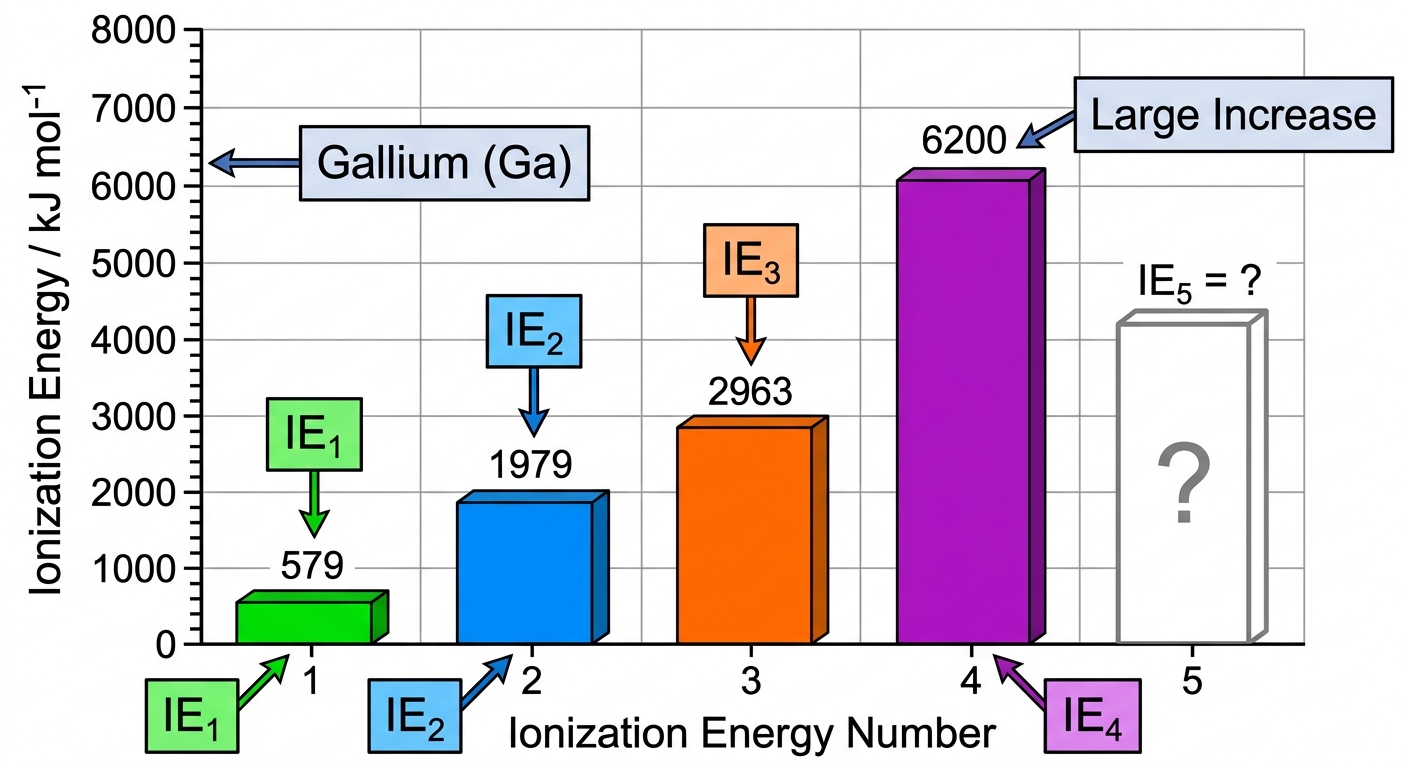
Write the equation for the second ionization energy of gallium.
Explain why is greater than .
Explain the large increase between and .
Deduce the charge on the gallium ion in its compounds and the formula of gallium oxide.
Predict, with a reason, whether is closer to or to .
revisionprep.com
Summary Answer
Not available for this question.
Model Answer
Not available for this question.
Marking Scheme
Not available for this question.
Examiner Insights
Not available for this question.
Group classification of elements
The diagram shows the first and second ionization energies of the Group 2 metals and observations when each is added to cold water.
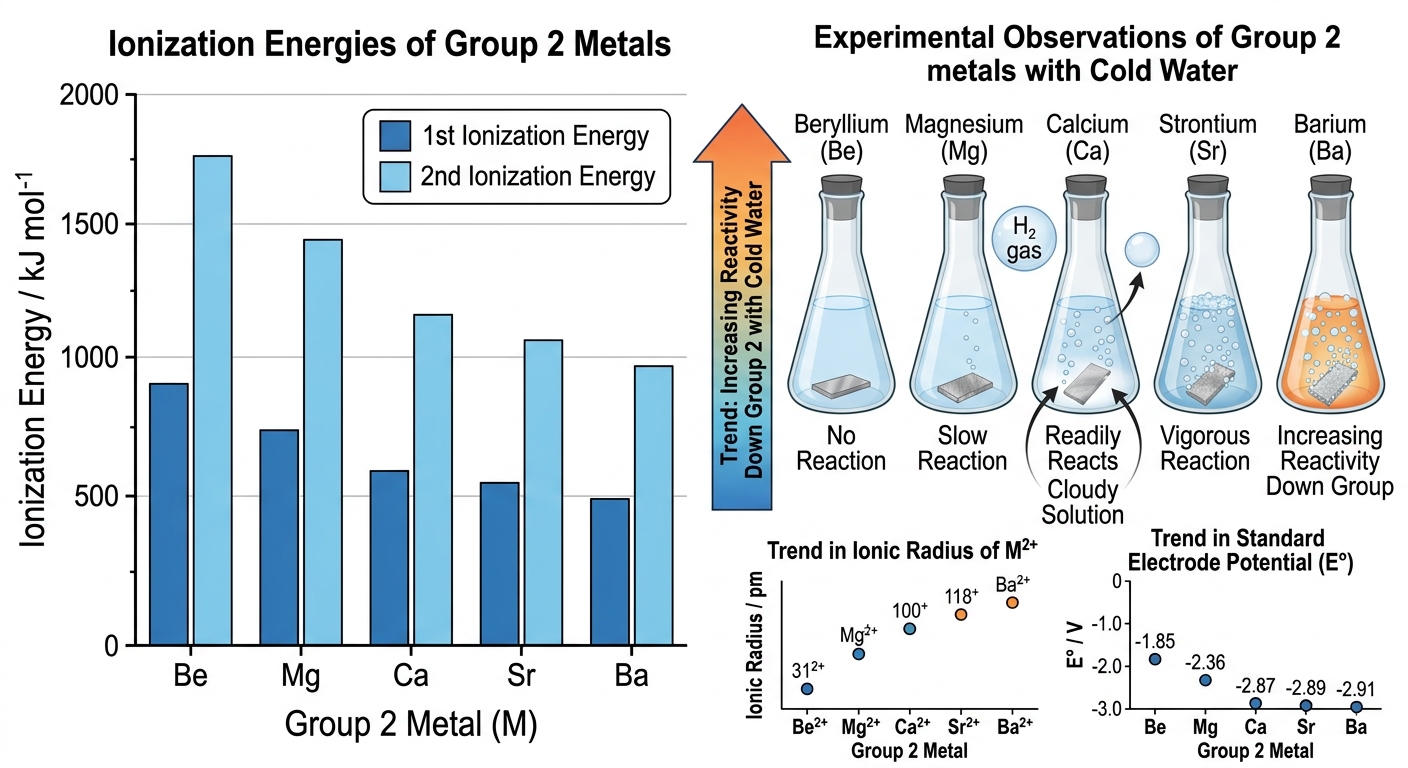
Determine the sum for magnesium and for barium, using the values 738, 1451 and 503, 965 .
Explain the decrease in this sum down the group.
Write an equation for the reaction of calcium with water and explain why the solution looks cloudy.
Use the ionization energies to explain the trend in reactivity with water shown in the diagram.
Suggest why beryllium shows no reaction even though its ionization energies are only moderately higher than those of magnesium.
revisionprep.com
Summary Answer
Not available for this question.
Model Answer
Not available for this question.
Marking Scheme
Not available for this question.
Examiner Insights
Not available for this question.
Group classification of elements
Some data for Group 1 and Group 17 elements are shown.
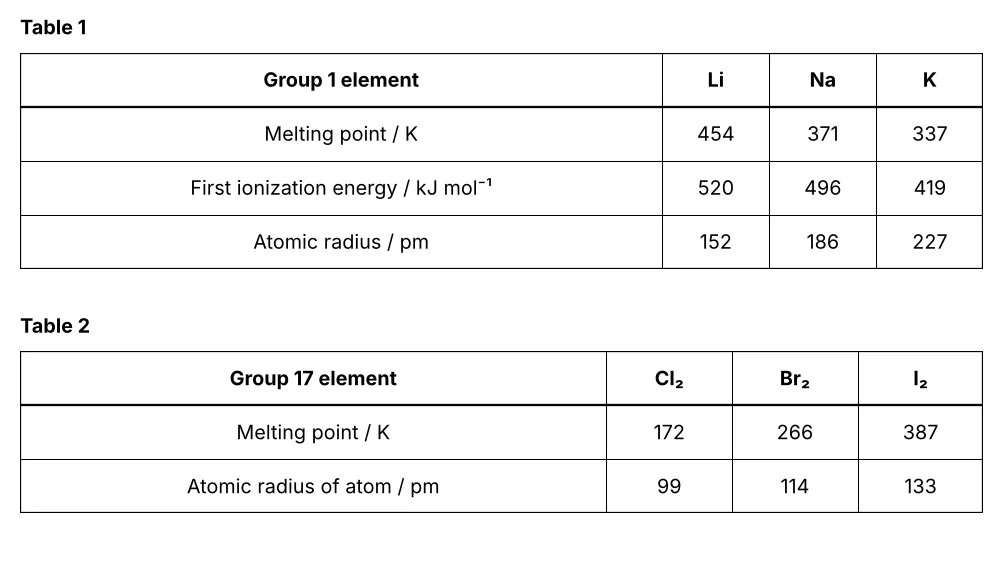
Describe how the melting points change down Group 1 and down Group 17.
Explain why reactivity increases down Group 1 but decreases down Group 17.
Chlorine water is added to aqueous potassium iodide, then hexane is added and the mixture is shaken. State the colour of the upper hexane layer and write the ionic equation for the reaction.
Explain why the melting points of the halogens increase down Group 17, whereas those of the Group 1 metals decrease down the group.
revisionprep.com
Summary Answer
Not available for this question.
Model Answer
Not available for this question.
Marking Scheme
Not available for this question.
Examiner Insights
Not available for this question.
Transition metals and their unique properties
Data
A technician treats a sample of groundwater containing of ions by bubbling chlorine gas through the water. The redox reaction is:
The produced then precipitates as and is removed by filtration.
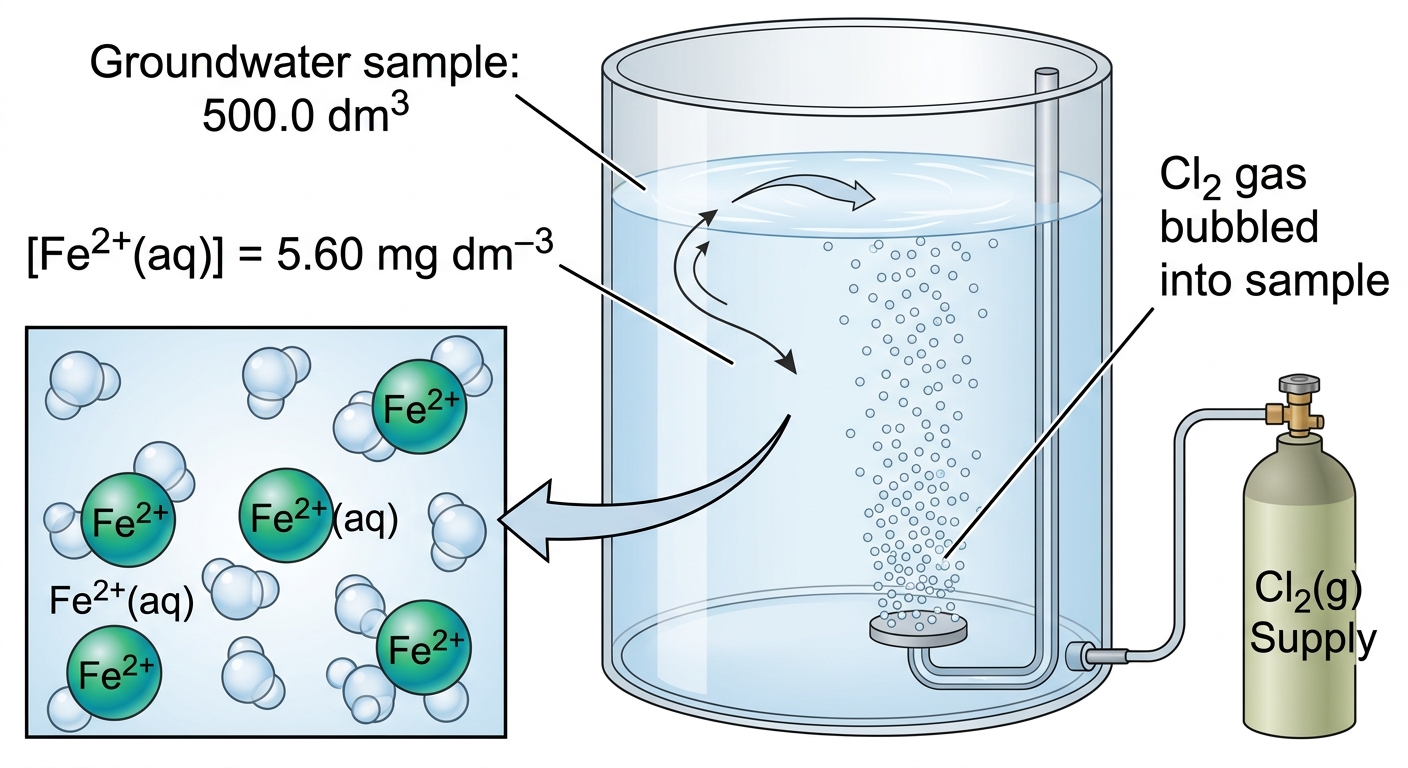
Calculate the minimum mass, in grams, of chlorine gas required to completely oxidize all the in the sample.
The ion is more stable than in aqueous solution. Deduce, with reference to electron configuration, why has greater stability than .
Hydrogen peroxide () can also oxidize to in acidic solution according to: Evaluate the use of chlorine versus hydrogen peroxide as the oxidizing agent for this water treatment process.
revisionprep.com
Summary Answer
Not available for this question.
Model Answer
Not available for this question.
Marking Scheme
Not available for this question.
Examiner Insights
Not available for this question.
That's every free question here — 6 of 306.
+300 more questions, plus Mock Papers & Worksheets, are waiting in Premium.