The Metallic Model · Paper 1 — Free Chemistry HL Practice Questions
Free questions
Open in full, with answers, mark scheme and examiner insights.
Metallic bonding and electron sea model
Which statement about the metallic bonding in iron, a transition element, is correct?
revisionprep.com
Summary Answer
Not available for this question.
Model Answer
Not available for this question.
Marking Scheme
Not available for this question.
Examiner Insights
Not available for this question.
Electrical conductivity of metals
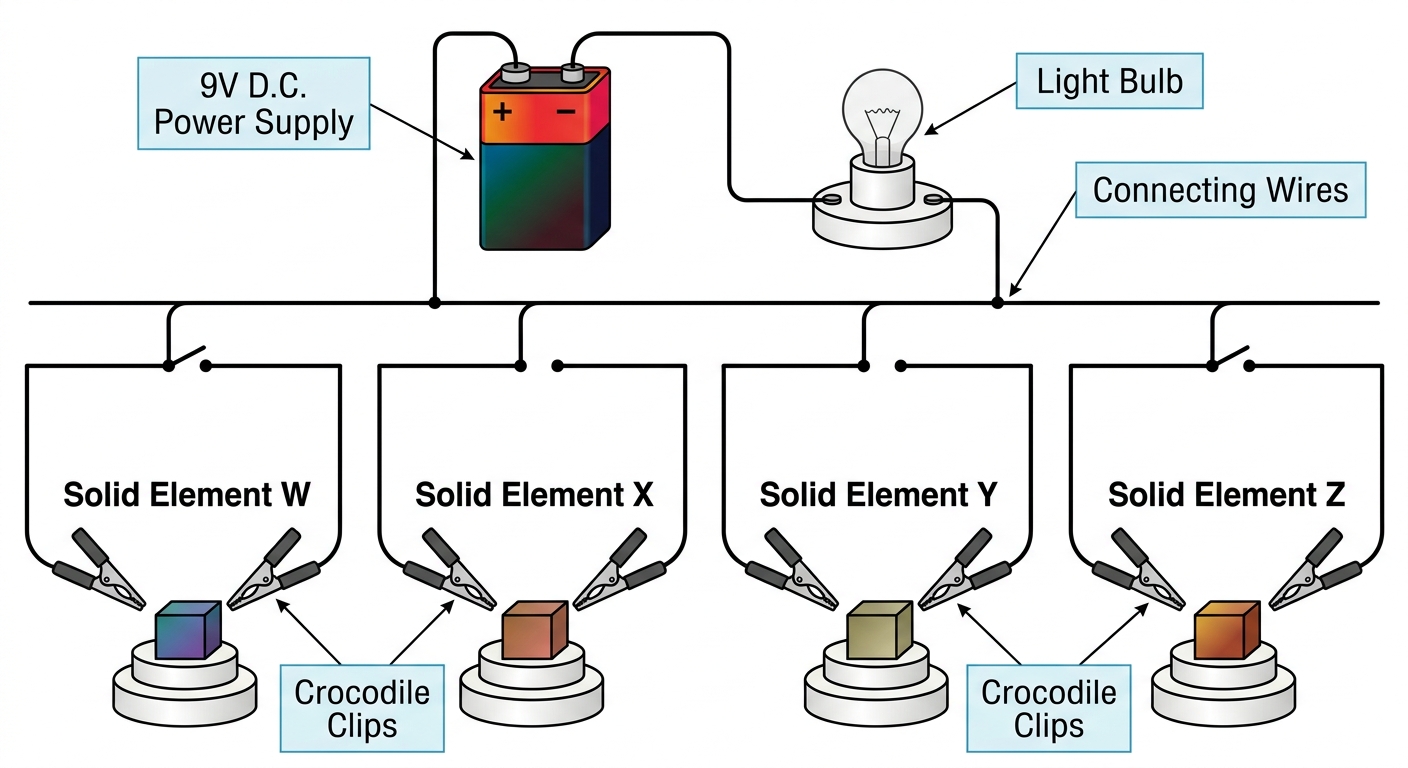
Four solid elements are tested for electrical conductivity at room temperature. Elements W and Y conduct electricity, while elements X and Z do not. Which two elements are most likely to be metals?
revisionprep.com
Summary Answer
Not available for this question.
Model Answer
Not available for this question.
Marking Scheme
Not available for this question.
Examiner Insights
Not available for this question.
Metallic bonding and electron sea model
A teacher plots the melting points of five period 4 metals against the number of delocalized electrons per atom, counting all 3d and 4s electrons. Figure 1 shows the data. Each melting point has an uncertainty of ±20 K.
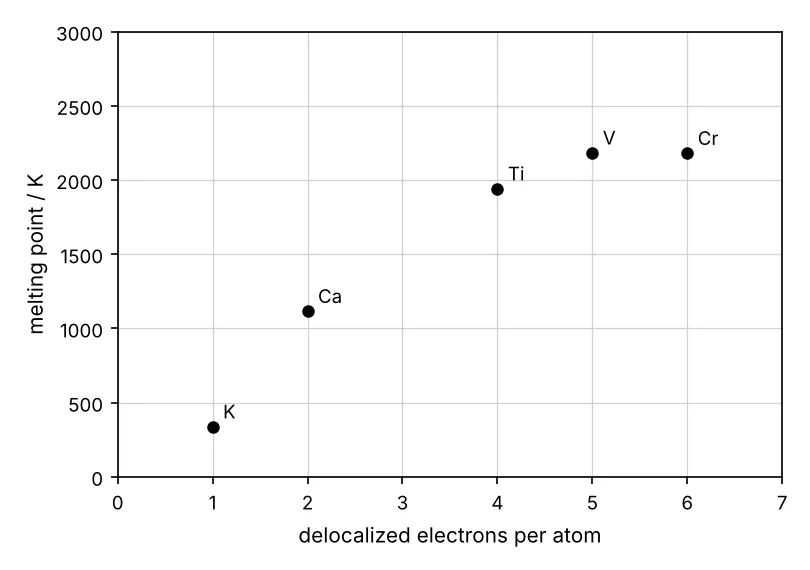
State the relationship between the number of delocalized electrons per atom and the melting point for potassium to vanadium.
Determine the gradient of the straight line through the points for potassium and vanadium.
Use the line to estimate the melting point of a metal whose atoms each delocalize three electrons.
The point for chromium lies below the line through potassium and vanadium. Suggest, with a reason, what this shows about the model in which all 3d and 4s electrons are delocalized.
Calculate the percentage uncertainty in the melting point of calcium.
Explain why titanium has a higher melting point than calcium.
revisionprep.com
Summary Answer
Not available for this question.
Model Answer
Not available for this question.
Marking Scheme
Not available for this question.
Examiner Insights
Not available for this question.
Electrical conductivity of metals
A student measures the resistance of a thin iron wire at four temperatures with the wire in a stirred oil bath. Iron is a transition element. Table 1 shows the data.
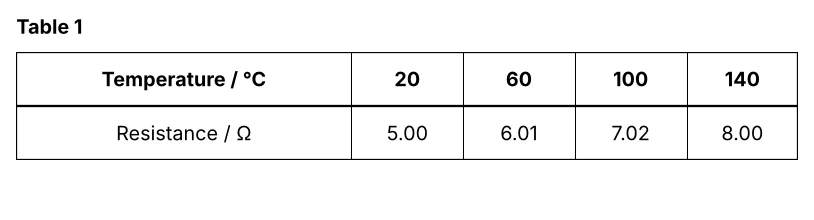
Identify the independent variable.
Calculate the gradient of the graph of resistance against temperature, using the first and last points in Table 1.
Calculate the percentage increase in resistance between and .
Explain the trend in the data using the model of metallic bonding in iron.
Suggest one improvement that would make the readings more reliable.
revisionprep.com
Summary Answer
Not available for this question.
Model Answer
Not available for this question.
Marking Scheme
Not available for this question.
Examiner Insights
Not available for this question.
Metallic bonding and electron sea model
The energy needed to convert one mole of a solid metal into gaseous atoms is a measure of the strength of its metallic bonding. Figure 1 plots the melting points of nine metals against this energy. The line drawn passes through the origin. The melting points have an uncertainty of ±20 K and the energies an uncertainty of ±5 kJ mol⁻¹.
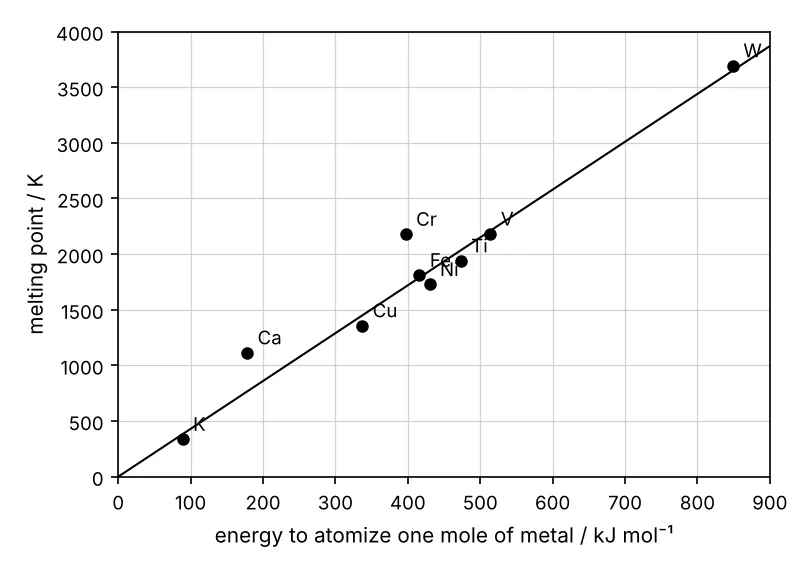
Use two points on the line in Figure 1 to determine its gradient.
Estimate the melting point of a metal that needs to be atomized.
Calculate the percentage by which the measured melting point of calcium is above the value given by the line.
Discuss whether the uncertainties in the data could account for the distance of the calcium point from the line.
Explain why the d-block metals (Ti, V, Cr, Fe, Ni) lie to the right of, and above, potassium and calcium on the graph.
revisionprep.com
Summary Answer
Not available for this question.
Model Answer
Not available for this question.
Marking Scheme
Not available for this question.
Examiner Insights
Not available for this question.
Electrical conductivity of metals
Copper and iron are transition elements. Copper () has an electrical conductivity of and iron () has , although an iron atom can delocalize more electrons than a copper atom. Which statement is the best explanation?
revisionprep.com
Summary Answer
Not available for this question.
Model Answer
Not available for this question.
Marking Scheme
Not available for this question.
Examiner Insights
Not available for this question.
That's every free question here — 6 of 117.
+111 more questions, plus Mock Papers & Worksheets, are waiting in Premium.