You're viewing 1 free preview question for Chemistry HL — subscribe to unlock 149 more, plus the Full Question Bank, Mock Papers & Worksheets.Upgrade
From Models to Materials · Paper 2 — Free Chemistry HL Practice Questions
1ChallengeSAQ-LPhysical properties of materials6 marksPaper 2~9 min

Data
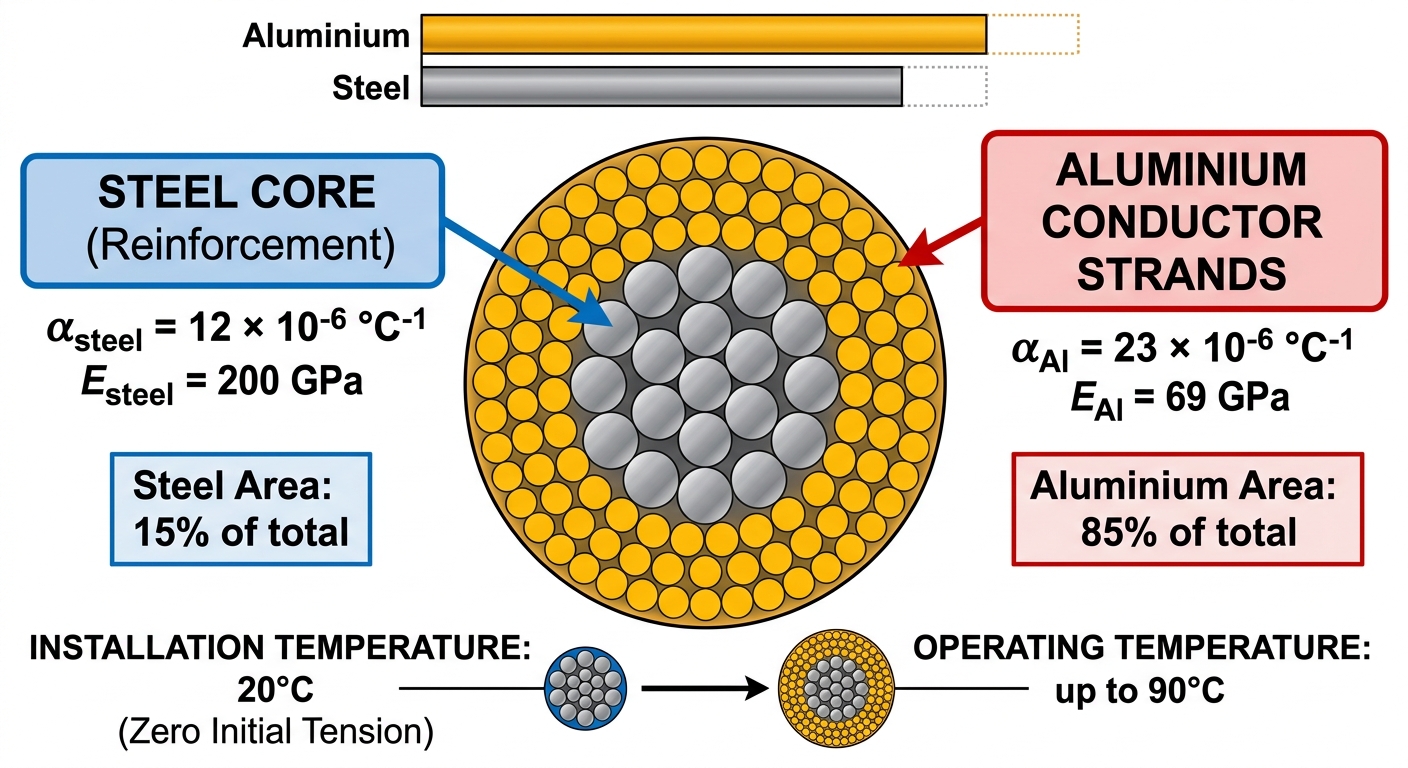
Property — Aluminium — Steel
Coefficient of linear thermal expansion, — —
Young's modulus, — —
A transmission line uses aluminium cables reinforced with a steel core (ACSR — Aluminium Conductor Steel Reinforced). During operation, electrical resistance heats the cable to temperatures up to on hot days. The cable is installed at with zero initial tension. The steel core occupies of the cross-sectional area; aluminium occupies .
(a)
Calculate the free thermal strain, , for each material when the cable heats from to . [2 marks]
(b)
Explain why bonding the two materials together creates internal stress in the cable when the temperature changes. [2 marks]
(c)
Determine which material is under tension and which is under compression at . [1 mark]
(d)
Evaluate the mechanical design of the ACSR cable, referring to the role of each material at both low and high operating temperatures. [2]
(e) Suggest one modification to the cable design that would reduce the internal stress at high temperatures. [1 mark]

Solutions
That's every free question here — 1 of 150.
+149 more questions, plus Mock Papers & Worksheets, are waiting in Premium.