The Ionic Model · Paper 2 — Free Chemistry HL Practice Questions
Free questions
Open in full, with answers, mark scheme and examiner insights.
Properties of ionic compounds
Calcium fluoride, , is found as the mineral fluorite. It melts at , whereas sodium fluoride melts at .
State the formulas of the ions present in calcium fluoride.
Explain why calcium fluoride has a higher melting point than sodium fluoride.
State whether solid calcium fluoride conducts electricity.
revisionprep.com
Summary Answer
Not available for this question.
Model Answer
Not available for this question.
Marking Scheme
Not available for this question.
Examiner Insights
Not available for this question.
Ionic bonding and formation of ions
Sodium sulfide, , is used in the leather industry.
State the full electron configuration of the sulfide ion.
Describe, in terms of electrons, how the ions in sodium sulfide form from sodium and sulfur atoms.
Deduce the formula of aluminium sulfide.
revisionprep.com
Summary Answer
Not available for this question.
Model Answer
Not available for this question.
Marking Scheme
Not available for this question.
Examiner Insights
Not available for this question.
Properties of ionic compounds
The diagram shows a section of an ionic lattice before and after a force moves the top layer along by one ion position.
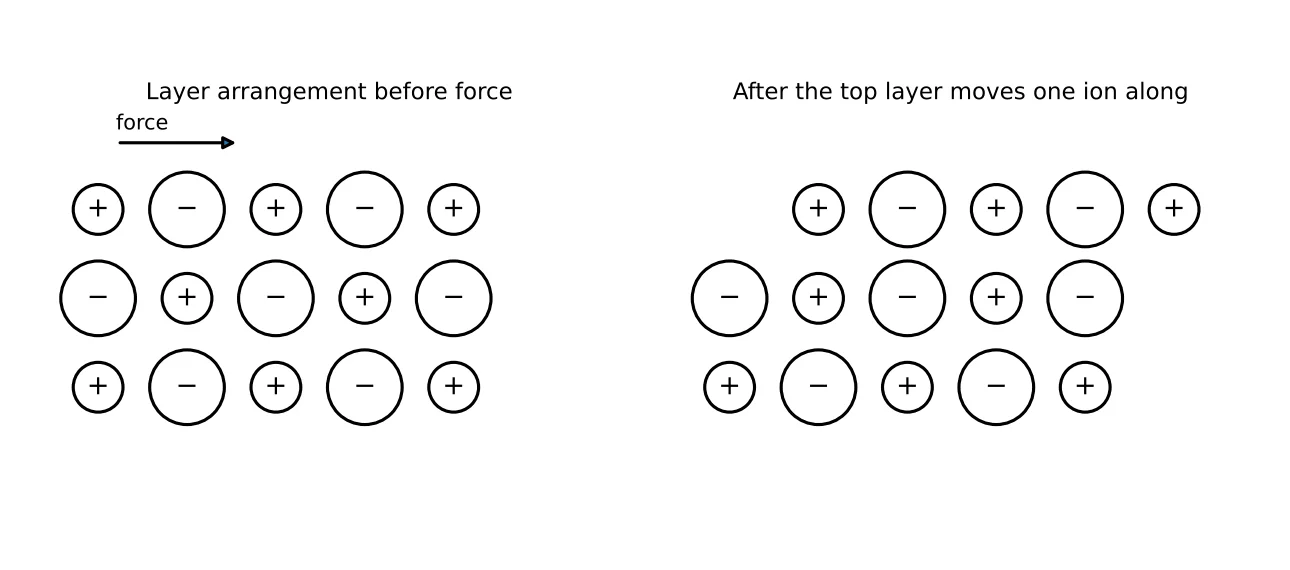
State the type of attraction that holds the ions together before the force is applied.
Explain, using the diagram, why ionic solids are brittle.
A copper wire bends instead of shattering when it is hit. Explain this difference using the bonding in copper.
Suggest why a sodium chloride crystal splits cleanly along flat faces when struck with a blade.
Explain, in terms of the structure and bonding, why sodium chloride conducts electricity when molten but not when solid, whereas copper conducts in both states.
Magnesium oxide is much harder than sodium chloride. Suggest why, in terms of the ions present.
A student compares the brittleness of sodium chloride and magnesium oxide crystals by striking them with a hammer. Outline two ways to make the comparison fair.
revisionprep.com
Summary Answer
Not available for this question.
Model Answer
Not available for this question.
Marking Scheme
Not available for this question.
Examiner Insights
Not available for this question.
Lattice structure in ionic solids
The diagram shows one unit cell of a crystal of an ionic compound of calcium and fluorine. The cell contains ions at the corners and at the centres of the six faces, and eight ions wholly inside the cell.
A corner ion is shared between unit cells. A face-centre ion is shared between unit cells.
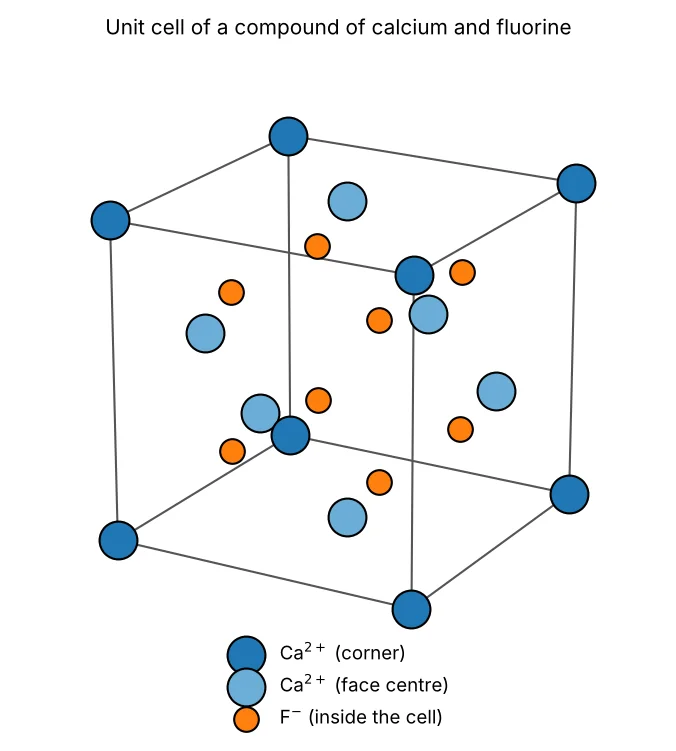
Calculate the number of ions that belong to one unit cell.
State the number of ions that belong to one unit cell.
Deduce the empirical formula of the compound.
Determine the total charge of the ions in the unit cell, and hence state whether the cell is neutral.
Explain why the ratio of ions in the unit cell is the same as the ratio of ions in a whole crystal.
revisionprep.com
Summary Answer
Not available for this question.
Model Answer
Not available for this question.
Marking Scheme
Not available for this question.
Examiner Insights
Not available for this question.
Lattice structure in ionic solids
Sodium chloride, NaCl, and caesium chloride, CsCl, are both ionic compounds with the formula MCl.
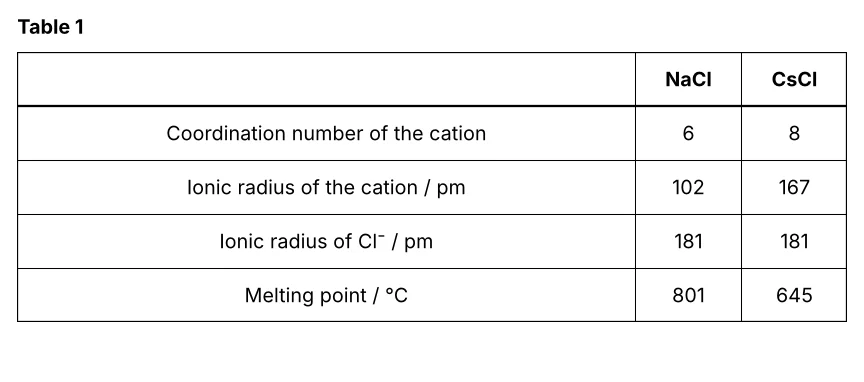
State the number of nearest neighbours of the chloride ion in each compound.
State two features that are the same in both lattices.
Explain why the cation in CsCl has a higher number of nearest neighbours than the cation in NaCl.
Predict whether the lattice enthalpy of CsCl is greater or smaller than that of NaCl, and explain how this agrees with the melting points.
Calculate the sum of the ionic radii of the cation and in NaCl and in CsCl.
Explain why CsCl melts at a lower temperature than NaCl although each ion has more nearest neighbours.
revisionprep.com
Summary Answer
Not available for this question.
Model Answer
Not available for this question.
Marking Scheme
Not available for this question.
Examiner Insights
Not available for this question.
Conductivity and solubility of ionic compounds
Sodium chloride, NaCl, dissolves readily in water, but calcium carbonate, , which is also an ionic compound, is almost insoluble. has a radius of and carries a charge; has a radius of and carries a charge.
Describe how water molecules interact with the ions when NaCl dissolves.
Explain, in terms of the attractions between the ions in the lattice and the attractions between the ions and water molecules, why NaCl is soluble but is almost insoluble.
Predict, with a reason, how the conductivity of a saturated solution compares with that of a saturated NaCl solution.
The solubility of sodium chloride at is per of water. Calculate the amount, in mol, of sodium chloride in of water in a saturated solution.
Explain why a saturated sodium chloride solution conducts better than a sodium chloride solution.
revisionprep.com
Summary Answer
Not available for this question.
Model Answer
Not available for this question.
Marking Scheme
Not available for this question.
Examiner Insights
Not available for this question.
That's every free question here — 6 of 159.
+153 more questions, plus Mock Papers & Worksheets, are waiting in Premium.