The Nuclear Atom · Paper 1 — Free Chemistry HL Practice Questions
Free questions
Open in full, with answers, mark scheme and examiner insights.
Structure of the atom: Protons, neutrons, electrons
In the gold foil experiment, a very small fraction of alpha particles was deflected through angles greater than . Which conclusion follows directly from this observation?
revisionprep.com
Summary Answer
Not available for this question.
Model Answer
Not available for this question.
Marking Scheme
Not available for this question.
Examiner Insights
Not available for this question.
Atomic number, mass number, isotopes
The relative isotopic mass of an isotope is its mass compared with one twelfth of the mass of a carbon-12 atom. Table 1 gives the relative isotopic masses of six isotopes, measured by a laboratory.
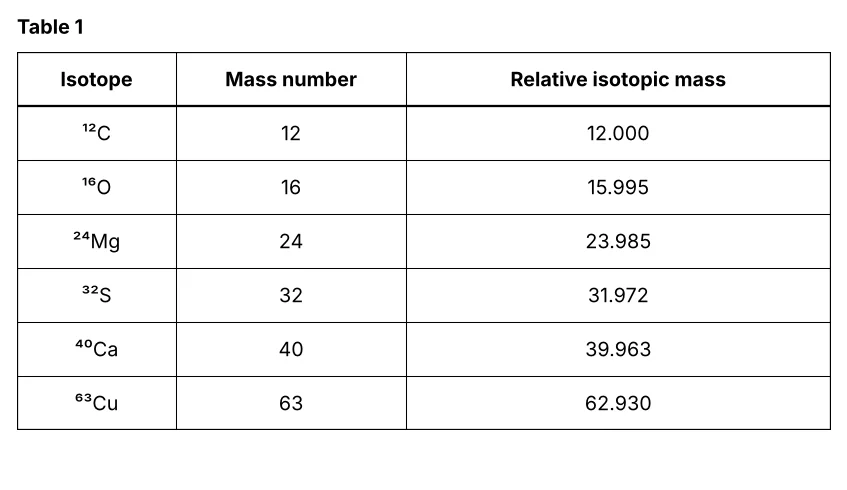
Determine the gradient of a graph of relative isotopic mass against mass number, using the data for ¹²C and ⁶³Cu.
State what a gradient this close to 1 shows about the relative isotopic mass and the mass number of an isotope.
Calculate the percentage difference between the mass number and the relative isotopic mass of ⁶³Cu, taking the relative isotopic mass as the accurate value.
revisionprep.com
Summary Answer
Not available for this question.
Model Answer
Not available for this question.
Marking Scheme
Not available for this question.
Examiner Insights
Not available for this question.
Structure of the atom: Protons, neutrons, electrons
In a repeat of the gold foil experiment, foils of different thickness are used. For each foil, 100 000 alpha particles are fired at the foil and the number deflected by more than 90° is counted. Figure 1 shows the results, with a straight line of best fit drawn through the origin.
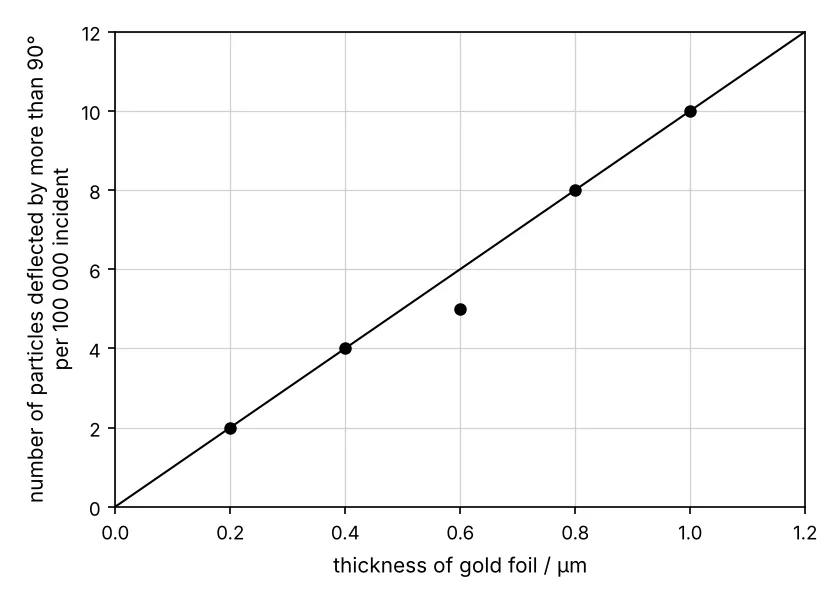
Determine the gradient of the line of best fit in Figure 1, with its units.
Predict the number of particles deflected by more than 90° for a foil of thickness 0.5 μm.
Explain why the number of large deflections is proportional to the thickness of the foil.
The point for the 0.6 μm foil lies below the line. Calculate the percentage difference between the measured count and the value given by the line.
Explain why this point does not show that the nuclear model of the atom is wrong.
Suggest one improvement that would reduce the effect of this random error.
revisionprep.com
Summary Answer
Not available for this question.
Model Answer
Not available for this question.
Marking Scheme
Not available for this question.
Examiner Insights
Not available for this question.
Atomic number, mass number, isotopes
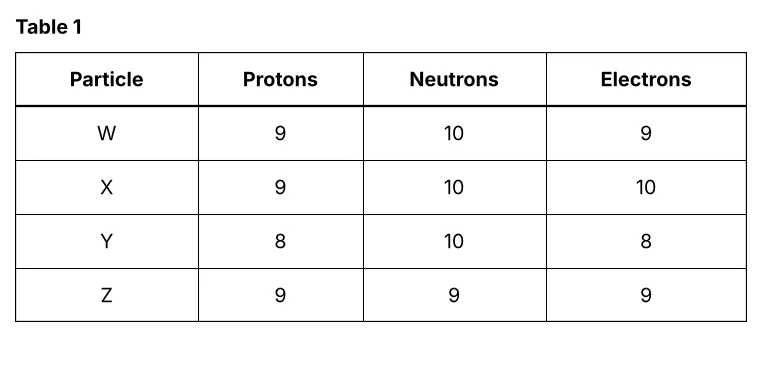
The table shows the composition of four particles, W, X, Y and Z.
Which two particles are isotopes of the same element?
revisionprep.com
Summary Answer
Not available for this question.
Model Answer
Not available for this question.
Marking Scheme
Not available for this question.
Examiner Insights
Not available for this question.
Structure of the atom: Protons, neutrons, electrons
An ion has 28 electrons and a mass number of 65. How many neutrons are in the nucleus of X?
revisionprep.com
Summary Answer
Not available for this question.
Model Answer
Not available for this question.
Marking Scheme
Not available for this question.
Examiner Insights
Not available for this question.
Atomic number, mass number, isotopes
Silicon enriched in ²⁸Si is used in the manufacture of quantum computing devices. Natural silicon contains ²⁸Si, ²⁹Si and ³⁰Si. In every enriched sample the ratio of ²⁹Si atoms to ³⁰Si atoms is the same as in natural silicon, 4.67 : 3.10. Table 1 gives the relative atomic masses calculated for four samples with different abundances of ²⁸Si. Take the relative mass of each isotope to be its mass number.
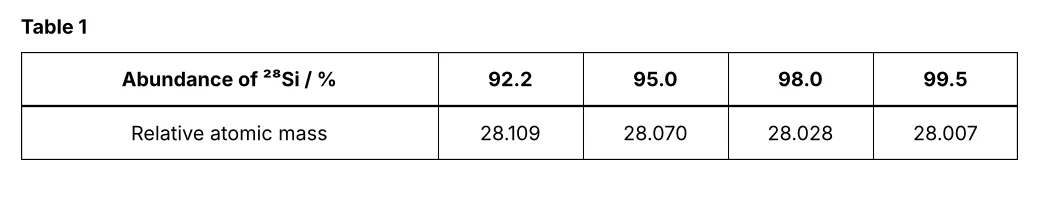
Determine the gradient of a graph of relative atomic mass against the percentage abundance of ²⁸Si, using the first and last columns of Table 1.
Predict the relative atomic mass of a sample with 99.9% ²⁸Si, by using the gradient.
Determine the percentage abundance of ²⁸Si in a sample with a relative atomic mass of 28.050.
A laboratory can measure a relative atomic mass to ±0.001. Determine the corresponding uncertainty in the percentage abundance of ²⁸Si.
Evaluate whether the laboratory could distinguish between samples with 99.5% and 99.9% ²⁸Si.
State why enriched and natural silicon have the same chemical properties.
revisionprep.com
Summary Answer
Not available for this question.
Model Answer
Not available for this question.
Marking Scheme
Not available for this question.
Examiner Insights
Not available for this question.
That's every free question here — 6 of 91.
+85 more questions, plus Mock Papers & Worksheets, are waiting in Premium.