You're viewing 1 free preview question for Chemistry HL — subscribe to unlock 114 more, plus the Full Question Bank, Mock Papers & Worksheets.Upgrade
Electron Configurations · Paper 2 — Free Chemistry HL Practice Questions
1ChallengeSAQ-LElectron arrangement and atomic orbitals7 marksPaper 2~11 min

Data
- Speed of light:
- Planck constant:
- Rydberg constant:
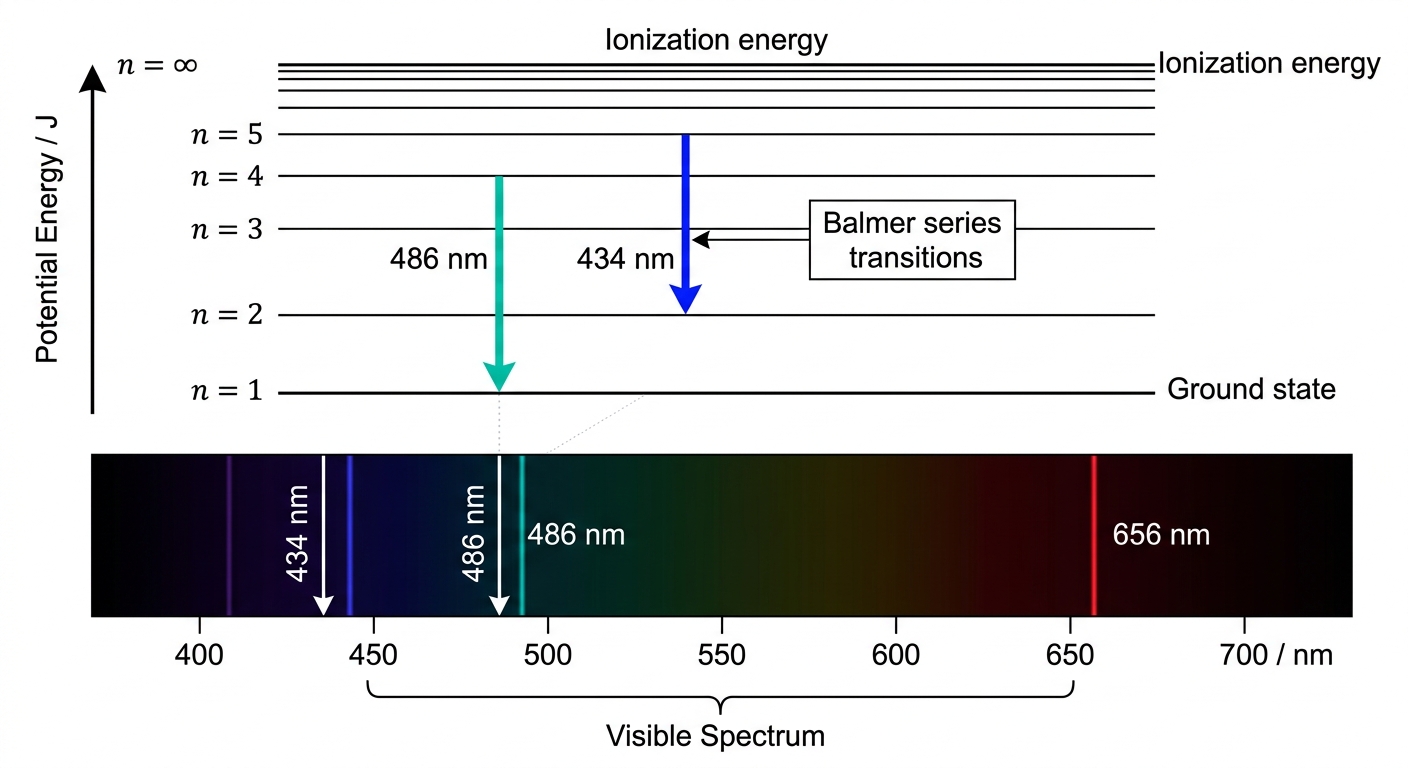
A student investigates the emission spectrum of atomic hydrogen. A spectral line is observed at , corresponding to the transition from to (Balmer series).
(a)
Calculate the energy, in J, of the photon emitted during the to transition. [2 marks]
(b)
Using the Rydberg equation, determine the value of for a transition that emits a photon of wavelength (another line in the Balmer series, where ). [2 marks]
(c)
State the physical significance of the integer in the quantum mechanical model of the hydrogen atom. [1 mark]
(d)
Evaluate two limitations of the Bohr model of the hydrogen atom when applied to multi-electron atoms such as iron (Fe, ). In your answer, refer to atomic orbitals and the quantum mechanical model.
Relevant equations:
[2 marks]

Solutions
That's every free question here — 1 of 115.
+114 more questions, plus Mock Papers & Worksheets, are waiting in Premium.