Ideal Gases · Paper 2 — Free Chemistry HL Practice Questions
Free questions
Open in full, with answers, mark scheme and examiner insights.
Ideal gas law (PV = nRT)
Dinitrogen monoxide decomposes:
A rigid container holds of at . The initial pressure is .
Calculate the pressure when the reaction is complete, at the same temperature.
Explain, with reference to the ideal gas equation, why the pressure increases as the reaction proceeds.
revisionprep.com
Summary Answer
Not available for this question.
Model Answer
Not available for this question.
Marking Scheme
Not available for this question.
Examiner Insights
Not available for this question.
Applications of the ideal gas law
The atmosphere of Mars has a pressure of and an average temperature of . Its mole fraction of carbon dioxide is . A device on a Mars rover makes oxygen from atmospheric carbon dioxide:
Calculate the amount of carbon dioxide in of the Martian atmosphere.
Calculate the volume of Martian atmosphere that must be processed to make of oxygen, assuming complete conversion.
The oxygen is stored at in a tank. Calculate the pressure in the tank.
revisionprep.com
Summary Answer
Not available for this question.
Model Answer
Not available for this question.
Marking Scheme
Not available for this question.
Examiner Insights
Not available for this question.
Ideal gas law (PV = nRT)
A student measures the volume of a fixed amount of gas at a constant pressure of .
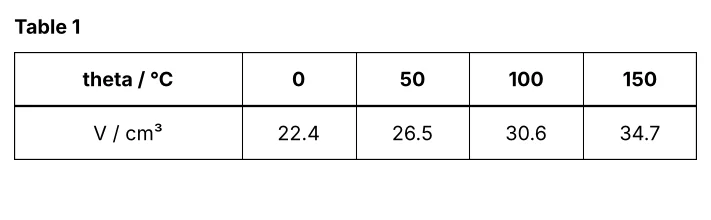
Show that is proportional to the absolute temperature, using the first and last results.
Predict the volume of the gas at .
Calculate the amount, in mol, of gas in the sample.
At the measured volume is . Explain why this is smaller than the volume predicted by the ideal gas model.
revisionprep.com
Summary Answer
Not available for this question.
Model Answer
Not available for this question.
Marking Scheme
Not available for this question.
Examiner Insights
Not available for this question.
Gas laws: Boyle's law, Charles's law, Avogadro's law
A student measures the pressure and volume of a fixed amount of nitrogen at .
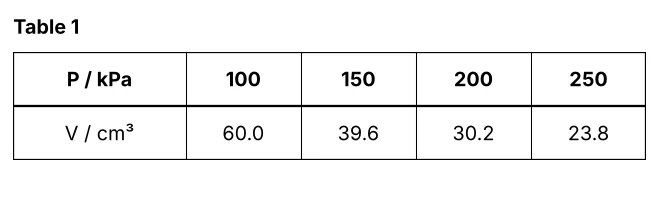
Calculate for each result and the mean value of , with units.
Determine the amount, in mol, of nitrogen.
Deduce whether nitrogen behaves as an ideal gas over this range, using your answer to (a).
revisionprep.com
Summary Answer
Not available for this question.
Model Answer
Not available for this question.
Marking Scheme
Not available for this question.
Examiner Insights
Not available for this question.
Gas laws: Boyle's law, Charles's law, Avogadro's law
A student investigates how closely dinitrogen monoxide, a gas used as a mild anaesthetic, follows the ideal gas equation. A gas syringe contains of dinitrogen monoxide, , at and .
Calculate the volume of the gas, in .
The pressure is increased to at constant temperature. Calculate the new volume predicted by the ideal gas equation.
The measured volume at is about smaller than your answer to (b). Explain this with reference to the molecules of .
Predict, with a reason, whether the percentage deviation is larger or smaller at .
At and the measured volume is . Calculate the compression factor and state what its value shows.
revisionprep.com
Summary Answer
Not available for this question.
Model Answer
Not available for this question.
Marking Scheme
Not available for this question.
Examiner Insights
Not available for this question.
Real gases vs ideal gases
of each of three gases is held in a steel vessel at and the pressure is measured.
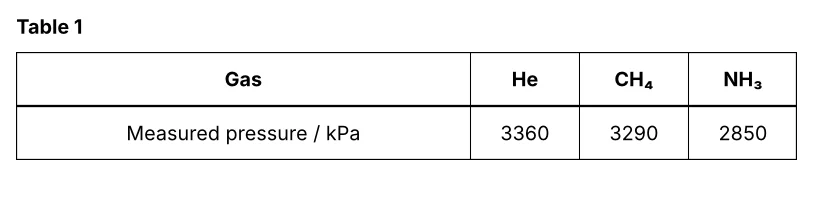
Calculate the pressure predicted by the ideal gas equation.
Calculate the compression factor for each gas.
Explain why for ammonia is much lower than for methane.
Explain why for helium is greater than 1.
Predict, with a reason, how for ammonia would change if the experiment were repeated at .
An engineer uses to find the amount of ammonia in a tank at and per of tank. Calculate the percentage error in the amount, and evaluate whether the ideal gas equation is acceptable for this gas.
revisionprep.com
Summary Answer
Not available for this question.
Model Answer
Not available for this question.
Marking Scheme
Not available for this question.
Examiner Insights
Not available for this question.
That's every free question here — 6 of 151.
+145 more questions, plus Mock Papers & Worksheets, are waiting in Premium.