You're viewing free preview questions. Upgrade to access more Chemistry HL questions.Upgrade
Introduction to the Particulate Nature of Matter · Paper 2 — Free Chemistry HL Practice Questions
1MasterySAQ-SSolid, liquid, gas phases and changes of state5 marksPaper 2~8 min

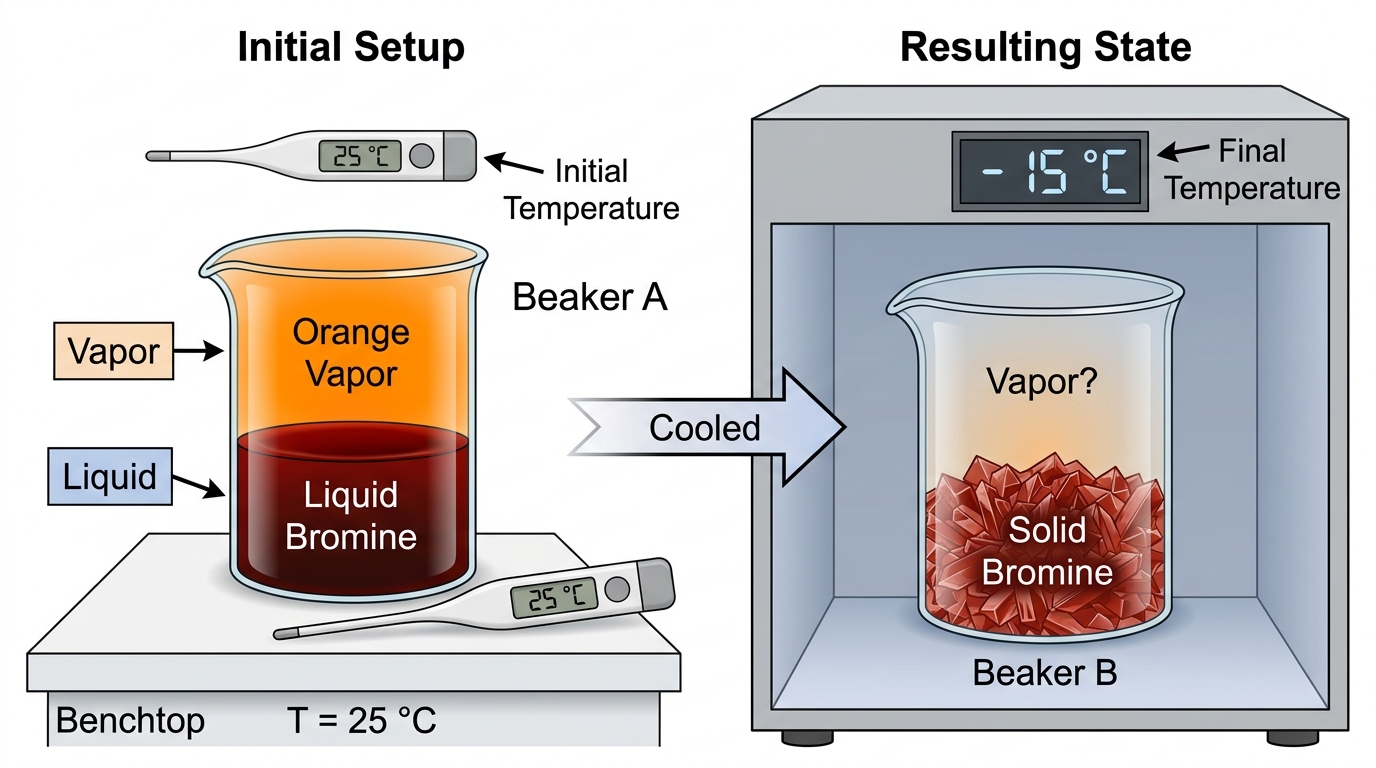
A student examines a sample of bromine, , at room temperature (). Bromine is a dark red liquid that evaporates readily, producing a toxic orange vapour. The melting point of bromine is and its boiling point is .
(a)
State the name of the change of state occurring when liquid bromine at produces orange vapour. [1 mark]
(b)
Describe the changes in particle arrangement and energy as liquid bromine solidifies. [2 marks]
(c)
A student claims that a sample of bromine stored at is entirely in the gaseous state. Evaluate this claim, referring to the data above. [2 marks]

Solutions
2MasterySAQ-SSolid, liquid, gas phases and changes of state8 marksPaper 2~12 min
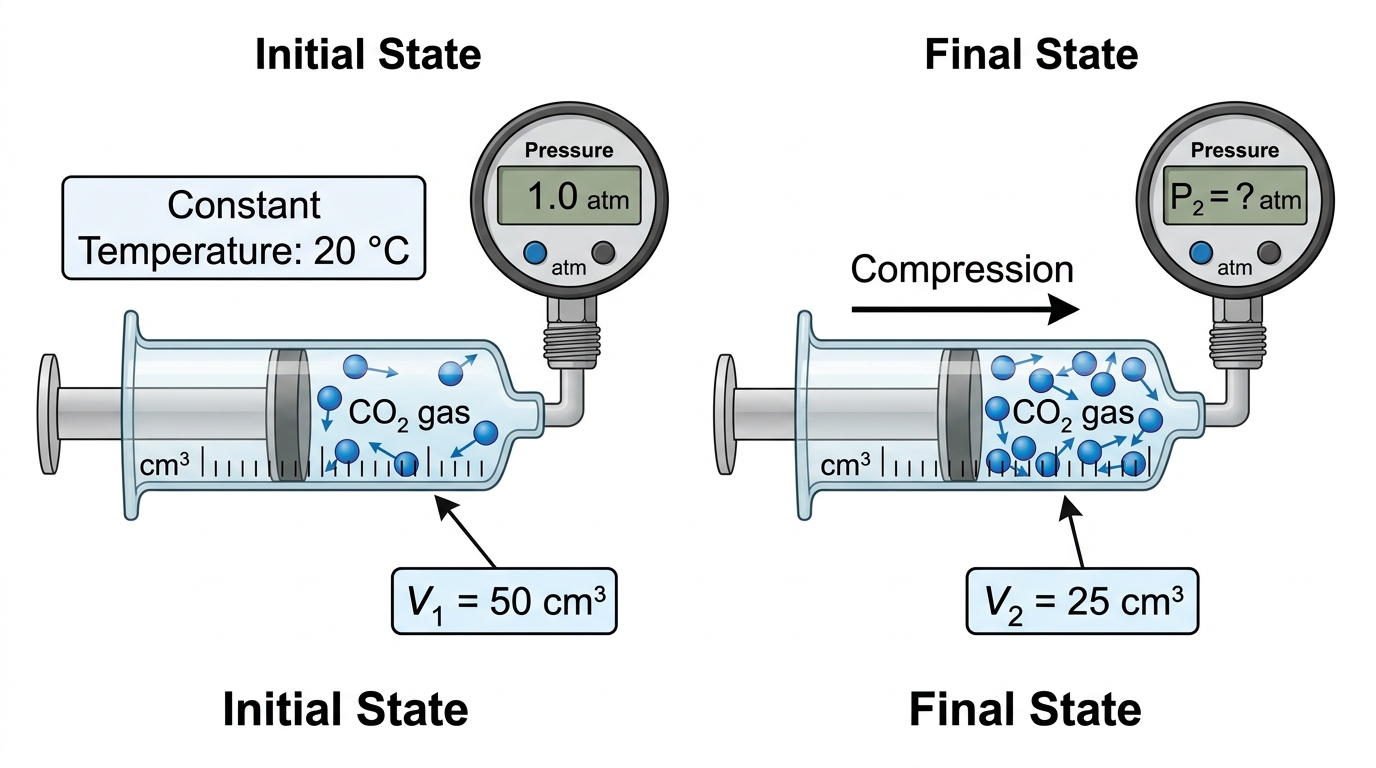
A student compresses a sample of carbon dioxide gas in a syringe at a constant temperature of . The initial volume is at a pressure of .
(a)
State Boyle's Law as a mathematical expression, defining all symbols used. [1 mark]
(b)
Calculate the pressure of the gas after the volume is reduced to , assuming ideal behaviour. [2 marks]
(c)
Using kinetic molecular theory, explain why reducing the volume at constant temperature causes the pressure to increase. [2 marks]
(d)
At very high pressures, the actual pressure of deviates from the value predicted by Boyle's Law. Deduce and explain the direction of this deviation for , referring to intermolecular forces and molecular volume. [3 marks]
Solutions
3MasterySAQ-SSolid, liquid, gas phases and changes of state5 marksPaper 2~8 min
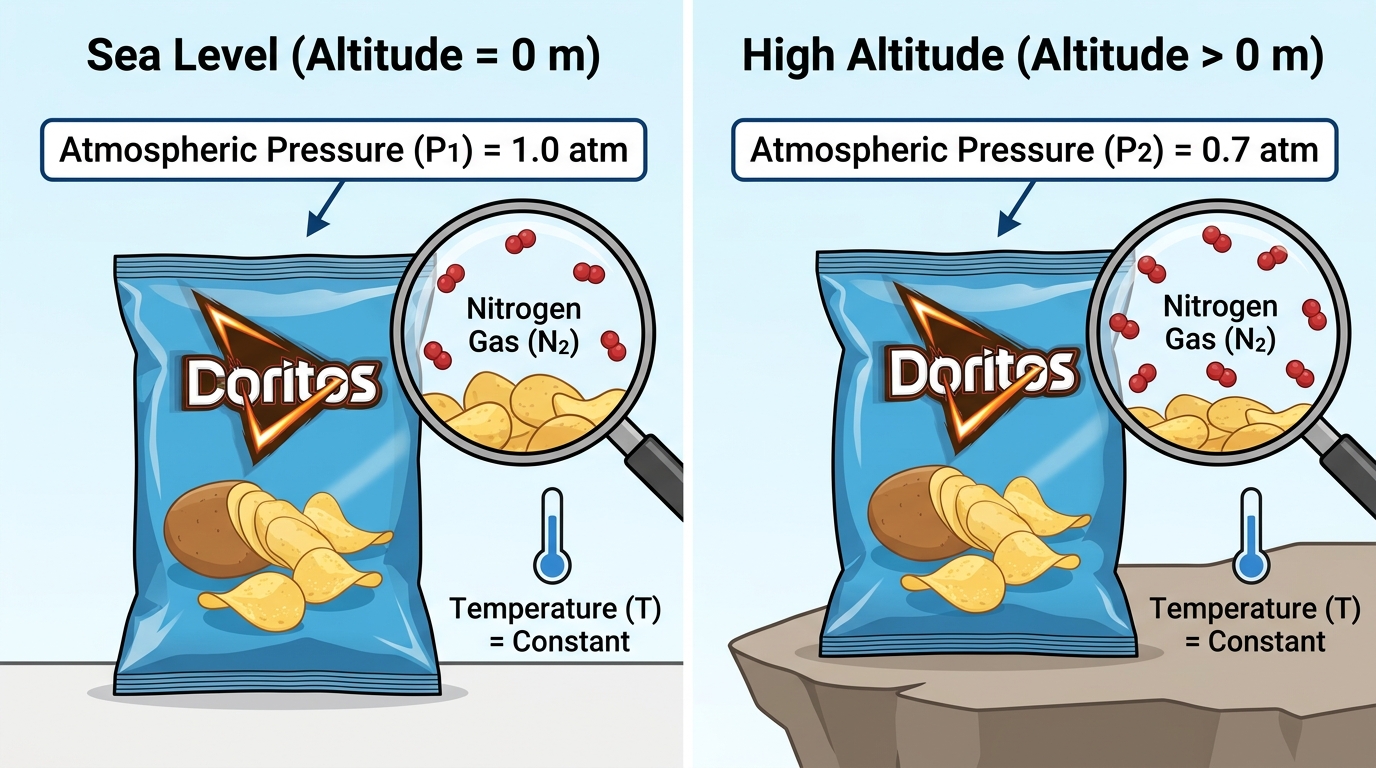
A student seals a bag of chips at sea level where the atmospheric pressure is . The sealed portion of the bag contains of nitrogen gas occupying a volume of at . The student hikes to high altitude where the atmospheric pressure drops to at the same temperature.
(a)
State Boyle's Law, including its mathematical form. [1 mark]
(b)
Explain why the bag puffs up when the student reaches high altitude. [2 marks]
(c)
Calculate the volume of nitrogen gas in the bag at high altitude, and hence determine the percentage increase in volume of the gas. [2 marks]
Solutions
4MasterySAQ-SSolid, liquid, gas phases and changes of state5 marksPaper 2~8 min
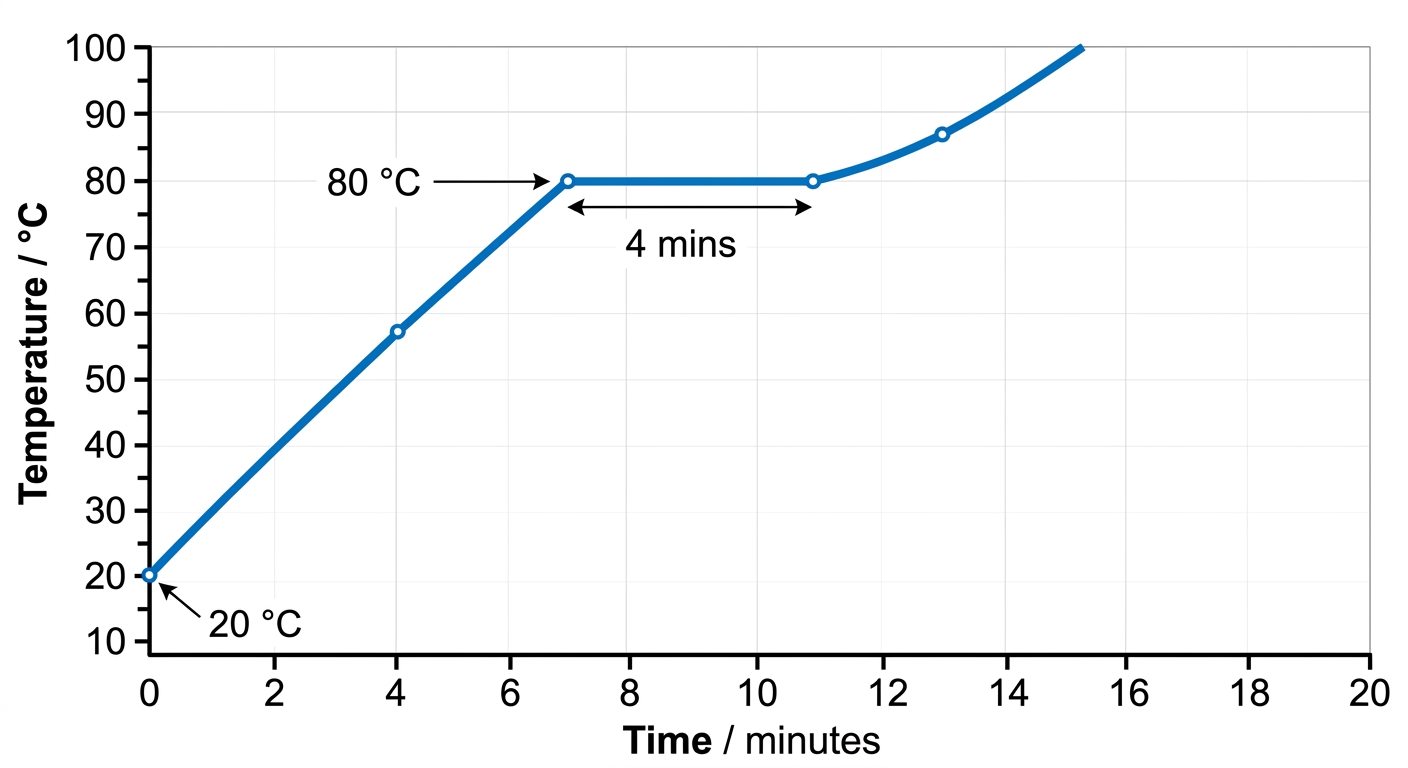
A student determines the melting point of naphthalene (, molar mass ). A test tube of solid naphthalene is placed in a hot water bath and its temperature recorded every minute. The temperature rises steadily from to , remains constant at for 4 minutes, then rises again.
(a)
State the change of state occurring during the 4-minute constant-temperature period. [1 mark]
(b)
Explain, in terms of intermolecular forces and particle energy, why the temperature remains constant during this period. [2 marks]
(c)
Calculate the energy transferred when of liquid naphthalene solidifies at . The specific latent heat of fusion of naphthalene is . State whether this energy is released to or absorbed from the surroundings. [2 marks]
Solutions
5MasterySAQ-SSolid, liquid, gas phases and changes of state5 marksPaper 2~8 min
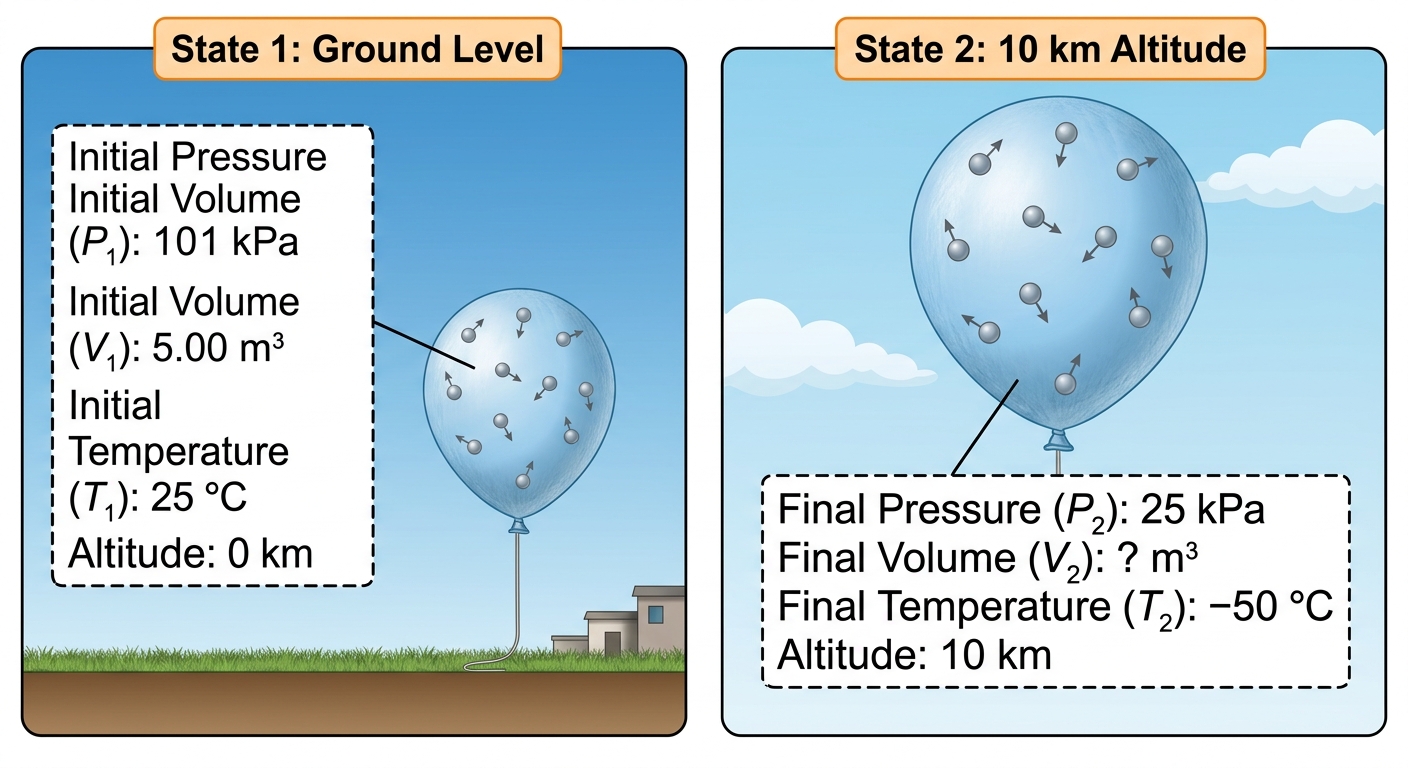
A weather balloon is filled with of helium gas at ground level where the pressure is and the temperature is . As the balloon rises, the external pressure decreases and the balloon expands. At an altitude of , the pressure is and the temperature is .
(a)
State how the average kinetic energy of the helium particles changes as the balloon rises from ground level to altitude. [1 mark]
(b)
Calculate the volume of the balloon at altitude, assuming the balloon is flexible and the gas behaves ideally. [2 marks]
(c)
Using your answer to (b) and the combined gas law, deduce whether the decrease in pressure or the decrease in temperature has the greater effect on the volume change. Support your answer with a numerical comparison. [2 marks]
Solutions
6MasterySAQ-SProperties of matter4 marksPaper 2~6 min
A student investigates the physical properties of three substances, X, Y, and Z, at and .
- Substance X: brittle, white crystalline solid; does not conduct electricity when solid, but its aqueous solution conducts electricity.
- Substance Y: shiny, grey solid; conducts electricity and can be hammered into thin sheets without breaking.
- Substance Z: colourless liquid; does not conduct electricity, boiling point , immiscible with water.
(a)
State the type of bonding present in substance X. [1 mark]
(b)
Explain, using the model of metallic bonding, why substance Y can be hammered into thin sheets without fracturing. [2 marks]
(c)
(i) Predict whether substance Z is soluble in water. [1]
(ii) Justify your prediction in (c)(i) with reference to polarity. [1 mark]
(ii) Justify your prediction in (c)(i) with reference to polarity. [1 mark]
Solutions
7MasterySAQ-SProperties of matter6 marksPaper 2~9 min
A student measures the density of a sample of liquid ethanol () at and finds it to be . The student then cools the ethanol to , where it becomes a solid with a density of .
(a)
Explain why the density of ethanol increases when it changes from liquid to solid. [2 marks]
(b)
State two physical properties, other than density, that differ between liquid ethanol and solid ethanol, and for each property state which phase has the greater value. [2 marks]
(c)
A sample of ethanol has a mass of .
(i) Calculate the volume, in , occupied by this sample in the liquid state at . [1]
(ii) Determine the percentage decrease in volume when this sample solidifies at . [2 marks]
(ii) Determine the percentage decrease in volume when this sample solidifies at . [2 marks]
Solutions
8MasterySAQ-SSolid, liquid, gas phases and changes of state6 marksPaper 2~9 min
A student investigates the properties of a pure liquid substance, X. The student places a sample of liquid X into an open beaker and heats it gently, recording temperature every 30 seconds. The temperature rises steadily from to , then remains constant at for several minutes despite continued heating. After all the liquid has disappeared, the temperature of the vapour begins to rise again.
(a)
State the boiling point of substance X at . [1 mark]
(b)
Explain, in terms of kinetic molecular theory and intermolecular forces, why the temperature of substance X remains constant at during the change of state. [2 marks]
(c)
A separate sample of liquid X is placed in a sealed rigid container at . The container is then heated to . Deduce and explain whether liquid X will be present in the container at . [3 marks]
Solutions
9MasterySAQ-SMolecular theory and the nature of matter6 marksPaper 2~9 min
A student investigates two solid substances: Substance X (silicon dioxide, ) and Substance Y (iodine, ). Both are pure substances at room temperature ().
Property — Substance X — Substance Y
Melting point — —
Electrical conductivity (solid) — none
Vapour colour — colourless — purple
Electronegativity values: , ,
(a)
Deduce the type of bonding and structure present in Substance X. [1 mark]
(b)
Explain why Substance Y has a much lower melting point than Substance X, with reference to the forces that must be overcome during melting. [3 marks]
(c)
The vapour of Substance Y is purple. Deduce the molecular formula of the species present in the vapour and explain what the purple colour indicates about the electronic structure of the molecule. [2 marks]
Solutions
10MasterySAQ-SProperties of matter5 marksPaper 2~8 min
Oxygen gas, , and ozone gas, , are both allotropes of oxygen. At room temperature and pressure, oxygen is a colourless gas while ozone is a pale blue gas with a distinct sharp odour.
(a)
State the type of bonding present in both and . [1 mark]
(b)
Explain why ozone has a higher boiling point () than oxygen (). [2 marks]
(c)
Predict, with a reason, whether liquid ozone would conduct electricity. [2 marks]
Solutions
11MasterySAQ-SProperties of matter4 marksPaper 2~6 min
A student investigates the physical properties of three unknown substances A, B, and C at . The following observations are recorded:
- Substance A: brittle solid, melting point , non-conductor in solid state, conducts electricity when molten.
- Substance B: soft solid, melting point , non-conductor in solid state and when molten.
- Substance C: shiny solid, can be hammered into sheets, conducts electricity in solid state, melting point .
(a)
Deduce the type of bonding present in substance A. Justify your deduction using two pieces of evidence from the observations. [2 marks]
(b)
Identify the type of structure and bonding present in substance B. [1 mark]
(c)
Explain why substance B does not conduct electricity when molten. [1 mark]
Solutions
12MasterySAQ-SProperties of matter6 marksPaper 2~9 min
Liquid bromine, , and liquid mercury, Hg(l), are both dense liquids at room temperature.
(a)
State the type of bonding present in . [1 mark]
(b)
State the type of bonding present in Hg. [1 mark]
(c)
Explain why the boiling point of mercury () is much higher than that of bromine (), and predict, with reasoning, whether solid mercury or solid bromine would have the higher electrical conductivity. [4 marks]
Solutions
13MasterySAQ-SMolecular theory and the nature of matter6 marksPaper 2~9 min
Data
; ; volume of a sphere *
This question is about the particulate nature of matter and the limitations of early atomic models.
Dalton's atomic model (1808) proposed that atoms are solid, indivisible spheres. Thomson's "plum pudding" model (1897) revised this by suggesting atoms contain negatively charged electrons embedded in a diffuse positive sphere of charge.
Data from Geiger–Marsden experiment:
- A beam of alpha particles is directed at a thin gold foil
- Most alpha particles pass straight through with negligible deflection
- Approximately 1 in 8000 alpha particles are deflected by more than
- Alpha particle charge:
- Gold atomic number:
- Radius of gold atom:
- Radius of gold nucleus:
*
(a)
State one observation from the Geiger–Marsden experiment that directly contradicts Thomson's plum pudding model. [1 mark]
(b)
Explain, using the concept of electrostatic forces, why only alpha particles passing very close to a gold nucleus are deflected through large angles. [2 marks]
(c)
Calculate the ratio for a gold atom. [1 mark]
(d)
Using your answer to (c), evaluate what the ratio implies about the distribution of mass within the gold atom. [2 marks]
Solutions
14MasterySAQ-SSolid, liquid, gas phases and changes of state4 marksPaper 2~6 min
A student places a sealed syringe containing of liquid water at into a freezer at . After several hours, the water has completely frozen, and the volume of the ice is measured as . The density of liquid water at is .
(a)
Explain why the volume of water increases upon freezing, in terms of the arrangement of molecules and hydrogen bonding. [2 marks]
(b)
Calculate the density of the ice formed, in . [2 marks]
Solutions
15MasterySAQ-SProperties of matter8 marksPaper 2~12 min
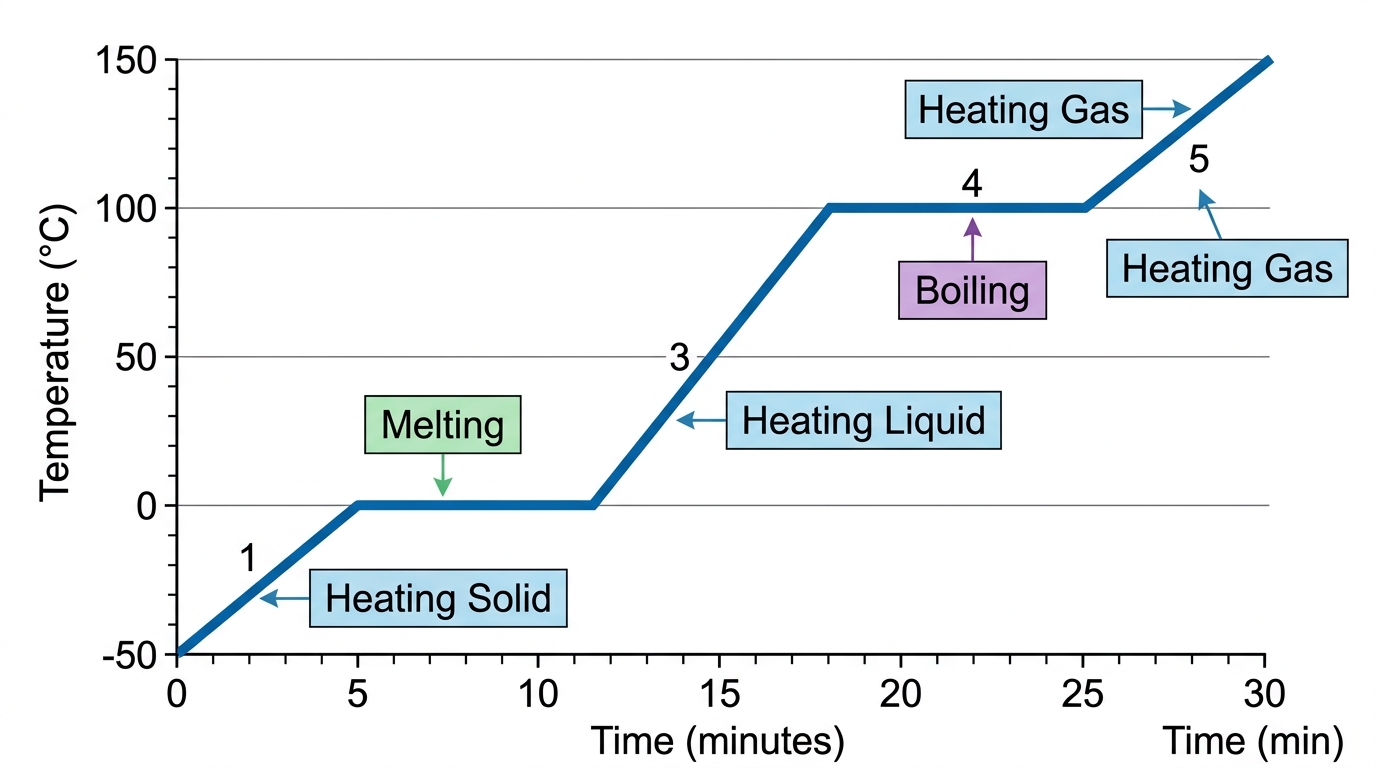
The graph below shows the heating curve of a pure substance. Temperature is plotted against time as the substance is heated from to at a constant rate. The substance has a melting point of and a boiling point of . The specific heat capacity of the solid is and of the liquid is .
(a)
Describe what is happening to the particles of the substance during the plateau at . [2 marks]
(b)
Describe how the physical state of the substance at differs from its state at , in terms of particle arrangement and compressibility. [2 marks]
(c)
Calculate the total energy required to raise the temperature of of the substance from to , excluding any energy required for a change of state. [2 marks]
(d)
The plateau at is longer than the plateau at on the heating curve. Explain why, in terms of intermolecular forces. [2 marks]
Solutions
16MasterySAQ-SProperties of matter7 marksPaper 2~11 min
Data
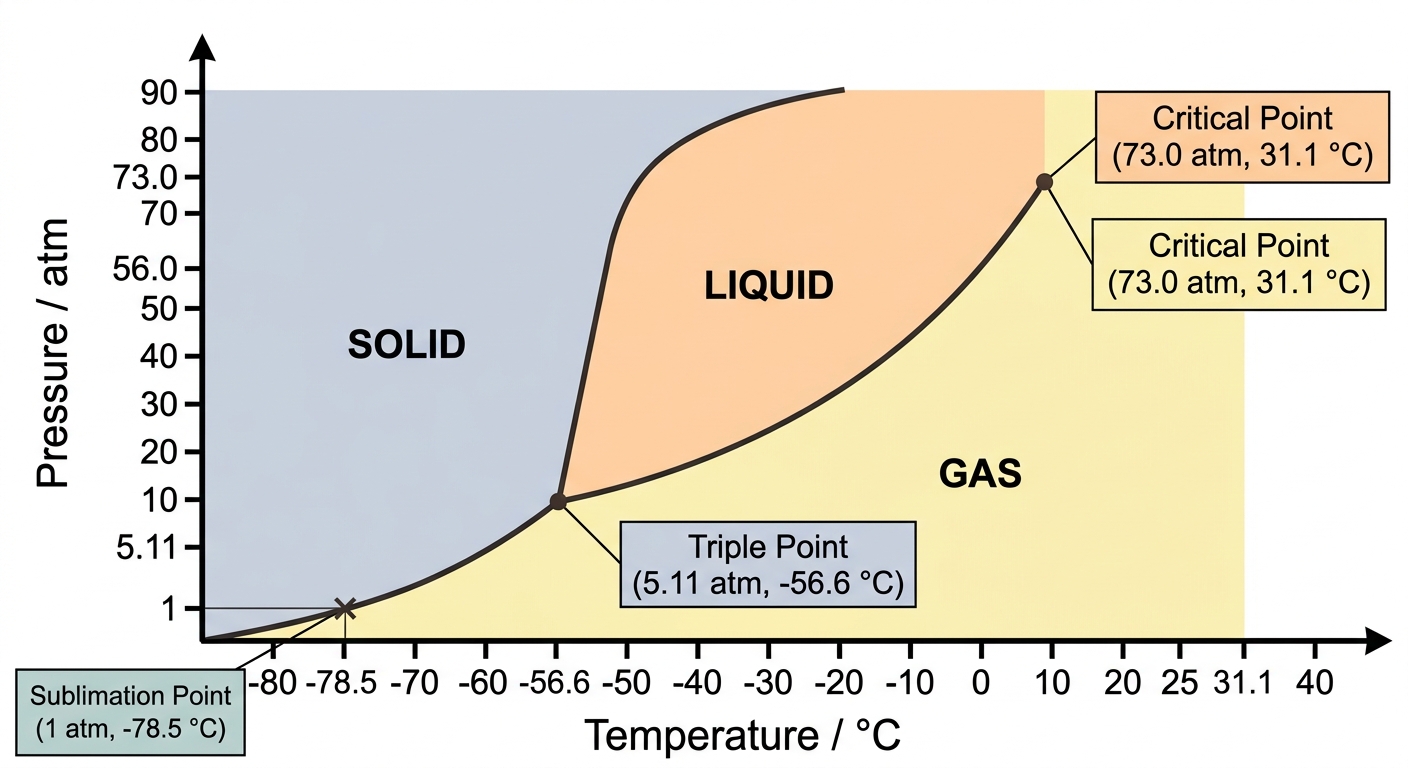
The phase for carbon dioxide () is shown below (not to scale). The triple point of is at and . The critical point is at and . At pressure, solid sublimes at .
(a)
Describe what happens to the physical state of a sample of , initially at and , when it is heated at constant pressure to . [2 marks]
(b)
Describe the arrangement and motion of particles in at the critical point (, ). [2 marks]
(c)
The enthalpy of vaporisation of liquid is . The vapour pressure of liquid at is .
Using the Clausius–Clapeyron equation, calculate the vapour pressure of liquid at . [3 marks]
Solutions
17MasterySAQ-SSolid, liquid, gas phases and changes of state7 marksPaper 2~11 min
A student investigates three pure substances, X, Y, and Z, at .
- Substance X: melting point ; boiling point ; brittle solid; does not conduct electricity when solid; molten form conducts electricity.
- Substance Y: melting point ; boiling point ; shiny, malleable liquid; conducts electricity in both liquid and solid states.
- Substance Z: melting point ; boiling point ; colourless liquid; does not conduct electricity; when electrolysed, gases form at both electrodes.
(a)
Deduce the type of bonding and structure present in substance X. Explain your reasoning with reference to three pieces of data. [2 marks]
(b)
Explain why substance Y conducts electricity in both the solid and liquid states, whereas substance X conducts only in the liquid state. [2 marks]
(c)
Substance Z is electrolysed using inert electrodes. Deduce the identity of the gas produced at each electrode and explain, at the molecular level, why substance Z does not conduct electricity before electrolysis begins. [3 marks]
Solutions
18MasterySAQ-SMolecular theory and the nature of matter6 marksPaper 2~9 min
A sample of radium-226 () undergoes alpha decay to form radon-222 () and an alpha particle ().
- Mass of atom:
- Mass of atom:
- Mass of atom:
-
-
(a)
State one way in which the alpha decay of radium-226 contradicts Dalton's atomic theory. [1 mark]
(b)
Calculate the mass defect, in kg, for the decay of one atom of radium-226. [3 marks]
(c)
State what happens to the mass that is lost during the decay. [1 mark]
(d)
Using , calculate the energy, in J, released during the decay of one atom of radium-226. [1 mark]
Solutions
19MasterySAQ-SProperties of matter4 marksPaper 2~6 min
Diamond and graphite are allotropes of carbon. Diamond is one of the hardest naturally occurring substances, while graphite is soft and can act as a lubricant.
(a)
Describe the bonding and structure in diamond that accounts for its extreme hardness. [2 marks]
(b)
Explain why graphite is soft and can act as a lubricant, despite containing strong covalent bonds. [2 marks]
Solutions
20MasterySAQ-SSolid, liquid, gas phases and changes of state4 marksPaper 2~6 min
A sample of solid iodine () is heated gently in a fume cupboard. The solid sublimes directly into a purple vapour without melting. The vapour is then cooled on a cold surface, where it reforms as solid iodine crystals.
(a)
State the change of state that occurs when solid iodine is heated. [1 mark]
(b)
Describe the change in the arrangement and movement of the particles when solid iodine sublimes. [1 mark]
(c)
The boiling point of iodine is , yet it sublimes at temperatures well below this. Using the concept of vapour pressure, suggest a reason for this observation. [2 marks]
Solutions
Showing 20 of 102 free questions