The Nuclear Atom · Paper 2 — Free Chemistry HL Practice Questions
Free questions
Open in full, with answers, mark scheme and examiner insights.
Structure of the atom: Protons, neutrons, electrons
The table gives data for three subatomic particles P, Q and R.
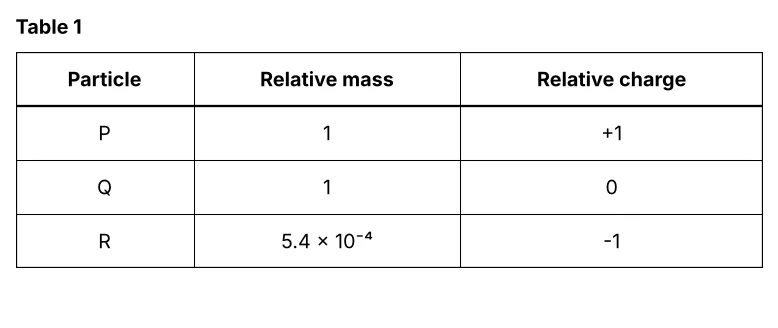
Identify the particles P, Q and R.
State where particle Q is found in an atom.
State why an atom has no overall charge.
revisionprep.com
Summary Answer
Not available for this question.
Model Answer
Not available for this question.
Marking Scheme
Not available for this question.
Examiner Insights
Not available for this question.
Mass spectra of elements and relative atomic mass
A mass spectrum of neon shows peaks for ions at with a relative abundance of and at with a relative abundance of . Neon has atomic number 10.
State the number of neutrons in the ion that gives the peak at .
Calculate the relative atomic mass of neon from the spectrum, to two decimal places. Assume that the relative mass of each isotope equals its mass number.
State why the peak at is much shorter than the peak at .
revisionprep.com
Summary Answer
Not available for this question.
Model Answer
Not available for this question.
Marking Scheme
Not available for this question.
Examiner Insights
Not available for this question.
Structure of the atom: Protons, neutrons, electrons
A tin sample is enriched in three isotopes for a research study. Tin has atomic number 50.
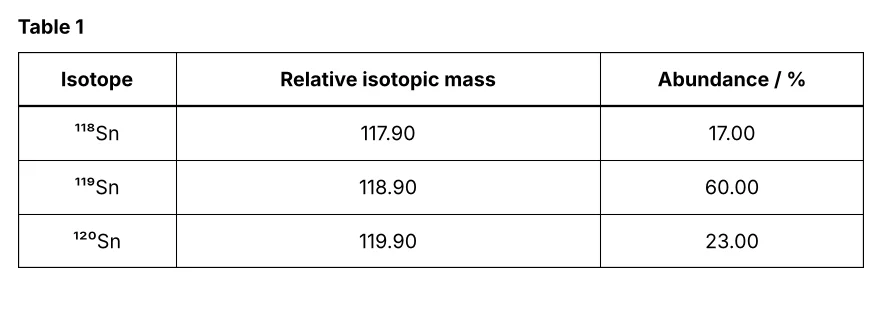
Define the term isotopes.
State the numbers of protons, neutrons and electrons in a neutral atom of .
Calculate the relative atomic mass of tin in this sample, to two decimal places.
Tin forms and ions. State the number of electrons in a ion.
Explain why a atom and a atom need the same energy to remove their outermost electron.
This sample is analysed by mass spectrometry and the tin atoms form ions. Predict the values of the three peaks, using mass numbers, and state which peak is the tallest.
revisionprep.com
Summary Answer
Not available for this question.
Model Answer
Not available for this question.
Marking Scheme
Not available for this question.
Examiner Insights
Not available for this question.
Atomic number, mass number, isotopes
A student studies the data for three species X, Y and Z of the same element.
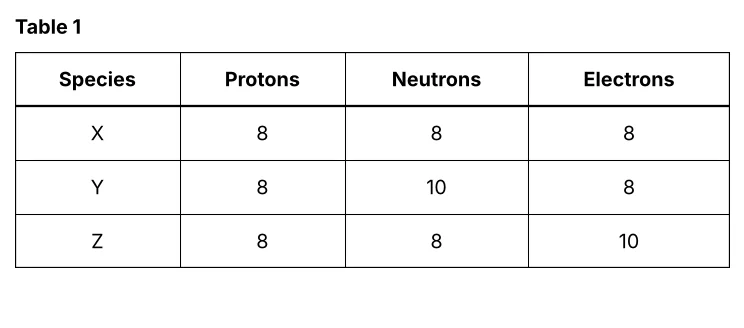
Deduce the relationship between X and Y.
Determine the mass number of Y.
Deduce the charge on Z and write its nuclide symbol, including its charge.
revisionprep.com
Summary Answer
Not available for this question.
Model Answer
Not available for this question.
Marking Scheme
Not available for this question.
Examiner Insights
Not available for this question.
Atomic number, mass number, isotopes
An ion X contains 10 electrons and 14 neutrons. An ion Y has the same number of electrons as X and a mass number of 19.
Deduce the atomic number of X.
Deduce the nuclide symbol, including the charge, for the ion X.
Deduce the atomic number of Y and identify the element.
Determine the number of neutrons in the ion Y.
Another isotope of X has 15 neutrons. State the mass number of this isotope.
State the full electron configuration of the ions X³⁺ and Y⁻.
revisionprep.com
Summary Answer
Not available for this question.
Model Answer
Not available for this question.
Marking Scheme
Not available for this question.
Examiner Insights
Not available for this question.
Atomic number, mass number, isotopes
Lead has four stable isotopes. Lead-206, lead-207 and lead-208 slowly accumulate in rocks from the breakdown of other elements, so the isotopic composition of lead depends on where it was mined. Assume the relative mass of each isotope equals its mass number.
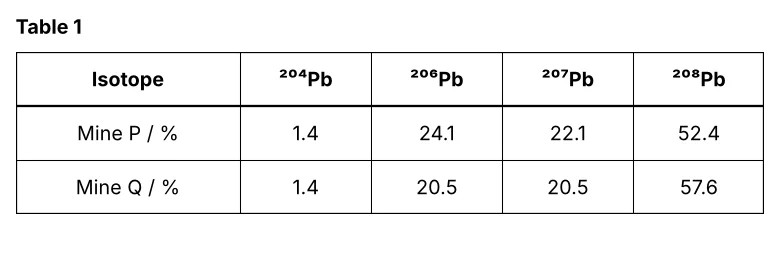
Calculate the relative atomic mass of lead from mine P, to four significant figures.
Calculate the relative atomic mass of lead from mine Q, to four significant figures.
Explain why the relative atomic mass of lead varies with its source, while that of most elements is almost constant.
State the values of the two tallest peaks for mine P.
A lead weight from an ancient shipwreck has a ratio of and a ratio of . Evaluate the claim that the lead came from mine P rather than mine Q.
Suggest two ways in which the investigation in (e) could be improved to make the conclusion about the origin of the lead more reliable.
revisionprep.com
Summary Answer
Not available for this question.
Model Answer
Not available for this question.
Marking Scheme
Not available for this question.
Examiner Insights
Not available for this question.
That's every free question here — 6 of 102.
+96 more questions, plus Mock Papers & Worksheets, are waiting in Premium.