How Far? The Extent of Chemical Change · Paper 1 — Free Chemistry SL Practice Questions
Free questions
Open in full, with answers, mark scheme and examiner insights.
The equilibrium constant K: expression and magnitude
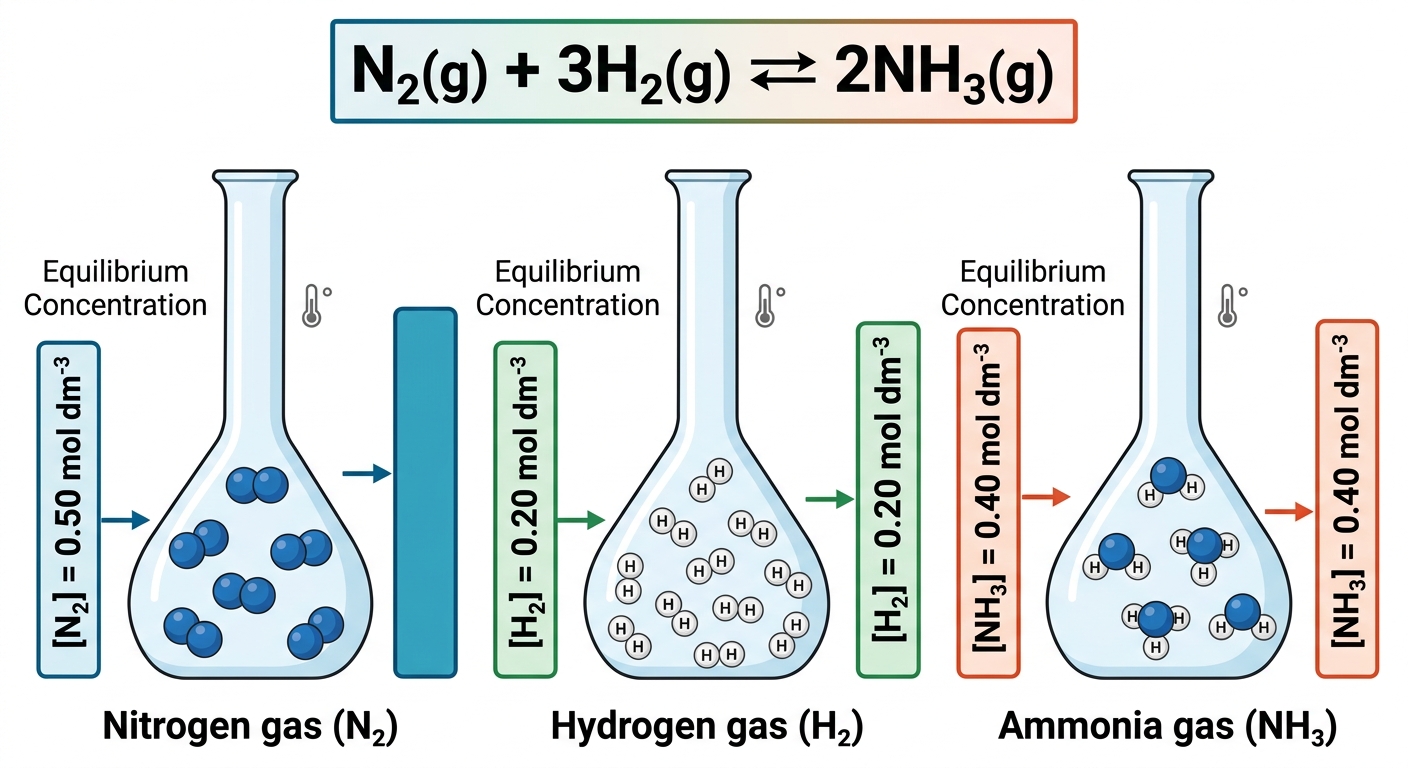
The shows the equilibrium concentrations in a mixture for the reaction . What is the value of ?
revisionprep.com
Summary Answer
Not available for this question.
Model Answer
Not available for this question.
Marking Scheme
Not available for this question.
Examiner Insights
Not available for this question.
Dynamic equilibrium
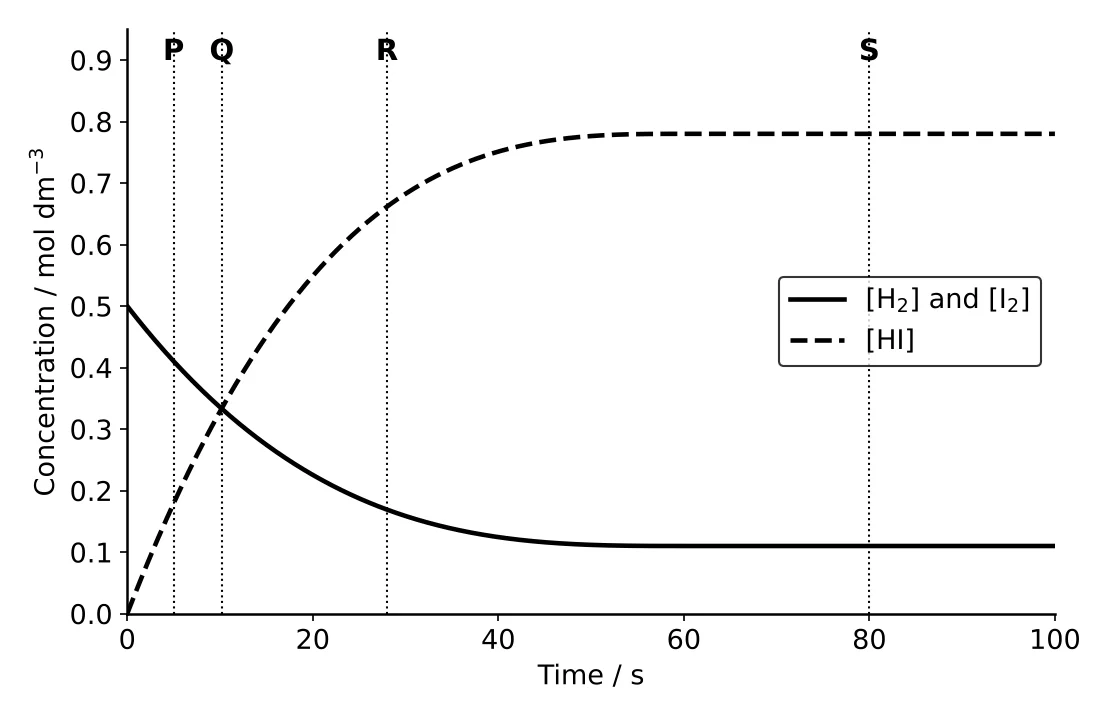
Hydrogen and iodine, each at , are sealed in a flask at . The graph shows how the concentrations change with time. Four times, P, Q, R and S, are marked.
At which time is the mixture at dynamic equilibrium?
revisionprep.com
Summary Answer
Not available for this question.
Model Answer
Not available for this question.
Marking Scheme
Not available for this question.
Examiner Insights
Not available for this question.
The equilibrium constant K: expression and magnitude
Ethanoic acid and ethanol react in a stoppered flask at :
After several days the equilibrium concentrations were measured (Table 1). The ethanoic acid concentration was found by titrating samples with sodium hydroxide solution; the mean titre was .
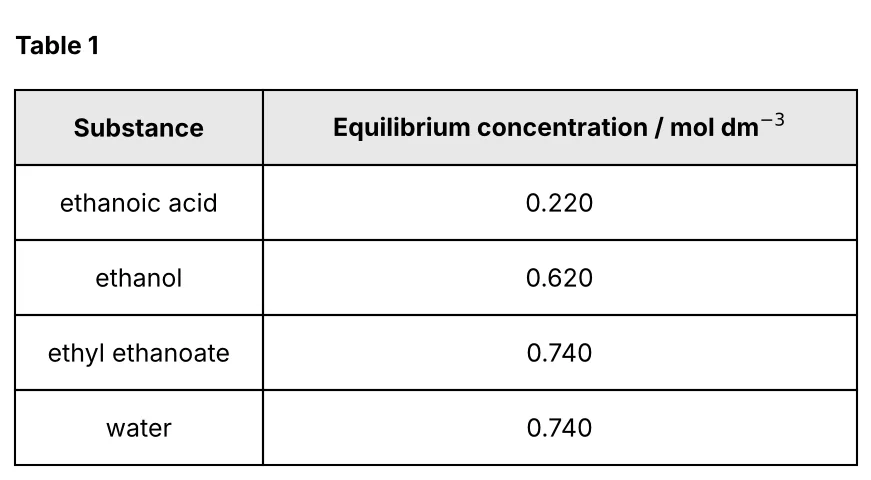
Calculate the value of at .
Determine the percentage uncertainty in the mean titre.
Explain why each sample was cooled in iced water immediately before it was titrated.
revisionprep.com
Summary Answer
Not available for this question.
Model Answer
Not available for this question.
Marking Scheme
Not available for this question.
Examiner Insights
Not available for this question.
Dynamic equilibrium
A small volume of liquid ethanol is injected into an evacuated flask, which is then sealed and kept at . Some liquid remains at all times. The pressure due to ethanol vapour, , is recorded.
Table 1 gives the pressure of ethanol vapour against time at .
The experiment is repeated at other temperatures and the constant pressure reached each time is recorded.
Table 2 gives the equilibrium pressure of ethanol vapour at three temperatures.
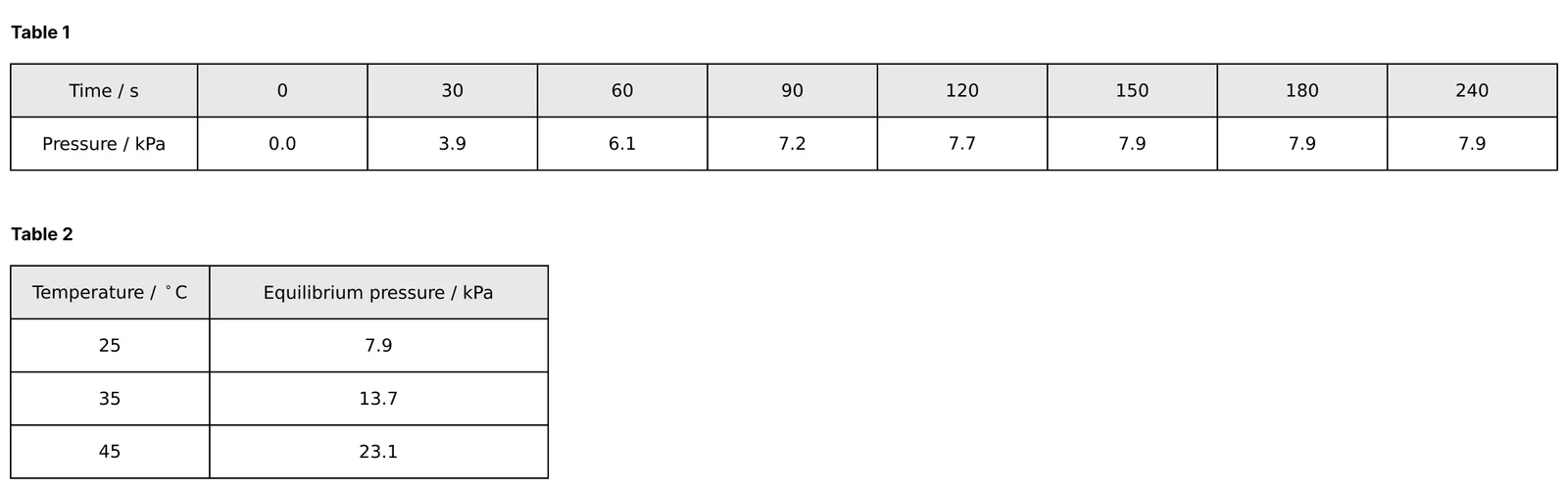
State the time, from Table 1, at which equilibrium is first established.
Calculate the average rate of increase in pressure, in , between 0 and 30 s and between 90 and 120 s.
Explain, in terms of the rates of evaporation and condensation, the shape of the data in Table 1.
Deduce, using Table 2 and Le Chatelier's principle, whether the evaporation of ethanol is exothermic or endothermic.
Another student uses a flask with a leaking stopper. The pressure rises but never stays constant, and the student concludes that ethanol cannot reach equilibrium with its vapour. Evaluate this conclusion.
revisionprep.com
Summary Answer
Not available for this question.
Model Answer
Not available for this question.
Marking Scheme
Not available for this question.
Examiner Insights
Not available for this question.
The equilibrium constant K: expression and magnitude
A student investigates the equilibrium between hydrogen, iodine and hydrogen iodide at 731 K:
Four sealed tubes were filled with different starting mixtures and kept at 731 K. After a set time each tube was cooled rapidly and its contents analysed. The results are shown in Table 1.
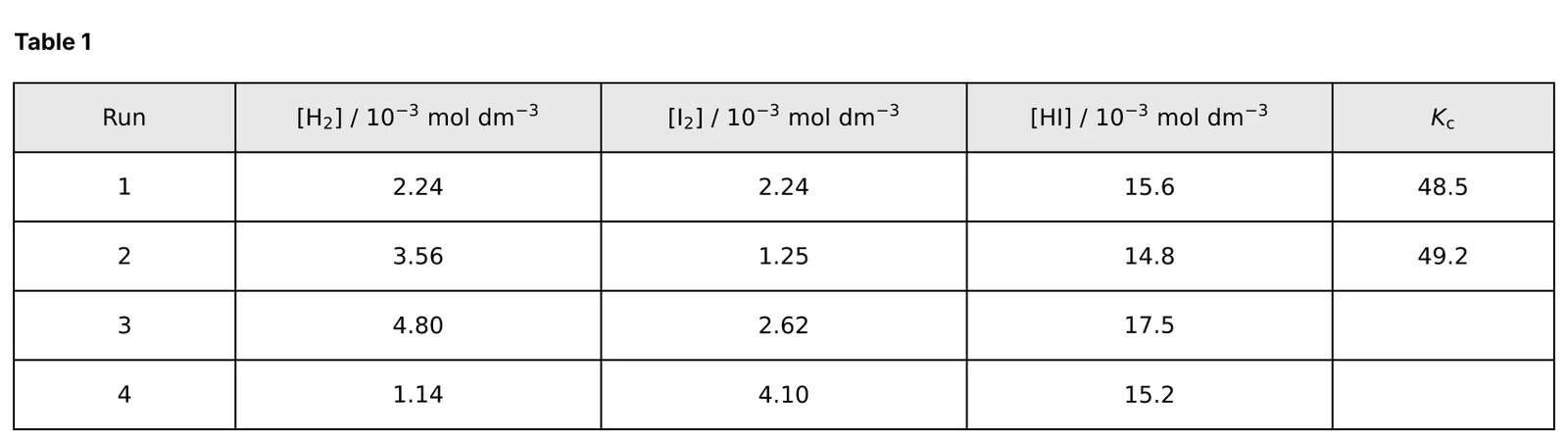
Deduce the equilibrium constant expression, , for this reaction.
Calculate for runs 3 and 4.
Explain why the factor of in the concentrations does not need to be included when calculating for this reaction.
Identify the anomalous run and suggest a reason for the anomaly.
Determine a mean value of at 731 K from the reliable runs.
Evaluate whether these results support the statement that, at a fixed temperature, does not depend on the starting concentrations.
revisionprep.com
Summary Answer
Not available for this question.
Model Answer
Not available for this question.
Marking Scheme
Not available for this question.
Examiner Insights
Not available for this question.
Dynamic equilibrium
Flask 1 contains an equilibrium mixture of , and HI(g) at temperature . Flask 2 contains an equilibrium mixture of , and DI(g) at the same temperature, where D is deuterium, an isotope of hydrogen. The two mixtures are combined in a sealed container and kept at temperature . Which species are present once the new equilibrium is reached?
revisionprep.com
Summary Answer
Not available for this question.
Model Answer
Not available for this question.
Marking Scheme
Not available for this question.
Examiner Insights
Not available for this question.
That's every free question here — 6 of 135.
+129 more questions, plus Mock Papers & Worksheets, are waiting in Premium.