How Fast? The Rate of Chemical Change · Paper 1 — Free Chemistry SL Practice Questions
Free questions
Open in full, with answers, mark scheme and examiner insights.
Factors affecting reaction rates: Concentration, temperature, surface area, catalysts
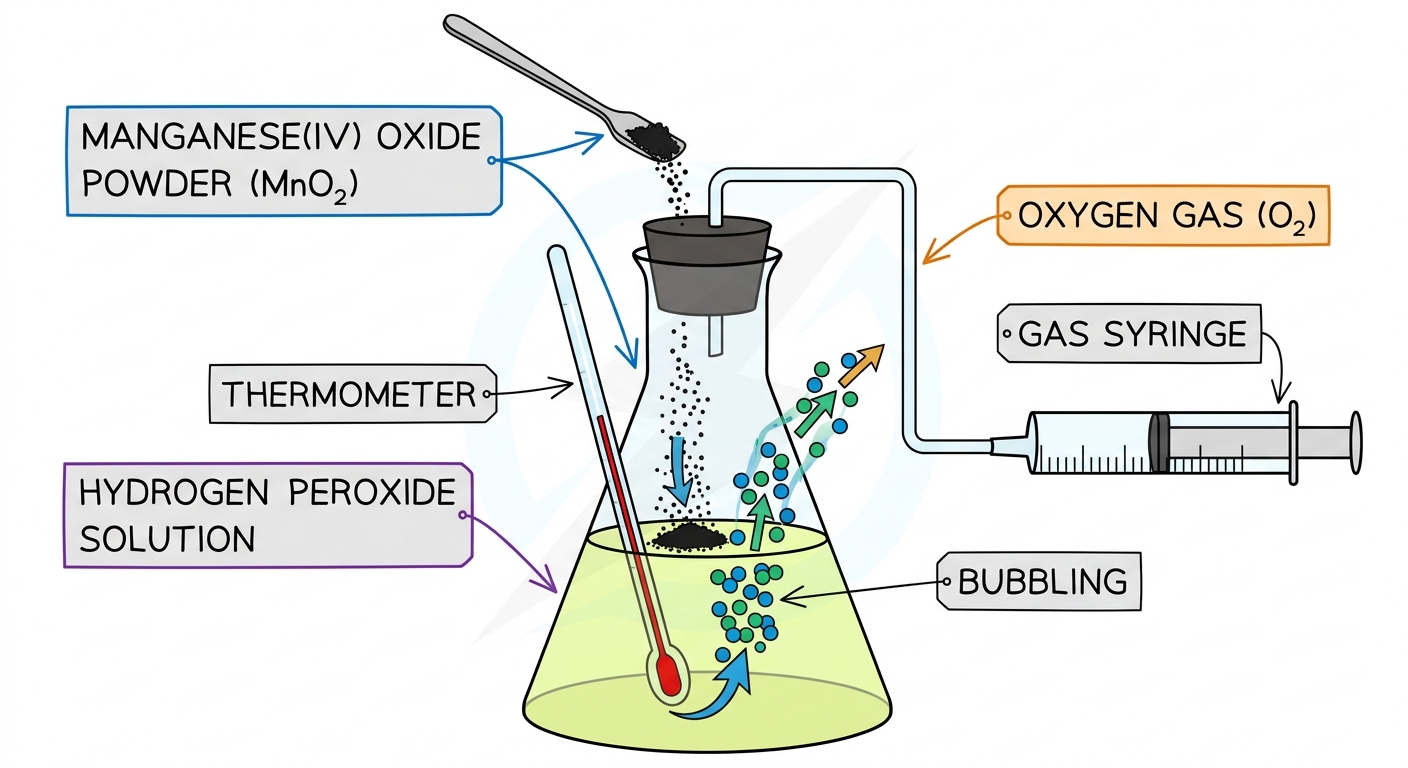
The apparatus is used to follow the decomposition of hydrogen peroxide catalysed by manganese(IV) oxide. The volume of oxygen in the gas syringe is recorded every 10 s and plotted against time. Which method gives the initial rate of reaction?
revisionprep.com
Summary Answer
Not available for this question.
Model Answer
Not available for this question.
Marking Scheme
Not available for this question.
Examiner Insights
Not available for this question.
Rate of reaction: definition, measurement and graphs
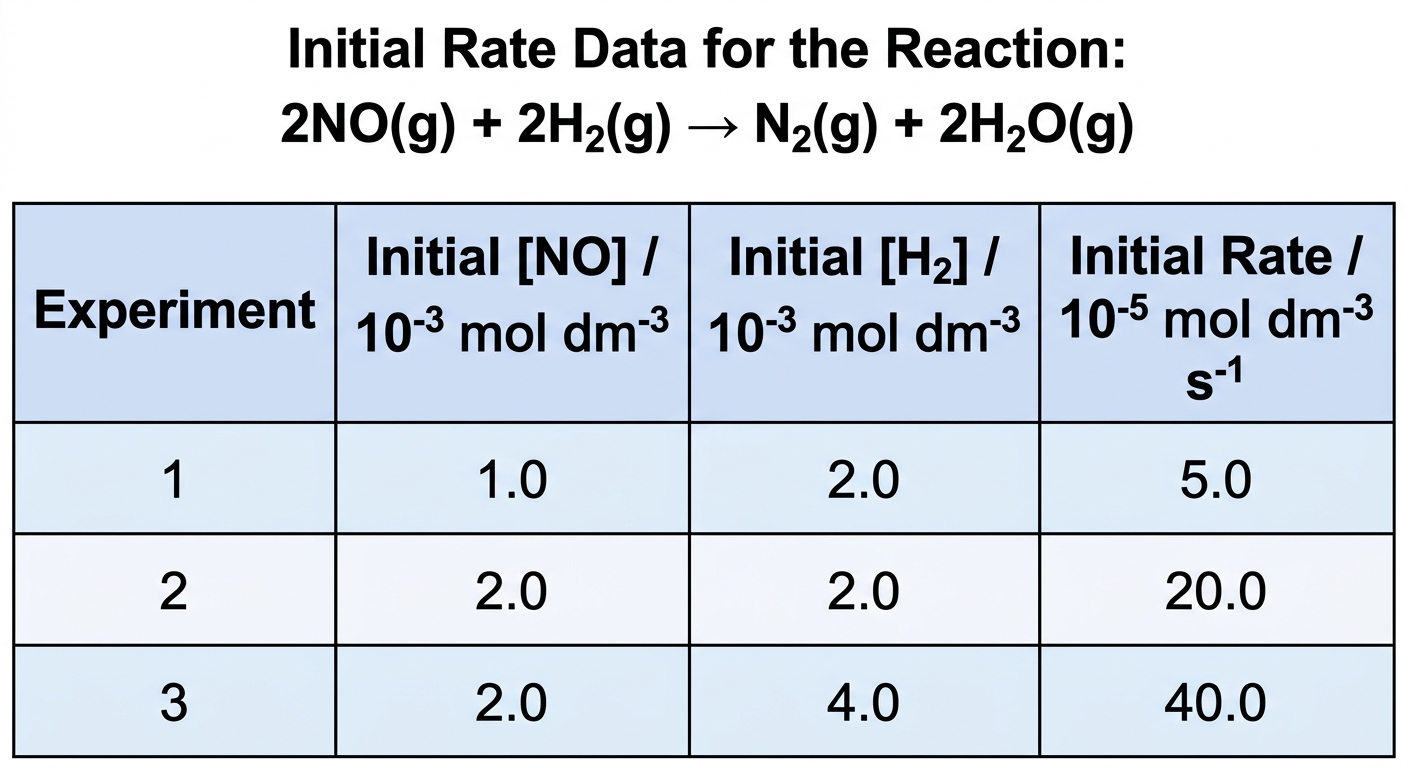
The table shows initial rates for the reaction between nitrogen monoxide and hydrogen at constant temperature. By what factor is the initial rate in experiment 3 greater than in experiment 1?
revisionprep.com
Summary Answer
Not available for this question.
Model Answer
Not available for this question.
Marking Scheme
Not available for this question.
Examiner Insights
Not available for this question.
Factors affecting reaction rates: Concentration, temperature, surface area, catalysts
A student investigated how the concentration of hydrochloric acid affects the rate of its reaction with magnesium ribbon. In each run, a 3.0 cm length of magnesium ribbon (in excess) was added to of acid at room temperature, and the time to collect of hydrogen in a gas syringe was measured. Each concentration was tested three times.
Table 1 shows the data.
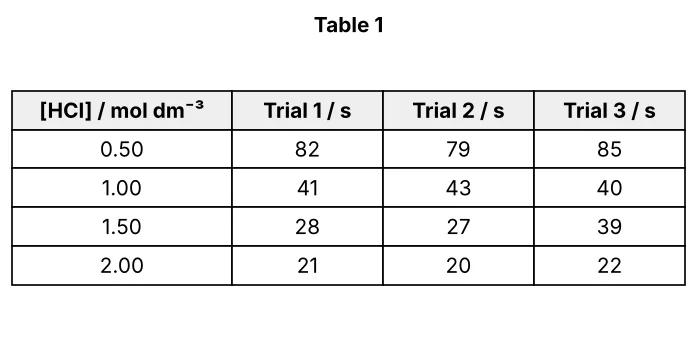
Identify the anomalous result and calculate the mean time for acid.
Determine the average rate of hydrogen production, in , for acid.
The gas syringe reads to . Taking the uncertainty in the mean time as half the range of the trials, calculate the percentage uncertainty in the rate in (b).
Deduce, using processed data, how the rate changes when the concentration of acid is doubled.
Explain this trend using collision theory.
Suggest one weakness of the method and an improvement that would reduce it.
revisionprep.com
Summary Answer
Not available for this question.
Model Answer
Not available for this question.
Marking Scheme
Not available for this question.
Examiner Insights
Not available for this question.
Rate of reaction: definition, measurement and graphs
A student added of magnesium carbonate powder to of hydrochloric acid (excess) in a flask on a balance. A loose cotton wool plug was placed in the neck of the flask.
The balance reads to .
Table 1 shows the data.
,
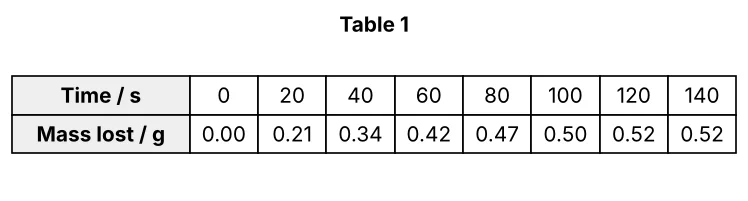
Calculate the average rate of production of carbon dioxide during the first 40 s, in .
Hence calculate the average rate at which hydrochloric acid was used up during the first 40 s, in .
Compare the average rates from 0 to 20 s and from 80 to 100 s, and explain the difference using collision theory.
Determine whether the total mass lost is consistent with all the magnesium carbonate reacting.
Outline one limitation of using this balance to measure the rate during the first 20 s, and suggest one improvement.
revisionprep.com
Summary Answer
Not available for this question.
Model Answer
Not available for this question.
Marking Scheme
Not available for this question.
Examiner Insights
Not available for this question.
Factors affecting reaction rates: Concentration, temperature, surface area, catalysts
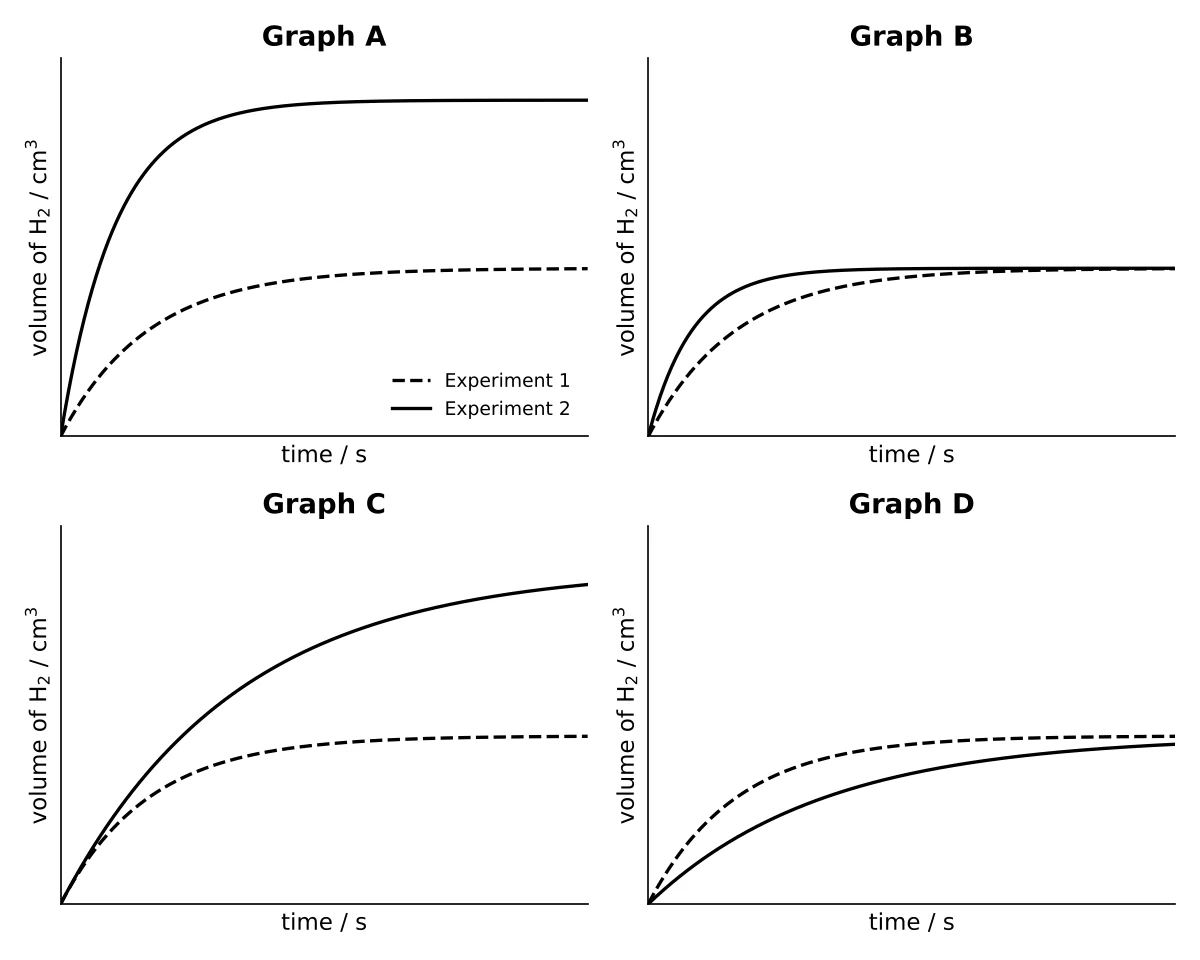
In Experiment 1, excess magnesium ribbon reacts with of hydrochloric acid and the volume of hydrogen is measured against time. In Experiment 2, the same mass and length of magnesium ribbon (still in excess) reacts with of the same acid at the same temperature. The ribbon is fully covered by the acid in both experiments. Which graph shows Experiment 1 (dashed line) and Experiment 2 (solid line)?
revisionprep.com
Summary Answer
Not available for this question.
Model Answer
Not available for this question.
Marking Scheme
Not available for this question.
Examiner Insights
Not available for this question.
Rate of reaction: definition, measurement and graphs
A student uses an iodate(V) clock reaction to compare rates. Potassium iodate(V) solution is measured with a measuring cylinder () and made up to a fixed total volume; all other solutions are the same in each run. The stopwatch reads to .
Table 1 shows the data.
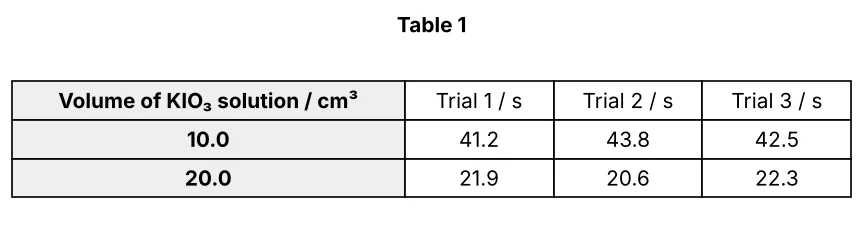
Determine the percentage uncertainty in measuring of potassium iodate(V) solution.
Calculate the mean time for , with its absolute uncertainty taken as half the range.
Calculate for and its absolute uncertainty.
Determine the ratio of the rates for and , and state what this suggests about the effect of doubling the iodate(V) concentration.
Evaluate which measurement contributes the larger uncertainty to the rate and suggest an improvement.
revisionprep.com
Summary Answer
Not available for this question.
Model Answer
Not available for this question.
Marking Scheme
Not available for this question.
Examiner Insights
Not available for this question.
That's every free question here — 6 of 135.
+129 more questions, plus Mock Papers & Worksheets, are waiting in Premium.