You're viewing 1 free preview question for Chemistry SL — subscribe to unlock 130 more, plus the Full Question Bank, Mock Papers & Worksheets.Upgrade
How Fast? The Rate of Chemical Change · Paper 2 — Free Chemistry SL Practice Questions
1MasterySAQ-SFactors affecting reaction rates: Concentration, temperature, surface area, catalysts5 marksPaper 2~8 min

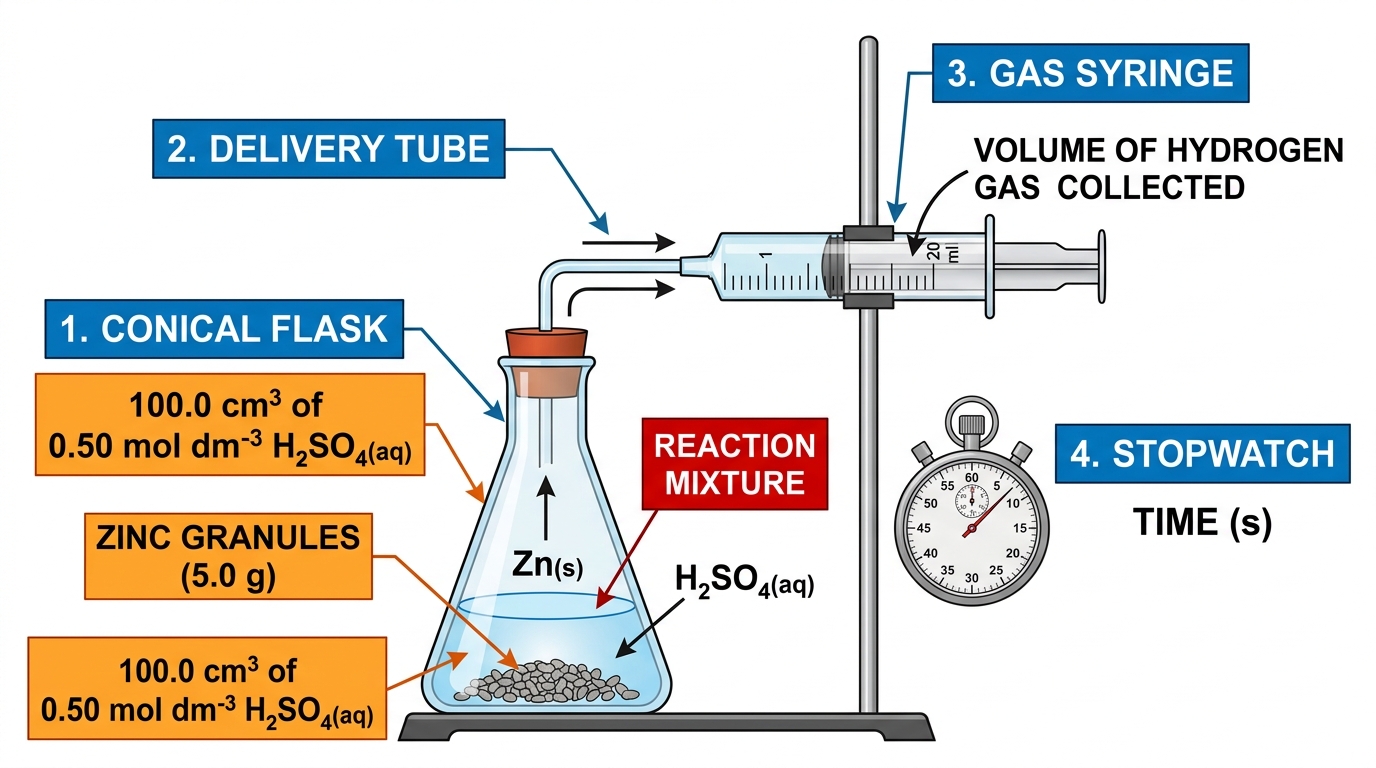
Zinc granules react with sulfuric acid:
A student places of zinc granules into of at and measures the volume of hydrogen gas collected every . The reaction is slow at first, then becomes faster, and finally slows down until it stops.
(a)
Explain why the reaction rate initially increases even though the concentration of acid is decreasing. [2 marks]
(b)
The student repeats the experiment using the same mass of zinc in the form of a single large piece. Describe two differences in the volume-of-gas versus time graph compared to the original experiment. [2 marks]
(c)
Explain, using collision theory, why these differences occur. [1 mark]

Solutions
That's every free question here — 1 of 131.
+130 more questions, plus Mock Papers & Worksheets, are waiting in Premium.