How Much? The Amount of Chemical Change · Paper 2 — Free Chemistry SL Practice Questions
Free questions
Open in full, with answers, mark scheme and examiner insights.
Stoichiometry and mole-to-mole ratios
Ammonia is made from nitrogen and hydrogen:
A reactor is charged with of and of . Assume the reaction goes to completion.
State the mole ratio in the equation.
Deduce, using the mole ratio, which reactant is limiting.
Calculate the maximum amount, in mol, of that can form.
Calculate the maximum mass, in g, of that can form.
revisionprep.com
Summary Answer
Not available for this question.
Model Answer
Not available for this question.
Marking Scheme
Not available for this question.
Examiner Insights
Not available for this question.
Limiting reagents and theoretical yield
Aspirin is made from salicylic acid and ethanoic anhydride:
A chemist reacts of salicylic acid with of ethanoic anhydride.
/ : 138; 102; 180
State what is meant by the theoretical yield.
Calculate the amount, in mol, of each reactant and deduce which is limiting.
Calculate the theoretical yield, in g, of aspirin.
Calculate the mass, in g, of ethanoic anhydride left unreacted.
revisionprep.com
Summary Answer
Not available for this question.
Model Answer
Not available for this question.
Marking Scheme
Not available for this question.
Examiner Insights
Not available for this question.
Stoichiometry and mole-to-mole ratios
In a blast furnace, iron(III) oxide is reduced by carbon monoxide:
A furnace is charged with of and excess carbon monoxide.
;
State the mole ratio .
Calculate the maximum mass, in kg, of iron that can be obtained.
Suggest two reasons why the mass of iron obtained in practice is less than your answer to (b).
revisionprep.com
Summary Answer
Not available for this question.
Model Answer
Not available for this question.
Marking Scheme
Not available for this question.
Examiner Insights
Not available for this question.
Limiting reagents and theoretical yield
Ethanol can be made by two routes.
Route A, fermentation:
Route B, hydration of ethene:
The two routes are compared in Table 1.
Molar masses / : ;
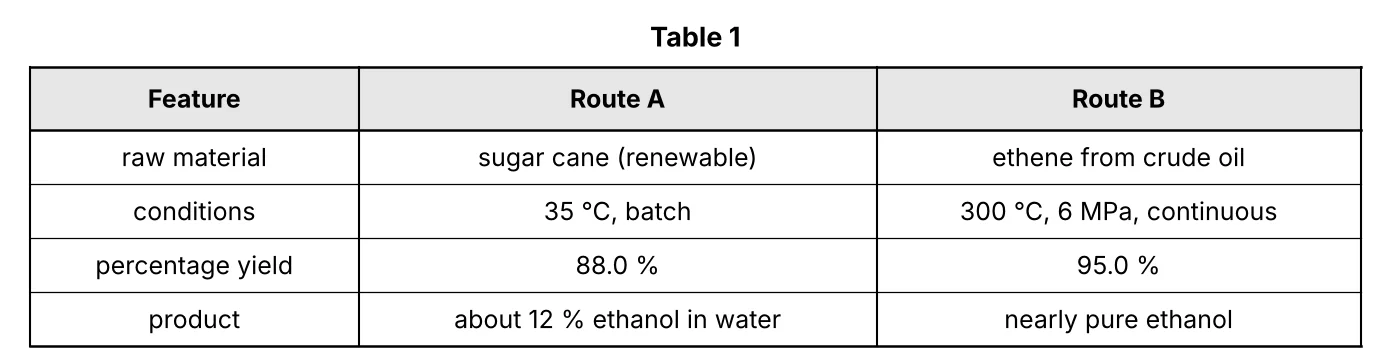
Calculate the atom economy of route A.
Calculate the mass of glucose, in kg, needed to produce () of ethanol by route A.
Evaluate which route is the more sustainable way to make ethanol, using atom economy, percentage yield and the information in Table 1.
Calculate the volume, in at STP, of carbon dioxide formed when of ethanol is made by route A. Carbon dioxide and ethanol form in a mole ratio. Molar volume at STP .
Calculate the mass, in kg, of ethene needed to make of ethanol by route B.
revisionprep.com
Summary Answer
Not available for this question.
Model Answer
Not available for this question.
Marking Scheme
Not available for this question.
Examiner Insights
Not available for this question.
Stoichiometry and mole-to-mole ratios
Nitric acid is manufactured from ammonia in three steps:
;
Deduce the overall mole ratio for the whole process.
Calculate the mass, in kg, of ammonia needed to make tonne () of , assuming every step is complete.
Show that of is used in total for every of formed.
Hence deduce the overall equation for converting into , including state symbols.
In practice only of the ammonia is converted into NO in Step 1; Steps 2 and 3 are complete. Calculate the mass, in kg, of ammonia needed to make tonne of .
Calculate the volume of air, in at STP, needed per mole of formed. Air is oxygen by volume; molar volume at STP .
Explain why the plant recycles unreacted nitrogen monoxide and uses excess air, and outline the effect on the overall yield of nitric acid.
revisionprep.com
Summary Answer
Not available for this question.
Model Answer
Not available for this question.
Marking Scheme
Not available for this question.
Examiner Insights
Not available for this question.
Concentration, volume, and number of particles
A swimming pool holds of water. The owner wants a copper(II) ion concentration of to control algae, added as copper(II) sulfate pentahydrate, .
Molar masses: ; ;
Calculate the mass, in g, of copper(II) ions needed.
Calculate the mass, in g, of that supplies this copper.
The owner first dissolves this solid and makes it up to in a bucket. Determine the concentration of in the bucket, in .
A friend weighs out the mass found in (b) but uses anhydrous copper(II) sulfate, . Deduce, with a calculation, the copper(II) ion concentration the pool would then reach, in .
revisionprep.com
Summary Answer
Not available for this question.
Model Answer
Not available for this question.
Marking Scheme
Not available for this question.
Examiner Insights
Not available for this question.
That's every free question here — 6 of 145.
+139 more questions, plus Mock Papers & Worksheets, are waiting in Premium.