Electron Sharing Reactions · Paper 1 — Free Chemistry SL Practice Questions
Free questions
Open in full, with answers, mark scheme and examiner insights.
Radicals and homolytic fission
Which species has an unpaired electron?
revisionprep.com
Summary Answer
Not available for this question.
Model Answer
Not available for this question.
Marking Scheme
Not available for this question.
Examiner Insights
Not available for this question.
Radical substitution of alkanes
A student added 2 cm³ of hexane and five drops of bromine to each of two test tubes. Tube 1 was placed in bright light; tube 2 was wrapped in aluminium foil. After 10 minutes damp blue litmus paper was held at the mouth of each tube. The observations are shown in Table 1.
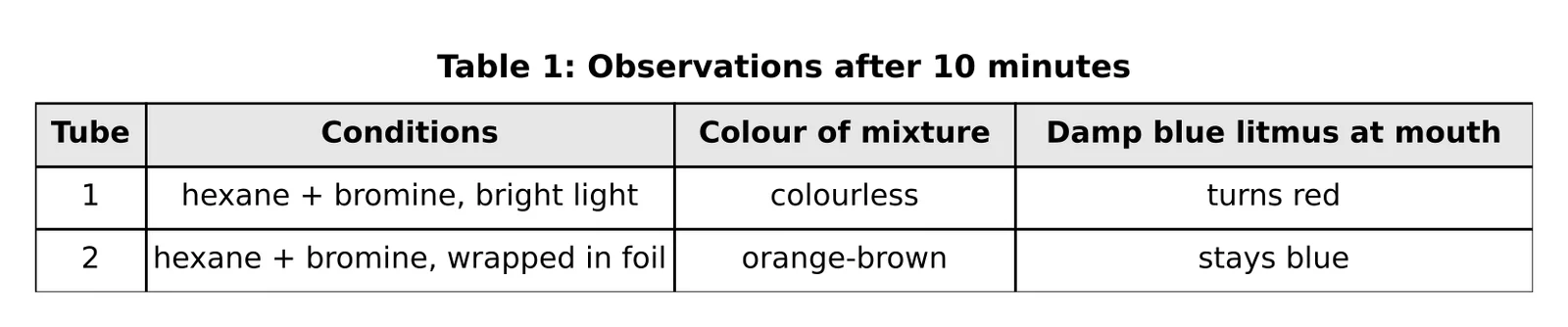
Deduce, giving the evidence in Table 1, whether a reaction occurred in tube 1.
Identify the gas that turned the damp blue litmus paper red.
State the purpose of tube 2 in this experiment.
Formulate an equation for the formation of a monobromohexane in tube 1.
Suggest one way to make the conclusion that light is needed for the reaction more reliable.
revisionprep.com
Summary Answer
Not available for this question.
Model Answer
Not available for this question.
Marking Scheme
Not available for this question.
Examiner Insights
Not available for this question.
Radicals and homolytic fission
A student mixed 1.0 cm³ of hexane with 1.0 cm³ of a dilute solution of bromine in an inert solvent in identical sealed glass tubes. Each tube was placed 20 cm from a lamp fitted with a different coloured filter, and the time for the orange colour of bromine to disappear was measured. The results are shown in Table 1.
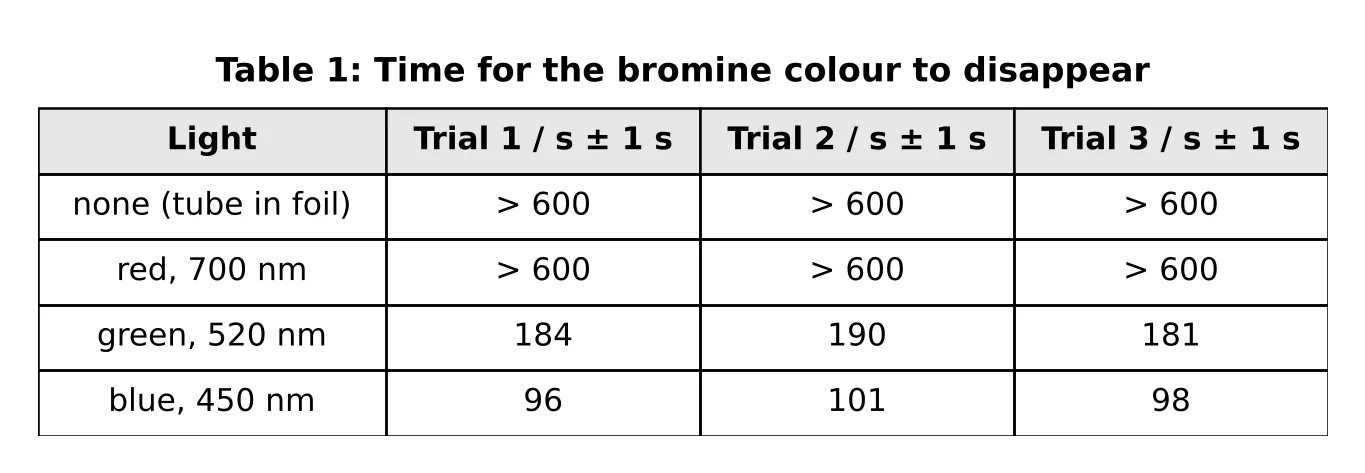
Identify the independent variable in this experiment.
Calculate the mean time for the tubes exposed to blue light and state its uncertainty, using half the range of the trials.
Explain, in terms of bond fission, why the bromine colour does not fade in the tube wrapped in foil.
State one variable, other than the one in (a), that must be controlled.
revisionprep.com
Summary Answer
Not available for this question.
Model Answer
Not available for this question.
Marking Scheme
Not available for this question.
Examiner Insights
Not available for this question.
Radical substitution of alkanes
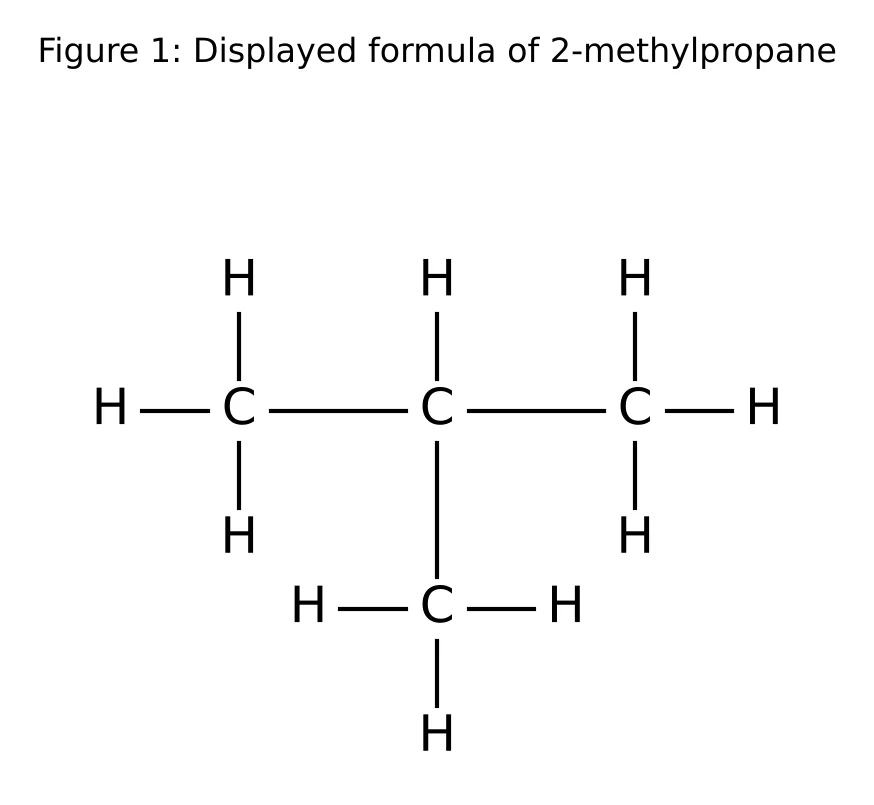
Figure 1 shows the displayed formula of 2-methylpropane.
How many different structural isomers with the formula C₄H₉Cl can form when 2-methylpropane reacts with chlorine in ultraviolet light?
revisionprep.com
Summary Answer
Not available for this question.
Model Answer
Not available for this question.
Marking Scheme
Not available for this question.
Examiner Insights
Not available for this question.
Radicals and homolytic fission
Which species are radicals?
I. NO (nitrogen monoxide) II. NO₂ (nitrogen dioxide) III. N₂O₄ (dinitrogen tetroxide)
revisionprep.com
Summary Answer
Not available for this question.
Model Answer
Not available for this question.
Marking Scheme
Not available for this question.
Examiner Insights
Not available for this question.
Initiation, propagation and termination steps
In a sealed photoreactor, a mixture of hydrogen and chlorine was irradiated for 60 s. Measurement with a light sensor showed that 2.0 × 10⁻⁶ mol of Cl₂ underwent homolytic fission in this time. All the HCl formed was absorbed in water and made up to 250.0 cm³. Portions of 25.00 cm³ were titrated with 0.0100 mol dm⁻³ sodium hydroxide solution. The results are shown in Table 1.
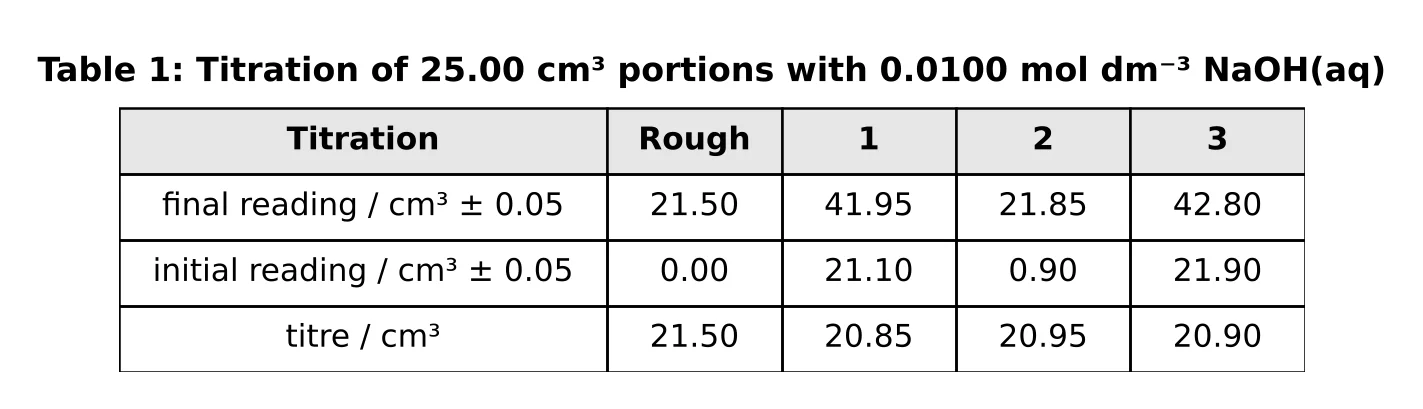
Calculate the mean titre using the concordant results.
Calculate the total amount, in mol, of HCl formed in the photoreactor.
Determine the number of HCl molecules formed for each chlorine radical produced in the initiation step.
Explain, with reference to propagation and termination, why the answer to (c) is much greater than 1.
Calculate the percentage uncertainty in the mean titre.
Some HCl escaped before it was absorbed. State and explain the effect of this systematic error on the value in (c).
revisionprep.com
Summary Answer
Not available for this question.
Model Answer
Not available for this question.
Marking Scheme
Not available for this question.
Examiner Insights
Not available for this question.
That's every free question here — 6 of 24.
+18 more questions, plus Mock Papers & Worksheets, are waiting in Premium.