Electron Transfer Reactions · Paper 1 — Free Chemistry SL Practice Questions
Free questions
Open in full, with answers, mark scheme and examiner insights.
Redox reactions and electron transfer
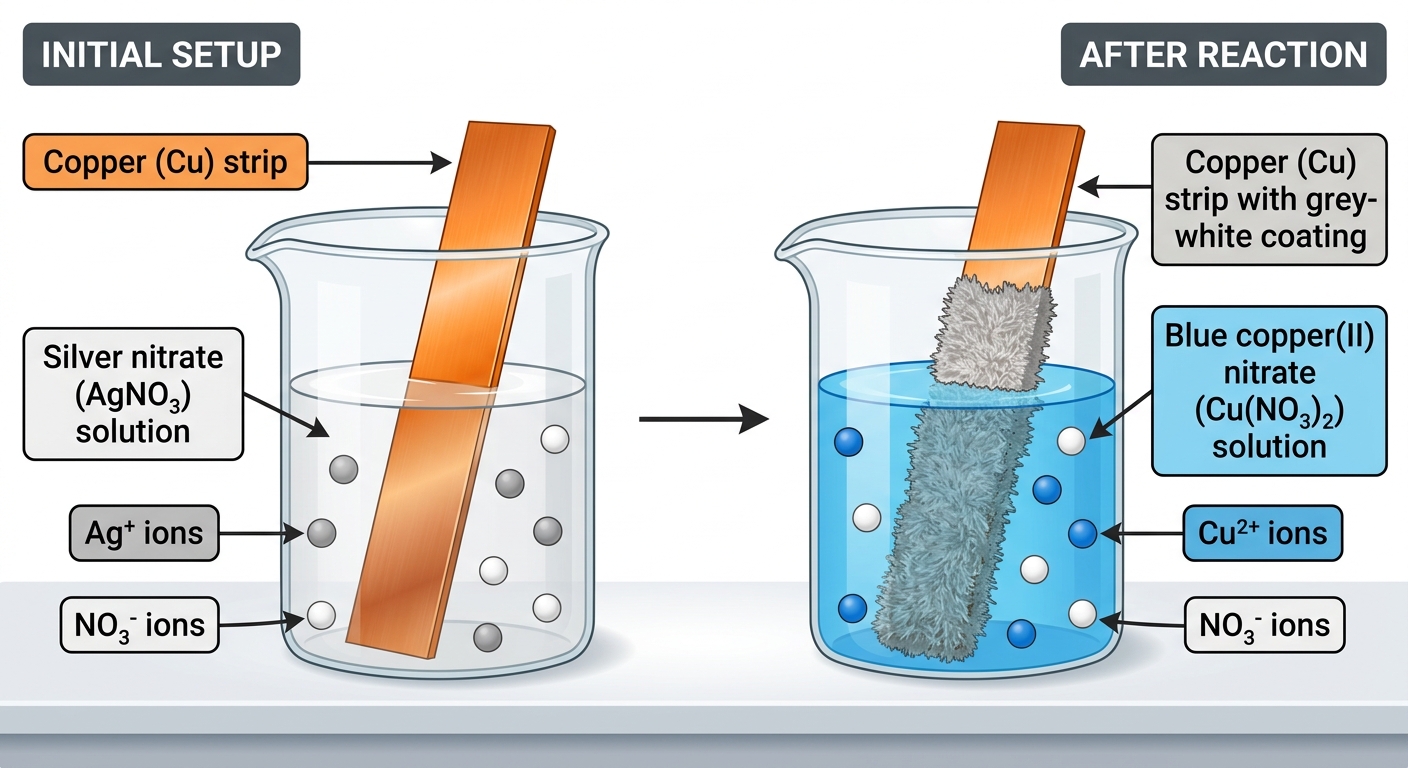
When copper metal is placed into silver nitrate solution, the copper becomes coated with a grey solid and the solution turns blue. Which balanced net ionic equation correctly represents this reaction?
revisionprep.com
Summary Answer
Not available for this question.
Model Answer
Not available for this question.
Marking Scheme
Not available for this question.
Examiner Insights
Not available for this question.
Oxidizing and reducing agents
A student places pieces of magnesium, zinc and copper in separate test tubes containing of copper(II) sulfate solution. The observations are shown in Table 1.
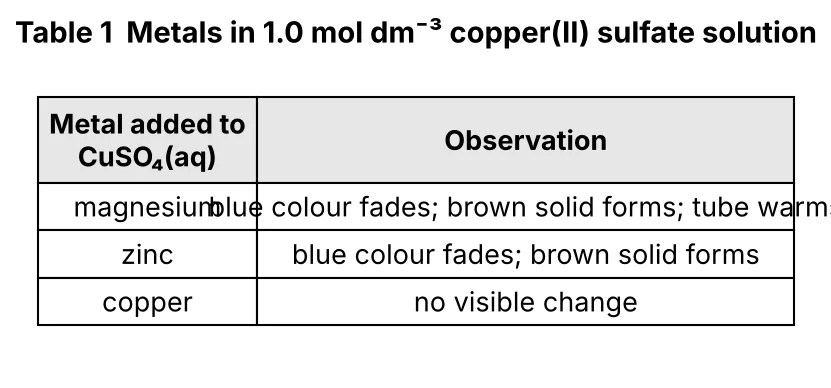
Explain the observations for zinc in terms of electron transfer.
Formulate the ionic equation for the reaction of magnesium.
Suggest a further test-tube experiment that would show whether magnesium is more reactive than zinc, and state one control variable.
Calculate the maximum mass, in g, of copper formed when of magnesium reacts with excess copper(II) sulfate solution.
revisionprep.com
Summary Answer
Not available for this question.
Model Answer
Not available for this question.
Marking Scheme
Not available for this question.
Examiner Insights
Not available for this question.
Redox reactions and electron transfer
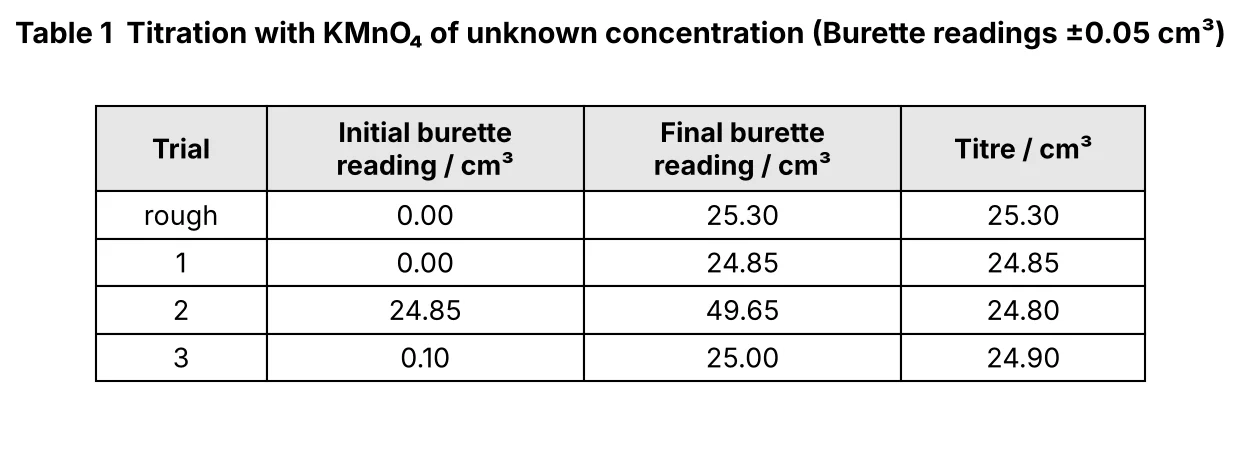
Potassium manganate(VII) solution slowly decomposes, so its concentration is checked against sodium ethanedioate, . A student dissolves of in water and makes the solution up to . Portions of are acidified, warmed and titrated with the solution. The results are shown in Table 1. .
State the oxidation state of carbon in and in .
Formulate the half-equation for the oxidation of ethanedioate ions to carbon dioxide.
Calculate the mean titre, using only concordant results.
Calculate the concentration, in , of the solution.
Explain why no separate indicator is needed in this titration.
Calculate the percentage uncertainty in the mean titre.
revisionprep.com
Summary Answer
Not available for this question.
Model Answer
Not available for this question.
Marking Scheme
Not available for this question.
Examiner Insights
Not available for this question.
Oxidizing and reducing agents
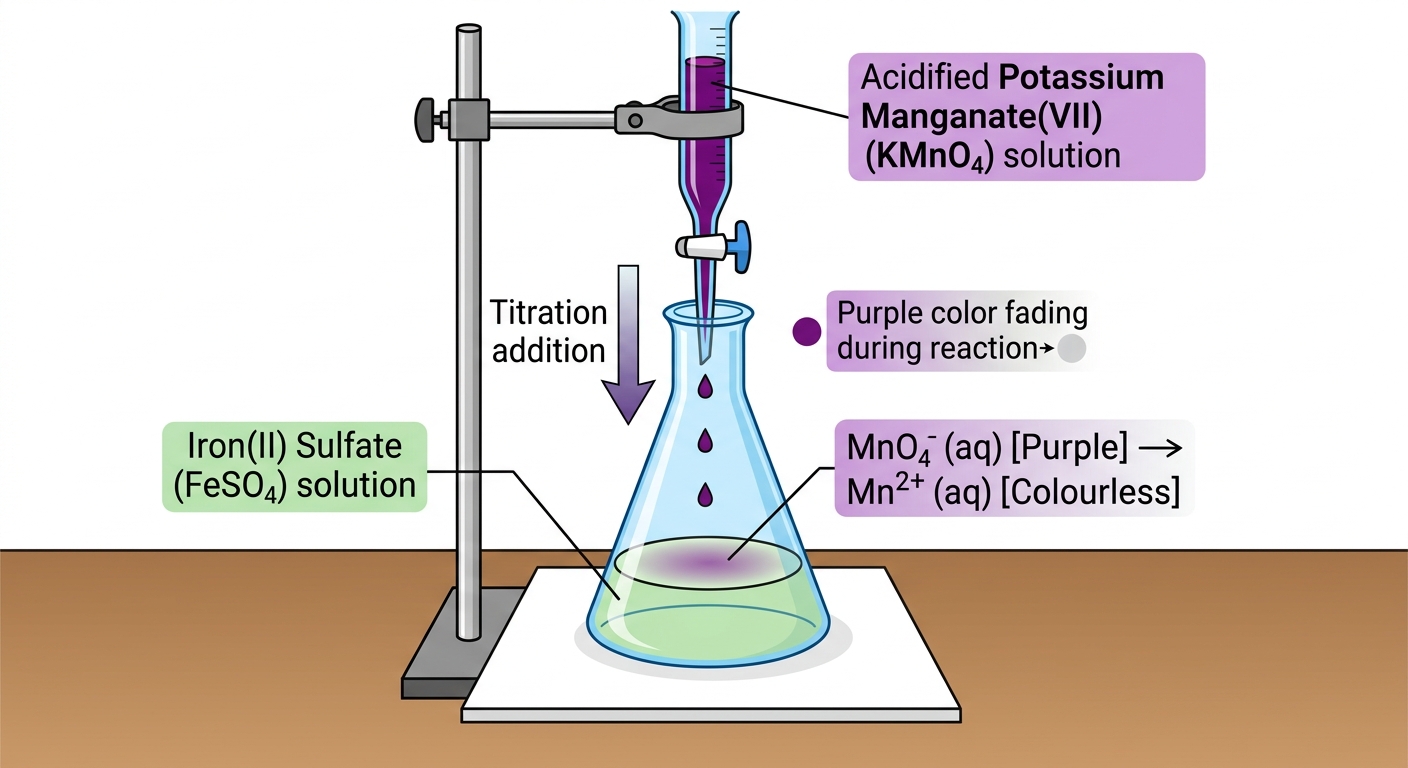
Acidified potassium manganate(VII) is added to iron(II) sulfate solution, as shown. The half-equations are:
Which statement identifies the reducing agent and accounts for the loss of the purple colour?
revisionprep.com
Summary Answer
Not available for this question.
Model Answer
Not available for this question.
Marking Scheme
Not available for this question.
Examiner Insights
Not available for this question.
Redox reactions and electron transfer
Two oxides of copper, X (red) and Y (black), were each heated in a stream of hydrogen until only copper remained. Water was the only other product. The tube and its contents were weighed before and after heating. The balance reads to .
The results are shown in Table 1.
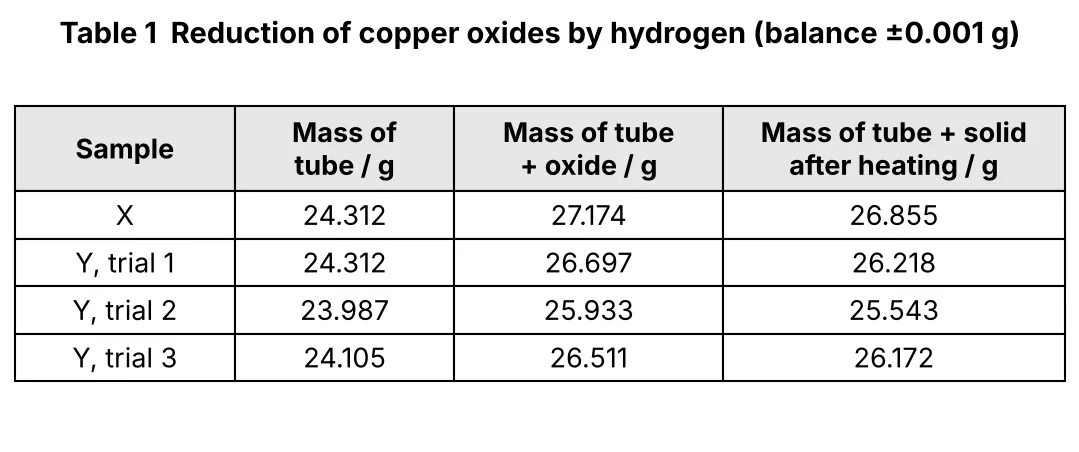
Calculate the amount, in mol, of copper and of oxygen in sample X.
Hence deduce the empirical formula of X.
Calculate the copper to oxygen mole ratio for Y in trials 1 and 2, and deduce the empirical formula of Y.
State the names of X and Y, using Roman numerals.
For Y the equation is . Deduce, with oxidation states, the species oxidized and the species reduced.
Trial 3 gives a copper to oxygen ratio of about 1.5. Suggest a reason for this result, explain its effect on the calculated ratio, and suggest an improvement to the method.
revisionprep.com
Summary Answer
Not available for this question.
Model Answer
Not available for this question.
Marking Scheme
Not available for this question.
Examiner Insights
Not available for this question.
Electrochemical cells and half-reactions
Three metals, J, L and M, each form 2+ ions. Metal J reacts with a solution of ions but does not react with a solution of ions. A voltaic cell is built from a J half-cell and an M half-cell. Which statement about this cell is correct?
revisionprep.com
Summary Answer
Not available for this question.
Model Answer
Not available for this question.
Marking Scheme
Not available for this question.
Examiner Insights
Not available for this question.
That's every free question here — 6 of 91.
+85 more questions, plus Mock Papers & Worksheets, are waiting in Premium.