Proton Transfer Reactions · Paper 1 — Free Chemistry SL Practice Questions
Free questions
Open in full, with answers, mark scheme and examiner insights.
Acid-base reactions: Bronsted-Lowry theory
A student adds magnesium oxide powder, a little at a time, to of hydrochloric acid until some solid remains undissolved. The mass of magnesium oxide that dissolved in each of three trials is shown in Table 1.

Formulate the ionic equation for the reaction and identify the species that acts as the Brønsted–Lowry base.
Calculate the mean mass of magnesium oxide that dissolved and its absolute uncertainty, using half the range of the results.
Calculate the mass of magnesium oxide that should react with the acid, and state whether the mean in (b) agrees with it.
revisionprep.com
Summary Answer
Not available for this question.
Model Answer
Not available for this question.
Marking Scheme
Not available for this question.
Examiner Insights
Not available for this question.
Strong vs weak acids and bases
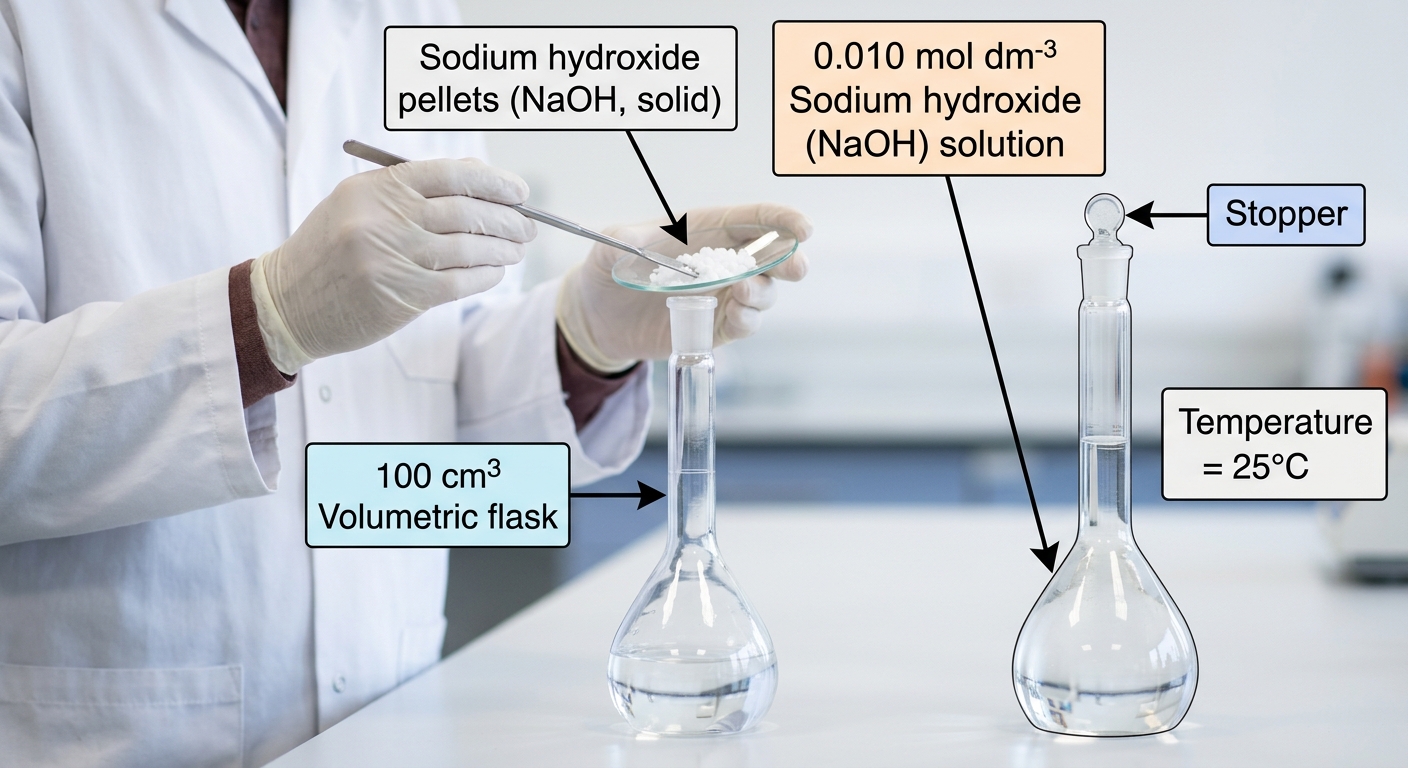
A solution of sodium hydroxide is prepared in a volumetric flask, as shown, at . What is the pH of the solution?
revisionprep.com
Summary Answer
Not available for this question.
Model Answer
Not available for this question.
Marking Scheme
Not available for this question.
Examiner Insights
Not available for this question.
Acid-base reactions: Bronsted-Lowry theory
Methanoic acid, HCOOH, reacts with ammonia in aqueous solution by the transfer of one proton. Which species are the products?
revisionprep.com
Summary Answer
Not available for this question.
Model Answer
Not available for this question.
Marking Scheme
Not available for this question.
Examiner Insights
Not available for this question.
Strong vs weak acids and bases
A student measures the pH of five dilutions of hydrochloric acid and five of ethanoic acid at and plots pH against of the acid concentration. Figure 1 shows the results with error bars of .
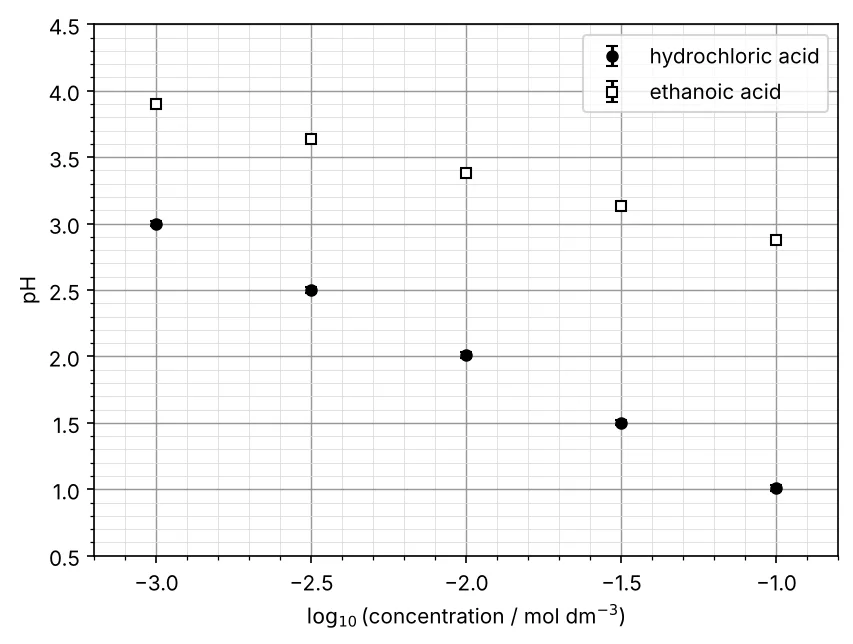
Determine the gradient of the line through the hydrochloric acid points.
Determine the gradient for ethanoic acid and state how it compares with the gradient for hydrochloric acid.
Explain, in terms of ionization, why the gradient for ethanoic acid has a smaller magnitude.
Suggest why error bars of do not affect your conclusion.
revisionprep.com
Summary Answer
Not available for this question.
Model Answer
Not available for this question.
Marking Scheme
Not available for this question.
Examiner Insights
Not available for this question.
Acid-base reactions: Bronsted-Lowry theory
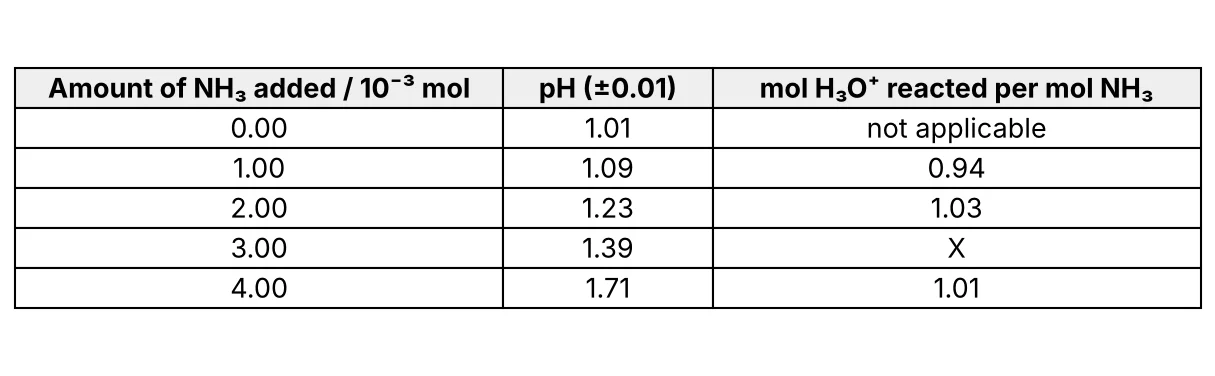
A student investigated the proton transfer between hydronium ions and ammonia. Measured amounts of ammonia were added to of hydrochloric acid at , and the pH was recorded with a calibrated pH meter reading to . The ammonia was added as a concentrated solution, so the total volume can be taken as throughout.
The amount of that reacted was found as the initial amount, , minus the amount left in solution.
The results are shown in Table 1.
Deduce the equation for the proton transfer between and .
Identify the two conjugate acid–base pairs in your equation, giving the acid first in each pair.
Calculate the amount, in mol, of left in solution after of ammonia had been added.
Hence determine the value of X.
Evaluate the student's conclusion that one mole of reacts with each mole of ammonia added. Refer to the data and to the precision of the pH meter.
revisionprep.com
Summary Answer
Not available for this question.
Model Answer
Not available for this question.
Marking Scheme
Not available for this question.
Examiner Insights
Not available for this question.
Strong vs weak acids and bases
A student uses a calibrated pH meter (uncertainty ) to measure the pH of hydrochloric acid and of a weak monoprotic acid, HA, at three concentrations at .
The results are shown in Table 1.
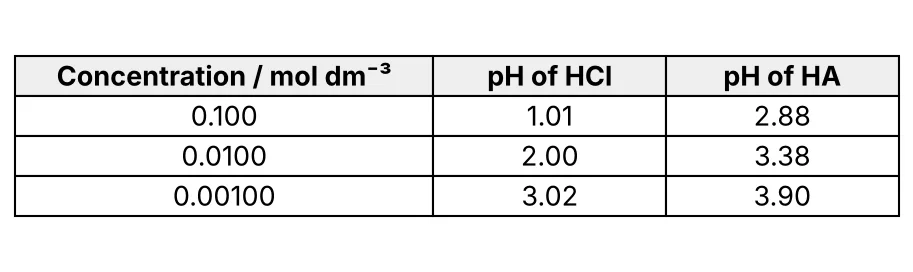
Calculate in each of the three HA solutions.
Calculate the percentage of HA molecules ionized at each concentration.
Describe the trend in the percentage ionization of HA as the solution is diluted.
Explain this trend using the equilibrium for the ionization of HA.
Outline how the HCl data indicate complete dissociation of hydrochloric acid.
The student concludes: the pH difference between HA and HCl gets smaller on dilution, so HA becomes a strong acid when it is very dilute. Evaluate this conclusion.
revisionprep.com
Summary Answer
Not available for this question.
Model Answer
Not available for this question.
Marking Scheme
Not available for this question.
Examiner Insights
Not available for this question.
That's every free question here — 6 of 111.
+105 more questions, plus Mock Papers & Worksheets, are waiting in Premium.