You're viewing 1 free preview question for Chemistry SL — subscribe to unlock 89 more, plus the Full Question Bank, Mock Papers & Worksheets.Upgrade
Electron Sharing Reactions · Paper 2 — Free Chemistry SL Practice Questions
1MasterySAQ-SCovalent bonds and electron sharing5 marksPaper 2~8 min

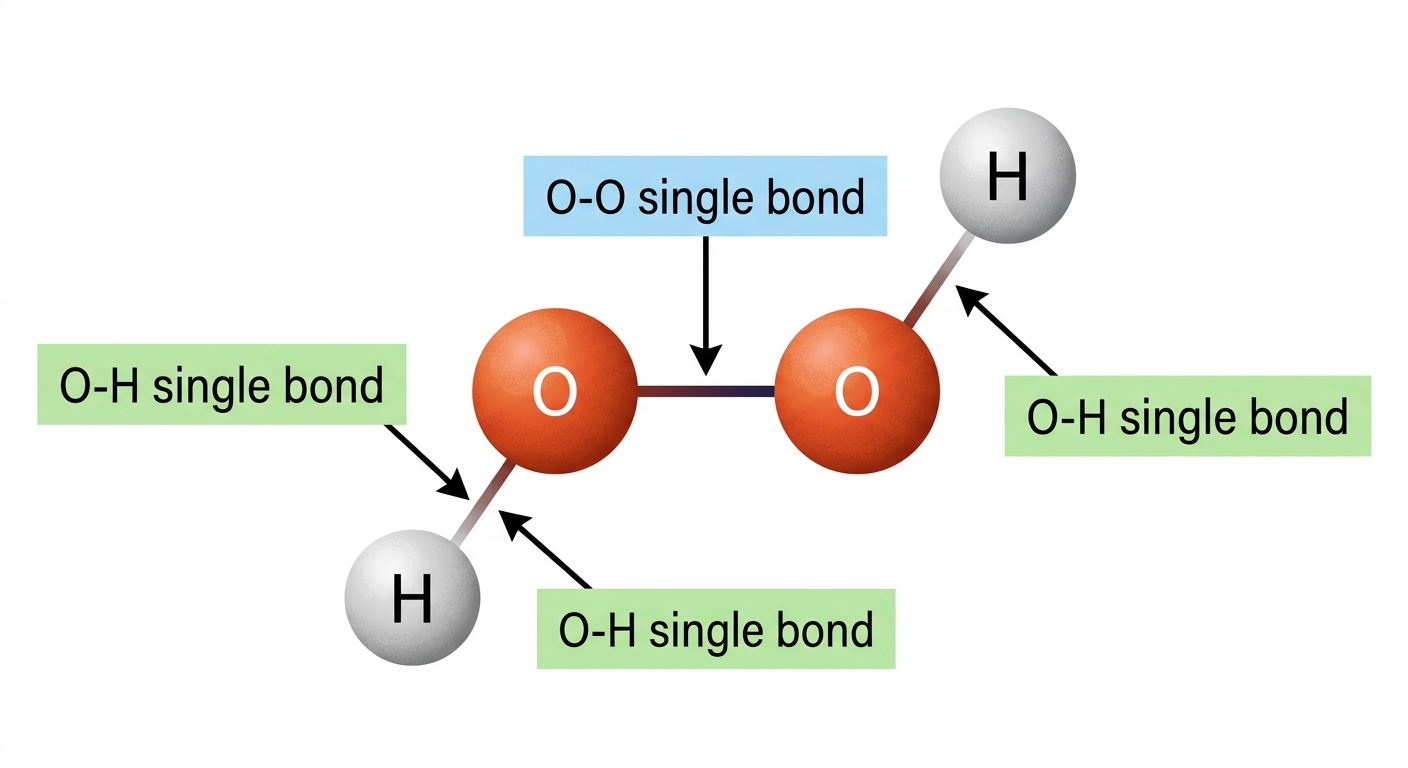
Hydrogen peroxide, , is used as a disinfectant and bleaching agent. Its structural formula is H–O–O–H, containing one O–O bond and two O–H bonds.
Bond enthalpies: ;
(a)
State the number of electrons shared in the O–O bond of . [1 mark]
(b)
Calculate the total energy, in , required to break all bonds in one mole of molecules. [2 marks]
(c)
Deduce, with reference to atomic orbital overlap, why the O–O bond enthalpy is significantly lower than the O–H bond enthalpy, and predict whether the O–O bond in would be stronger or weaker than a C–C single bond (bond enthalpy ), justifying your answer. [2 marks]

Solutions
That's every free question here — 1 of 90.
+89 more questions, plus Mock Papers & Worksheets, are waiting in Premium.