Electron Transfer Reactions · Paper 2 — Free Chemistry SL Practice Questions
Free questions
Open in full, with answers, mark scheme and examiner insights.
Redox reactions and electron transfer
Silver jewellery tarnishes in air that contains traces of hydrogen sulfide:
State the oxidation state of silver in .
Identify the species oxidized and the species reduced, giving the change in oxidation state of each.
Outline why sulfur is neither oxidized nor reduced.
The tarnish can be removed by warming the jewellery with aluminium foil in salt water: . Identify the reducing agent.
revisionprep.com
Summary Answer
Not available for this question.
Model Answer
Not available for this question.
Marking Scheme
Not available for this question.
Examiner Insights
Not available for this question.
Electrochemical cells and half-reactions
A student builds a voltaic cell from a zinc electrode in zinc nitrate solution and a lead electrode in lead(II) nitrate solution. The half-cells are joined by a salt bridge containing aqueous potassium nitrate, and the electrodes are connected to a voltmeter.
Deduce which electrode is the negative electrode. Give a reason.
Formulate the half-equations for the reactions at the negative electrode and at the positive electrode.
Explain the function of the salt bridge in this cell.
revisionprep.com
Summary Answer
Not available for this question.
Model Answer
Not available for this question.
Marking Scheme
Not available for this question.
Examiner Insights
Not available for this question.
Oxidizing and reducing agents
An iron nail is placed in a dish of salt water containing an indicator that turns blue with ions. After one hour, a blue colour appears near the point of the nail. The experiment is repeated with a strip of magnesium wrapped tightly around a second nail; no blue colour appears. Magnesium is above iron in the activity series.
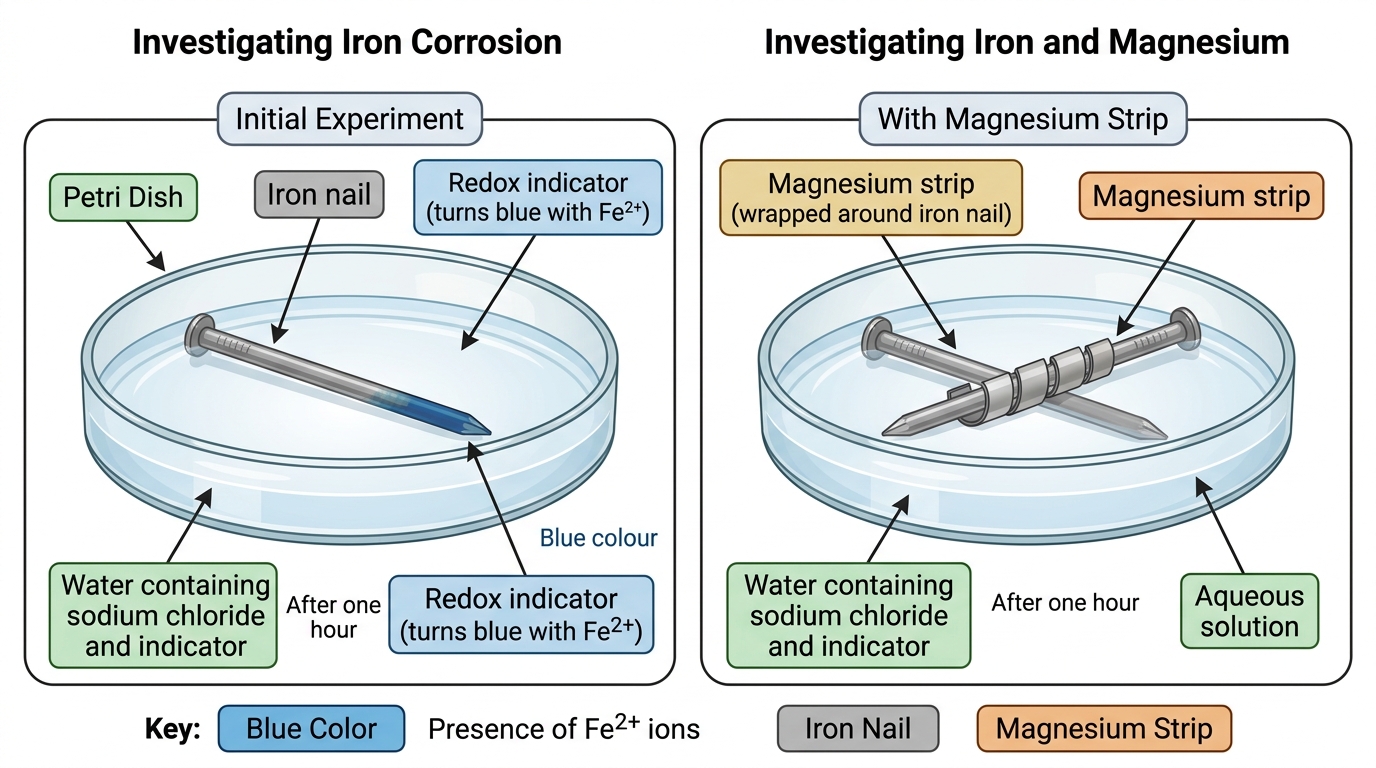
State the species that is oxidized where the blue colour appears.
Write the half-equation for the reduction of dissolved oxygen in water to hydroxide ions at the nail surface.
Explain, using the activity series, why the magnesium strip stops the iron from rusting.
revisionprep.com
Summary Answer
Not available for this question.
Model Answer
Not available for this question.
Marking Scheme
Not available for this question.
Examiner Insights
Not available for this question.
Oxidizing and reducing agents
Propan-1-ol is heated with acidified potassium dichromate(VI) using either apparatus X or apparatus Y, shown in the diagram.
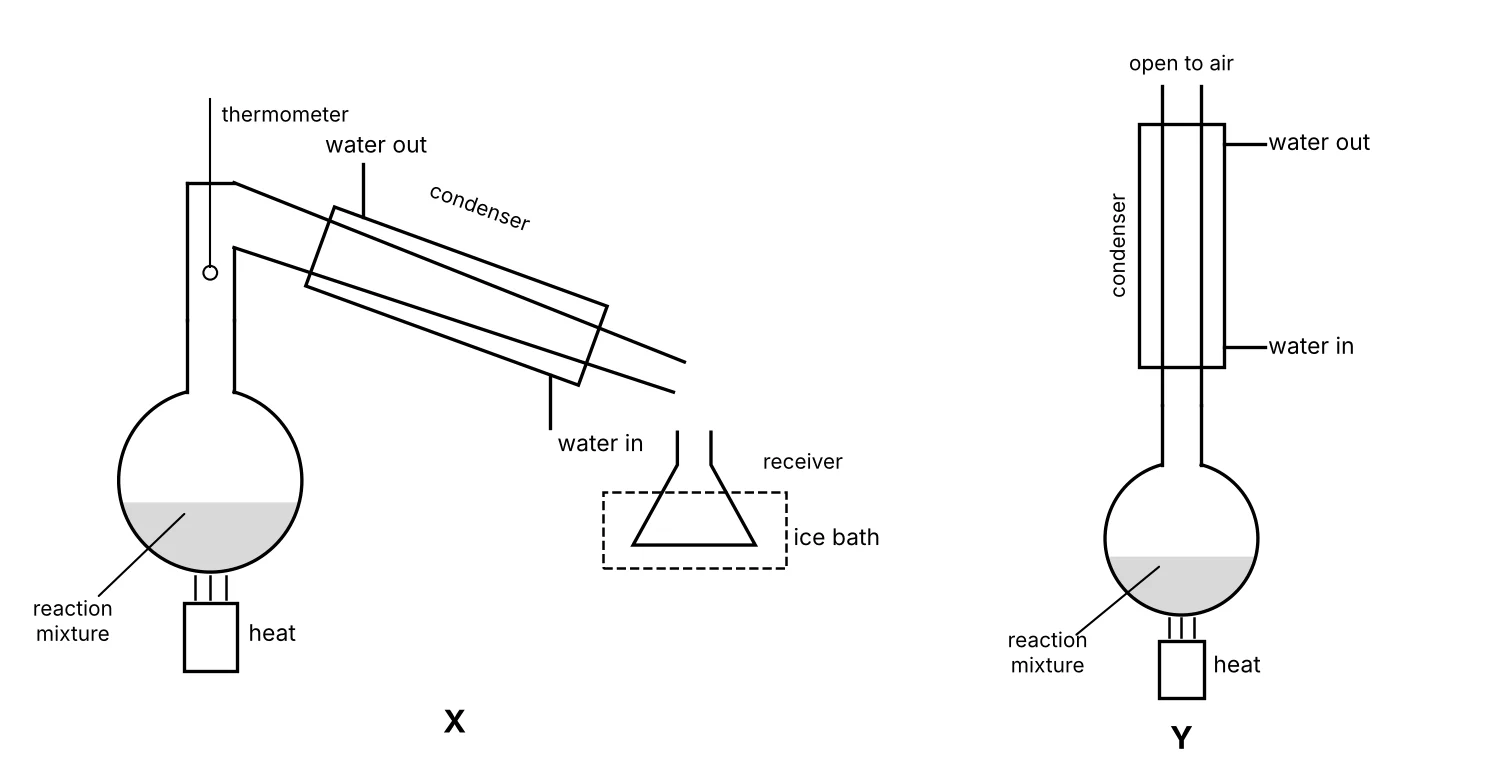
Identify the organic product collected in the receiver of apparatus X.
Explain, using the data, why apparatus X gives this product rather than the fully oxidized product.
Identify the main organic product left in the flask of apparatus Y and explain why apparatus Y gives this product.
Write an equation for the reaction in (c), using [O] to represent the oxidizing agent.
Propan-2-ol is heated with the same reagent in apparatus Y. Predict the organic product and explain why it is not oxidized further.
revisionprep.com
Summary Answer
Not available for this question.
Model Answer
Not available for this question.
Marking Scheme
Not available for this question.
Examiner Insights
Not available for this question.
Redox reactions and electron transfer
Chlorine is added to swimming-pool water to kill bacteria. It reacts with water:
Chloric(I) acid, HOCl, then partly ionizes:
Deduce the oxidation state of chlorine in , HCl and HOCl.
The ion is named chlorate(I). Explain why the ionization of HOCl is not a redox reaction, and what the (I) in the name shows.
A student claims: 'The reaction of chlorine with water cannot be redox, because chlorine does not gain or lose oxygen and no ions are transferred between atoms.' Discuss this claim, referring to the definitions of oxidation and reduction in terms of oxygen and hydrogen, electrons and oxidation states.
A pool contains of water. Calculate the mass, in kg, of chlorine that must be added to give of HOCl, assuming all the chlorine reacts by the first equation.
HOCl kills bacteria by oxidizing them and is itself reduced to . State the change in oxidation state of chlorine.
revisionprep.com
Summary Answer
Not available for this question.
Model Answer
Not available for this question.
Marking Scheme
Not available for this question.
Examiner Insights
Not available for this question.
Primary, secondary and electrolytic cells
In a direct methanol fuel cell with an acidic electrolyte, liquid methanol, , is oxidized to carbon dioxide at one electrode and oxygen is reduced to water at the other.
Deduce the oxidation state of carbon in and in .
Write the balanced half-equation for the oxidation of methanol to carbon dioxide in acidic solution.
Write the half-equation for the reduction of oxygen in acidic solution.
Deduce the overall equation for the cell reaction from your half-equations.
Outline one advantage and one disadvantage of methanol compared with hydrogen as the fuel in a fuel cell.
Calculate the volume, in , of oxygen at STP that reacts with of methanol in the cell. Molar volume of a gas at STP .
Explain how a fuel cell differs from a primary cell, and why it converts the energy of methanol into electrical energy more efficiently than burning methanol to drive a generator.
revisionprep.com
Summary Answer
Not available for this question.
Model Answer
Not available for this question.
Marking Scheme
Not available for this question.
Examiner Insights
Not available for this question.
That's every free question here — 6 of 80.
+74 more questions, plus Mock Papers & Worksheets, are waiting in Premium.