Proton Transfer Reactions · Paper 2 — Free Chemistry SL Practice Questions
Free questions
Open in full, with answers, mark scheme and examiner insights.
Acid-base reactions: Bronsted-Lowry theory
Liquid ammonia, like water, ionizes very slightly by proton transfer between two of its own molecules: .
State what is meant by an amphiprotic species and explain why ammonia is amphiprotic in this reaction.
Identify the two conjugate acid–base pairs in the equation.
Deduce the ion that behaves in liquid ammonia in the same way as the hydroxide ion behaves in water.
revisionprep.com
Summary Answer
Not available for this question.
Model Answer
Not available for this question.
Marking Scheme
Not available for this question.
Examiner Insights
Not available for this question.
Kw, neutralisation and pH curves (strong acid-strong base)
A rust remover is a solution of a strong acid with a pH of at .
State the expression for the ionic product of water, , and its value at .
Calculate and in the rust remover.
The rust remover is diluted with water. State how changes.
revisionprep.com
Summary Answer
Not available for this question.
Model Answer
Not available for this question.
Marking Scheme
Not available for this question.
Examiner Insights
Not available for this question.
Acid-base reactions: Bronsted-Lowry theory
of calcium hydroxide solution (limewater), , is titrated with hydrochloric acid. The pH is recorded with a pH meter. The graph shows the results.
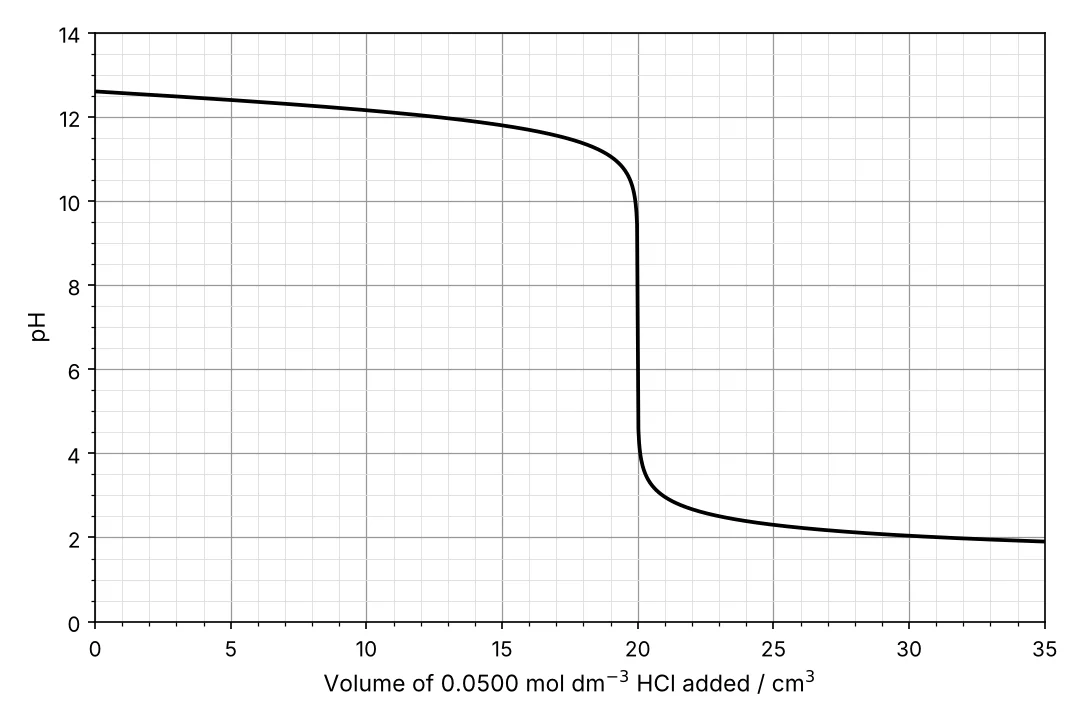
Deduce the ionic equation for the neutralisation.
State the volume of acid added at the equivalence point.
Calculate the concentration, in , of the calcium hydroxide solution.
State the pH at the equivalence point and identify the ions present in the solution at this point.
The titration is repeated with of sodium hydroxide solution of the same concentration in as the calcium hydroxide. Deduce the volume of acid needed to reach the equivalence point and calculate the initial pH of the sodium hydroxide solution at , using .
revisionprep.com
Summary Answer
Not available for this question.
Model Answer
Not available for this question.
Marking Scheme
Not available for this question.
Examiner Insights
Not available for this question.
Strong vs weak acids and bases
The diagram represents equal volumes of four aqueous solutions of monoprotic acids, HA. Water molecules are not shown. Beakers 3 and 4 contain the same acid at different concentrations.
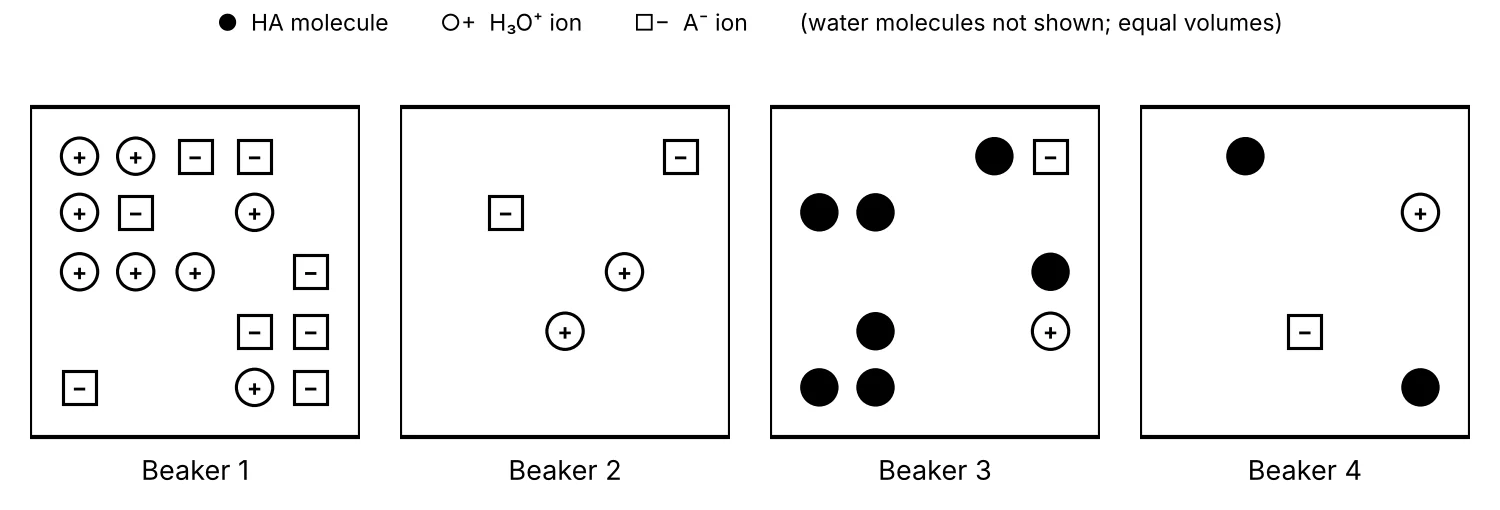
Identify the two beakers that contain a strong acid. Give a reason.
Identify the beaker that represents a concentrated solution of a weak acid.
Deduce, with a reason, which of beakers 2 and 3 has the lower pH.
Calculate the percentage of acid molecules ionized in beaker 3 and in beaker 4, and explain the difference.
revisionprep.com
Summary Answer
Not available for this question.
Model Answer
Not available for this question.
Marking Scheme
Not available for this question.
Examiner Insights
Not available for this question.
Strong vs weak acids and bases
Solution R is ethanoic acid. Solution S is hydrochloric acid prepared so that it has the same pH as solution R, , at .
Determine the concentration of the hydrochloric acid in solution S.
Calculate the volume of sodium hydroxide needed to neutralise of each solution.
Discuss why the two solutions have the same pH but need very different amounts of sodium hydroxide. Include equations for the ionization of each acid and refer to what happens to each equilibrium as the base is added.
of solution R and of solution S are each diluted to with distilled water. Calculate the pH of diluted S.
Predict, with reasons, whether the pH of diluted R rises by more than, less than or exactly the same amount as the pH of diluted S.
revisionprep.com
Summary Answer
Not available for this question.
Model Answer
Not available for this question.
Marking Scheme
Not available for this question.
Examiner Insights
Not available for this question.
pH scale and calculations
A student has hydrochloric acid and sodium hydroxide solution at 298 K. of each solution is made up separately to with distilled water.
Determine the pH of the original hydrochloric acid.
Calculate the pH of the original sodium hydroxide solution.
Determine the pH of each diluted solution.
The student writes: 'Diluting any solution of an acid or a base tenfold always raises its pH by exactly one unit.' Evaluate this statement, using your answers and your knowledge of the pH scale.
of the original hydrochloric acid is mixed with of the original sodium hydroxide solution. Calculate the pH of the mixture.
State the pH of the mixture when equal volumes of the two original solutions are mixed, and give a reason.
revisionprep.com
Summary Answer
Not available for this question.
Model Answer
Not available for this question.
Marking Scheme
Not available for this question.
Examiner Insights
Not available for this question.
That's every free question here — 6 of 103.
+97 more questions, plus Mock Papers & Worksheets, are waiting in Premium.