Functional Groups: Classification of Organic Compounds · Paper 1 — Free Chemistry SL Practice Questions
Free questions
Open in full, with answers, mark scheme and examiner insights.
IUPAC naming conventions for organic compounds
A student collects the boiling points of the structural isomers of from a data source. Table 1 shows the data.
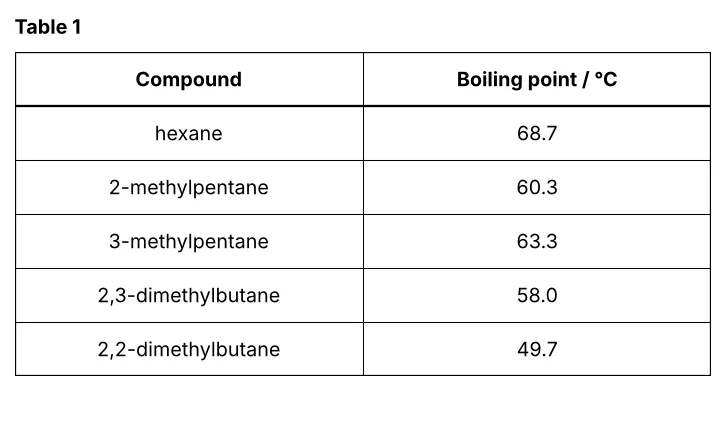
State the trend in boiling point as the number of methyl branches in the isomers increases.
Calculate the difference in boiling point between hexane and 2,2-dimethylbutane.
Explain the trend, using the shapes of the molecules.
Suggest one limitation of comparing boiling points that were collected from different sources.
revisionprep.com
Summary Answer
Not available for this question.
Model Answer
Not available for this question.
Marking Scheme
Not available for this question.
Examiner Insights
Not available for this question.
Introduction to organic chemistry and functional groups
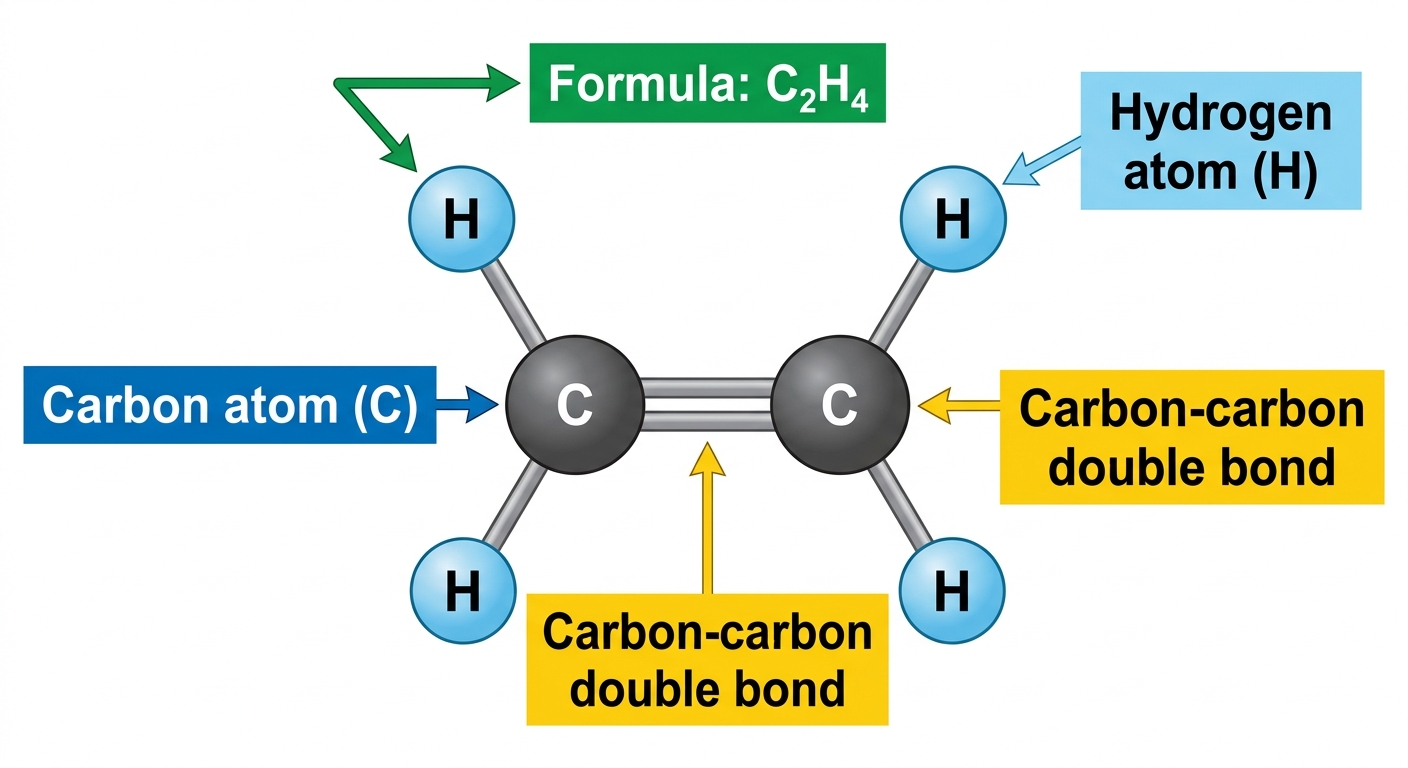
The shows a molecule of ethene. Which row gives the homologous series of ethene and the general formula of that series?
revisionprep.com
Summary Answer
Not available for this question.
Model Answer
Not available for this question.
Marking Scheme
Not available for this question.
Examiner Insights
Not available for this question.
IUPAC naming conventions for organic compounds
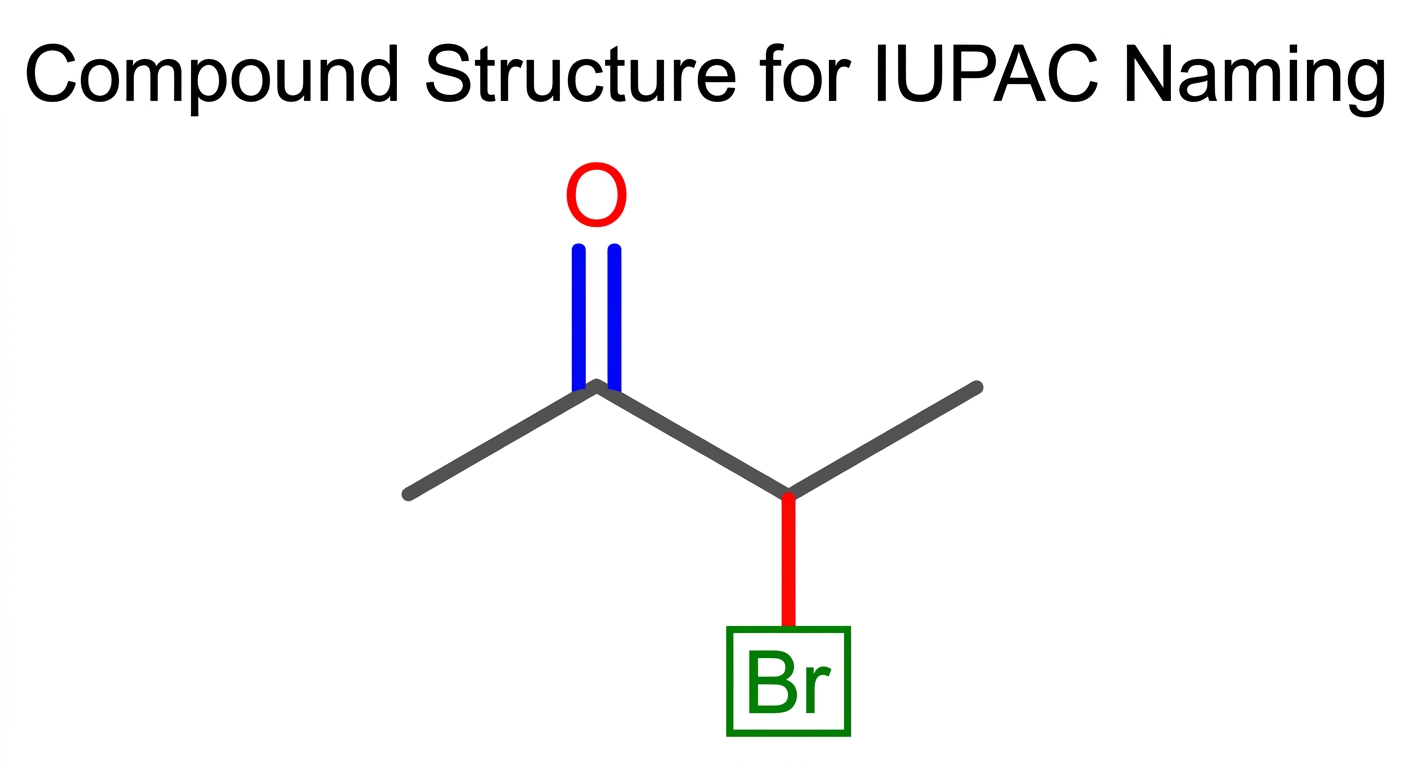
What is the IUPAC name of the compound shown?
revisionprep.com
Summary Answer
Not available for this question.
Model Answer
Not available for this question.
Marking Scheme
Not available for this question.
Examiner Insights
Not available for this question.
Introduction to organic chemistry and functional groups
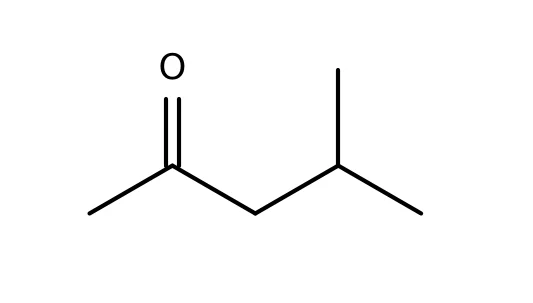
The skeletal formula of an organic compound is shown. Which row gives its molecular formula and its functional group?
revisionprep.com
Summary Answer
Not available for this question.
Model Answer
Not available for this question.
Marking Scheme
Not available for this question.
Examiner Insights
Not available for this question.
IUPAC naming conventions for organic compounds
The table shows boiling points of unbranched alkanes and of the corresponding 1-bromoalkanes.
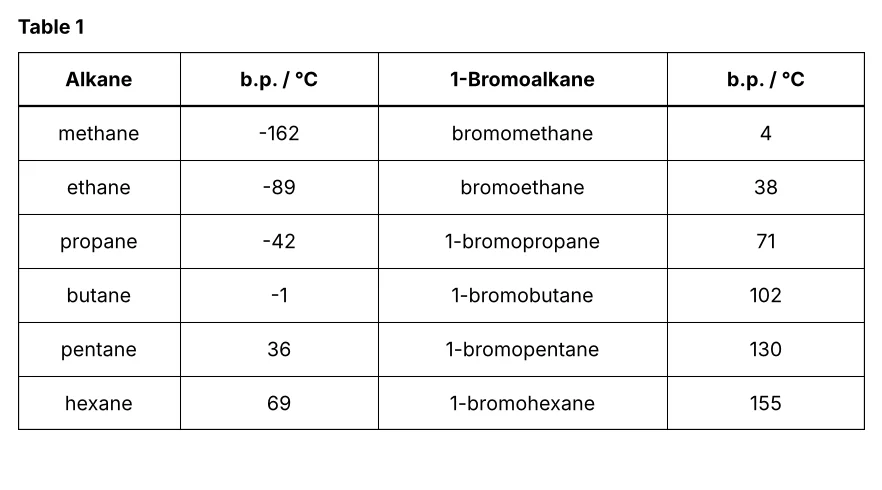
Calculate the mean increase in boiling point for each additional group from propane to hexane.
Predict the boiling point of 1-bromoheptane.
Explain the trend in the boiling points of the alkanes as the chain length increases.
Explain why bromoethane has a much higher boiling point than ethane.
2-Bromo-2-methylpropane boils at 73 °C and 1-bromobutane at 102 °C. A student says the difference is because 2-bromo-2-methylpropane has a smaller molar mass. Evaluate the validity of this claim.
revisionprep.com
Summary Answer
Not available for this question.
Model Answer
Not available for this question.
Marking Scheme
Not available for this question.
Examiner Insights
Not available for this question.
Introduction to organic chemistry and functional groups
A liquid used as a solvent contains only carbon, hydrogen and oxygen. Analysis gives C, H and O by mass, and its relative molecular mass is . Table 1 shows the results of tests on the liquid.
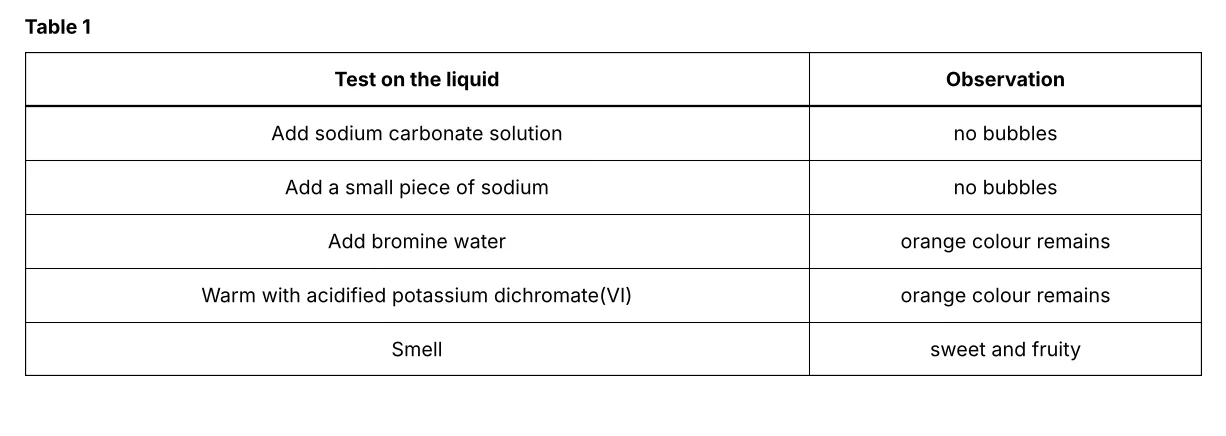
Deduce the empirical formula of the liquid.
Deduce the molecular formula of the liquid.
Deduce the functional group that the liquid contains, using the results in Table 1.
The liquid is the ester formed from ethanoic acid. Deduce its structural formula and IUPAC name.
Explain one limitation of identifying the liquid using these tests alone.
revisionprep.com
Summary Answer
Not available for this question.
Model Answer
Not available for this question.
Marking Scheme
Not available for this question.
Examiner Insights
Not available for this question.
That's every free question here — 6 of 247.
+241 more questions, plus Mock Papers & Worksheets, are waiting in Premium.