The Periodic Table: Classification of Elements · Paper 1 — Free Chemistry SL Practice Questions
Free questions
Open in full, with answers, mark scheme and examiner insights.
Periodic trends: Atomic radius, ionization energy, electronegativity
X, Y and Z are three consecutive elements in Period 3, but not in alphabetical or numerical order. A student measures their atomic radii. The student uses the same method and controlled variables for every element. Table 1 shows the data.
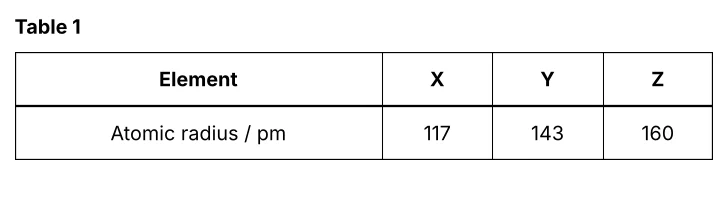
Deduce which element has the greatest nuclear charge, with a reason.
Calculate the difference in atomic radius between Z and X.
Explain why the atomic radius decreases across Period 3.
revisionprep.com
Summary Answer
Not available for this question.
Model Answer
Not available for this question.
Marking Scheme
Not available for this question.
Examiner Insights
Not available for this question.
Group classification of elements
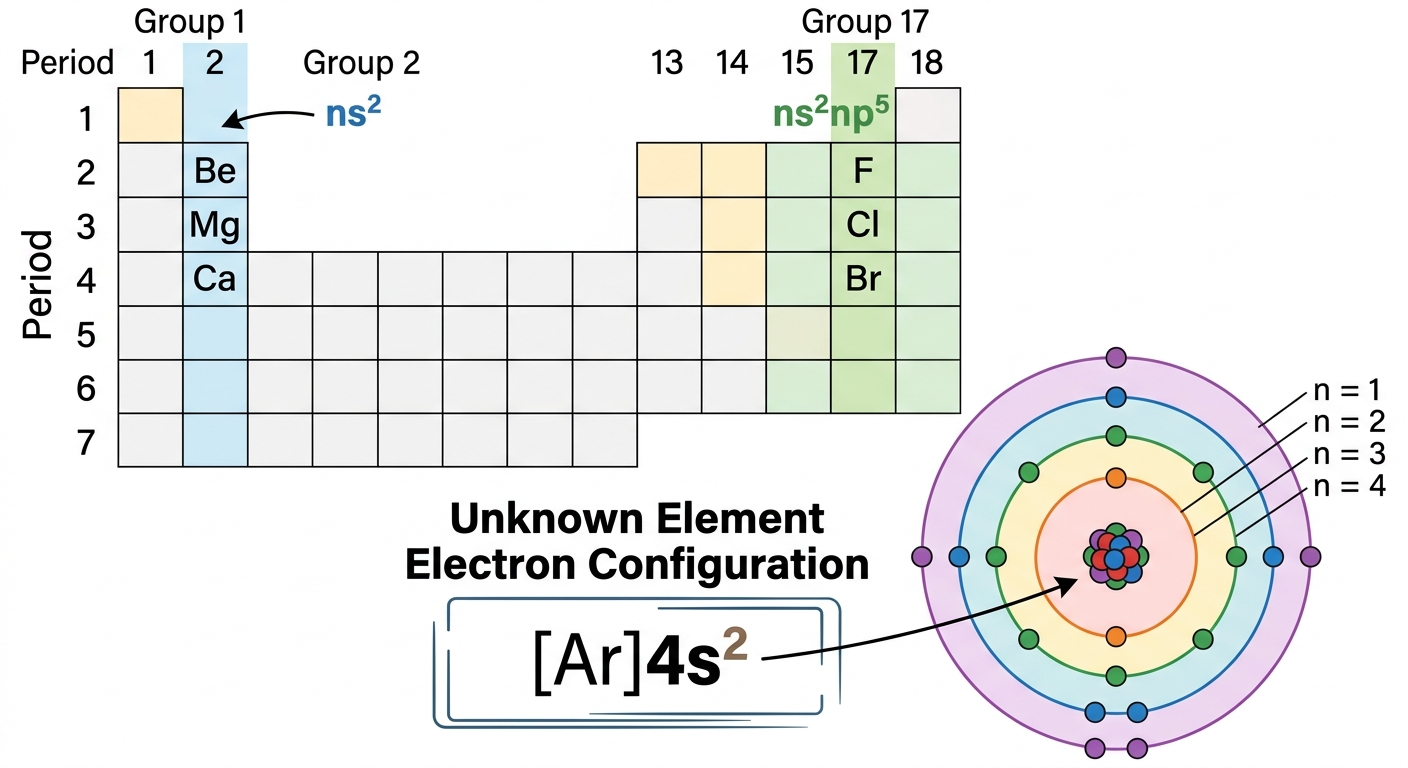
An unknown element has the electron configuration . To which group of the periodic table does this element belong?
revisionprep.com
Summary Answer
Not available for this question.
Model Answer
Not available for this question.
Marking Scheme
Not available for this question.
Examiner Insights
Not available for this question.
Periodic trends: Atomic radius, ionization energy, electronegativity
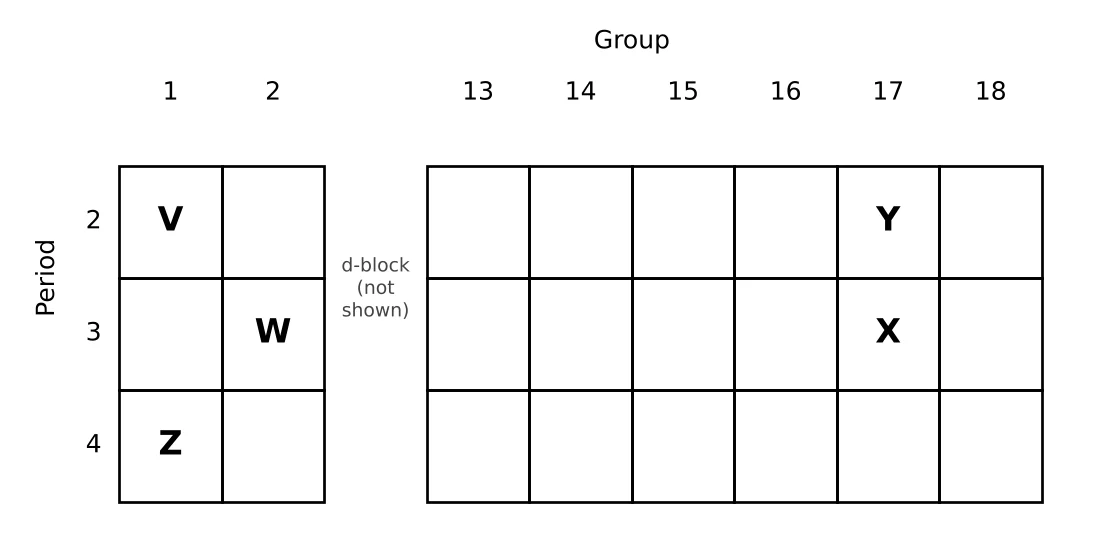
The shows part of the periodic table. The letters V to Z are not the symbols of the elements.
Which labelled element has the highest first ionization energy?
revisionprep.com
Summary Answer
Not available for this question.
Model Answer
Not available for this question.
Marking Scheme
Not available for this question.
Examiner Insights
Not available for this question.
Group classification of elements
The table gives data for the halogens fluorine to iodine. All four are simple molecular substances.
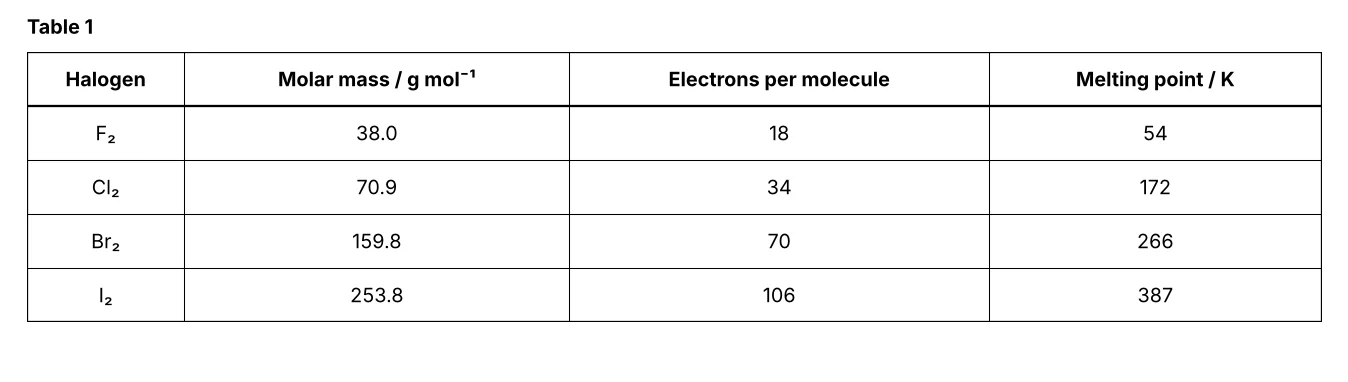
State the trend in melting point down Group 17.
Determine the melting point of iodine in .
Explain the trend in melting points in terms of the forces between molecules.
Predict whether the melting point of astatine, (170 electrons per molecule), is above or below 387 K. Give a reason.
Outline what happens to the molecules and the covalent bonds when solid iodine melts.
revisionprep.com
Summary Answer
Not available for this question.
Model Answer
Not available for this question.
Marking Scheme
Not available for this question.
Examiner Insights
Not available for this question.
Periodic trends: Atomic radius, ionization energy, electronegativity
Three elements X, Y and Z are in Period 3. Each is in a different group: Group 1, Group 2 or Group 17. A student collects data from a data book. Table 1 shows the data.
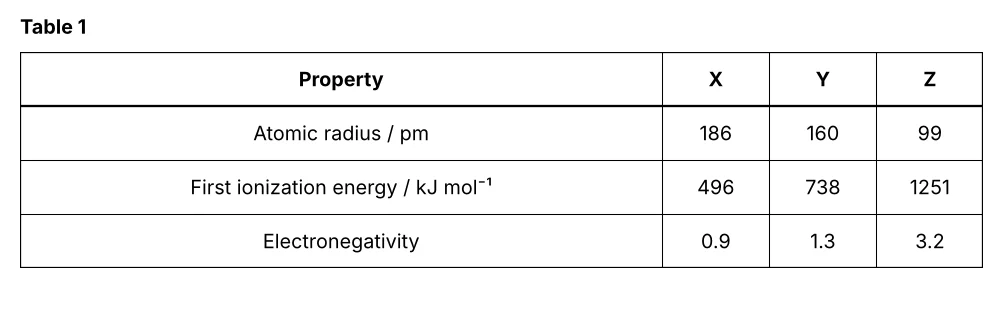
Deduce which element is in Group 17, giving two reasons from the data.
Calculate the ratio of the first ionization energy of Z to that of X.
Explain why Y has a higher first ionization energy than X.
Explain why Z has a higher electronegativity than Y.
Discuss whether data for three elements are enough to establish a periodic trend.
revisionprep.com
Summary Answer
Not available for this question.
Model Answer
Not available for this question.
Marking Scheme
Not available for this question.
Examiner Insights
Not available for this question.
Group classification of elements
A student shakes of each of six Period 3 oxides with of distilled water at and measures the pH. Distilled water has a pH of .
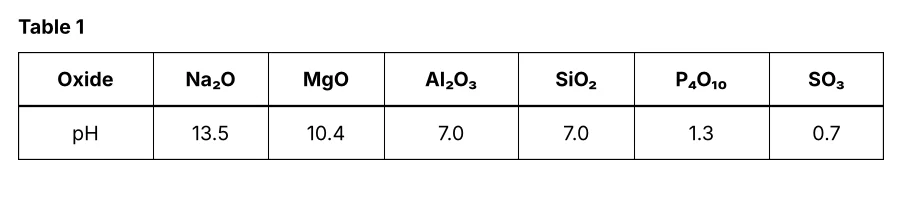
Identify the oxide that forms the most acidic solution and write an equation for its reaction with water.
Deduce, using the data, one similarity and one difference between the behaviour of and of MgO with water.
The pH is for both and . Deduce what this shows about their reaction with water and suggest why behaves in this way.
Predict whether the pH of a solution formed from chlorine(VII) oxide, , will be above or below . Justify your answer.
State one limitation of comparing the pH values of oxides using of each.
revisionprep.com
Summary Answer
Not available for this question.
Model Answer
Not available for this question.
Marking Scheme
Not available for this question.
Examiner Insights
Not available for this question.
That's every free question here — 6 of 164.
+158 more questions, plus Mock Papers & Worksheets, are waiting in Premium.