The Periodic Table: Classification of Elements · Paper 2 — Free Chemistry SL Practice Questions
Free questions
Open in full, with answers, mark scheme and examiner insights.
Periodic trends: Atomic radius, ionization energy, electronegativity
The table gives the radii of some atoms and ions.
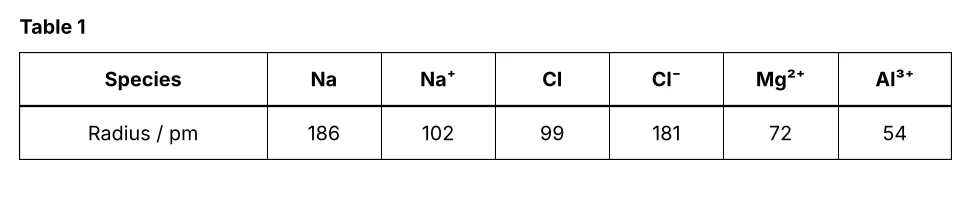
Calculate the percentage decrease in radius when a sodium atom forms a sodium ion.
Explain why the sodium ion is smaller than the sodium atom.
Explain why the chloride ion is larger than the chlorine atom.
The ions , and have the same electron configuration. Explain why their radii decrease in the order .
revisionprep.com
Summary Answer
Not available for this question.
Model Answer
Not available for this question.
Marking Scheme
Not available for this question.
Examiner Insights
Not available for this question.
Group classification of elements
Four elements, P, Q, R and S, are known only by their electron configurations. The table gives the configuration of each.
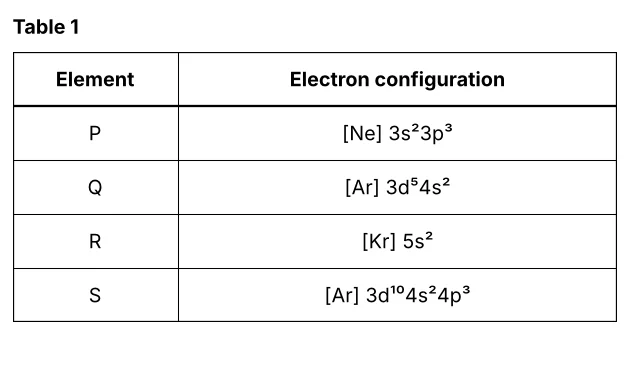
State the period and the group number of element P.
State the block (s, p, d or f) in which each of Q, R and S is found.
Identify the two elements that are in the same group. Give a reason for your choice.
Element T is in Period 4 and Group 13. Write the full electron configuration of an atom of T.
revisionprep.com
Summary Answer
Not available for this question.
Model Answer
Not available for this question.
Marking Scheme
Not available for this question.
Examiner Insights
Not available for this question.
Periodic trends: Atomic radius, ionization energy, electronegativity
The ions , , , and are isoelectronic. The ionic radii of three of them are given.
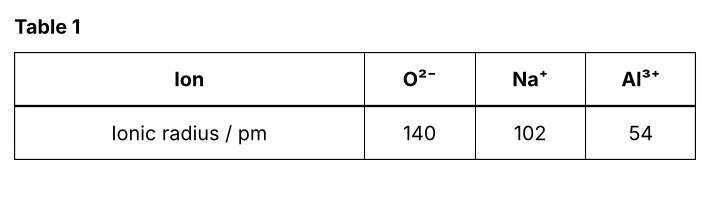
State the meaning of isoelectronic and write the electron configuration shared by these five ions.
Deduce the order of ionic radius of the five ions, from smallest to largest.
Explain the order in terms of nuclear charge, number of electrons and attraction.
State the number of protons in the ion with the smallest radius.
revisionprep.com
Summary Answer
Not available for this question.
Model Answer
Not available for this question.
Marking Scheme
Not available for this question.
Examiner Insights
Not available for this question.
Group classification of elements
A student adds a small piece of lithium, sodium and potassium in turn to water in a trough. Universal indicator is present in the water. The first ionization energies of the three metals and of rubidium are shown.

Describe two observations that show potassium is more reactive than lithium.
Write the equation for the reaction of potassium with water, including state symbols.
Identify the ion that causes the indicator to turn blue or purple.
Explain, using the data and atomic structure, why potassium is more reactive than lithium.
Predict how the vigor of the reaction of rubidium with water compares with that of potassium.
revisionprep.com
Summary Answer
Not available for this question.
Model Answer
Not available for this question.
Marking Scheme
Not available for this question.
Examiner Insights
Not available for this question.
Periodic trends: Atomic radius, ionization energy, electronegativity
The table gives data for two atoms from Period 3 and two atoms from Period 5.
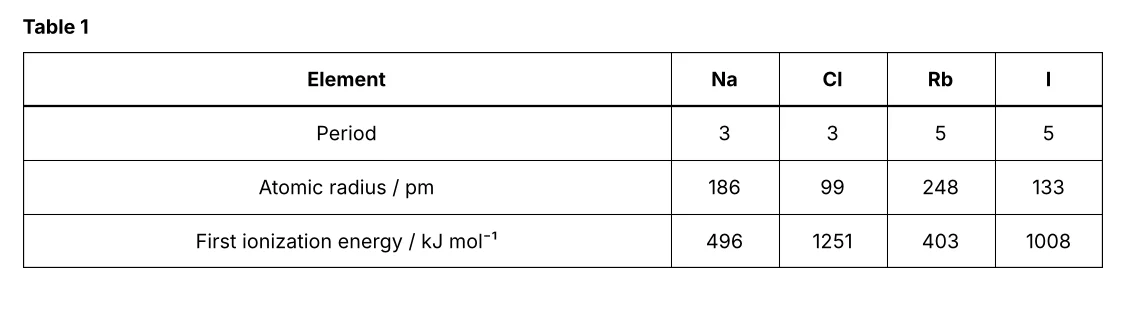
State which of the four elements has the highest first ionization energy and which has the largest atomic radius.
Explain why rubidium has a lower first ionization energy than sodium.
A student claims that every Period 5 element has a lower first ionization energy than every Period 3 element. Evaluate the claim using the data.
revisionprep.com
Summary Answer
Not available for this question.
Model Answer
Not available for this question.
Marking Scheme
Not available for this question.
Examiner Insights
Not available for this question.
Oxides of elements and oxidation states
A mixture of sodium oxide and aluminium oxide is shaken with water. The sodium oxide dissolves completely and of solid remains. Assume that the aluminium oxide does not dissolve. .
Deduce which oxide remains as the solid.
Determine the amount of sodium oxide in the mixture.
Calculate the volume of hydrochloric acid, in , needed to neutralise the solution.
Calculate the percentage by mass of in the mixture.
Evaluate the assumption that the aluminium oxide does not react with the sodium hydroxide solution, and state its effect on the percentage calculated in part (d).
revisionprep.com
Summary Answer
Not available for this question.
Model Answer
Not available for this question.
Marking Scheme
Not available for this question.
Examiner Insights
Not available for this question.
That's every free question here — 6 of 166.
+160 more questions, plus Mock Papers & Worksheets, are waiting in Premium.