From Models to Materials · Paper 1 — Free Chemistry SL Practice Questions
Free questions
Open in full, with answers, mark scheme and examiner insights.
The bonding triangle and type of bonding
A student tests the electrical conductivity of three solids, P, Q and R, using a conductivity probe. Each test is carried out once. Table 1 gives the results.
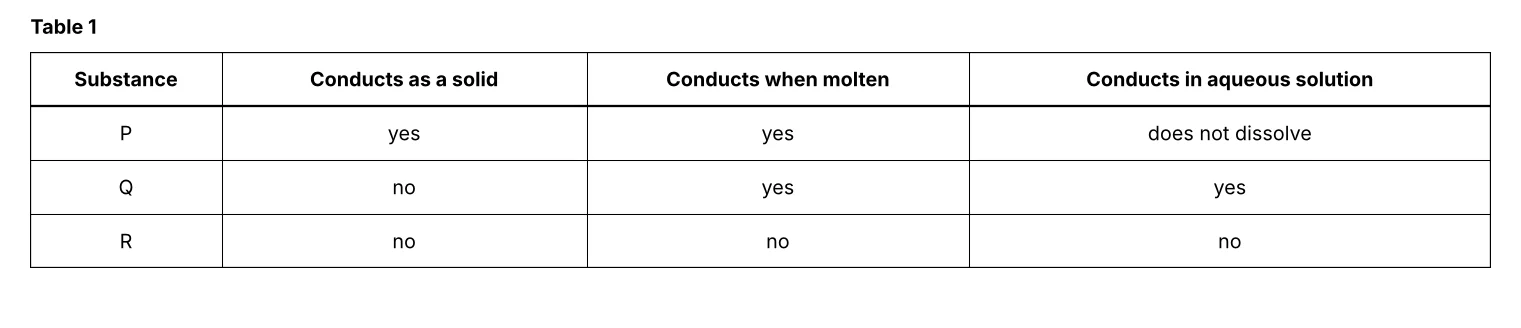
Identify the type of bonding in Q, giving a reason.
Identify which substance is a metal.
Explain why R does not conduct in any state.
Suggest one improvement to the experiment to increase the reliability of the conclusions.
revisionprep.com
Summary Answer
Not available for this question.
Model Answer
Not available for this question.
Marking Scheme
Not available for this question.
Examiner Insights
Not available for this question.
Physical properties of materials
Solid sodium chloride does not conduct electricity, but molten sodium chloride does. Which statement explains this?
revisionprep.com
Summary Answer
Not available for this question.
Model Answer
Not available for this question.
Marking Scheme
Not available for this question.
Examiner Insights
Not available for this question.
Physical properties of materials
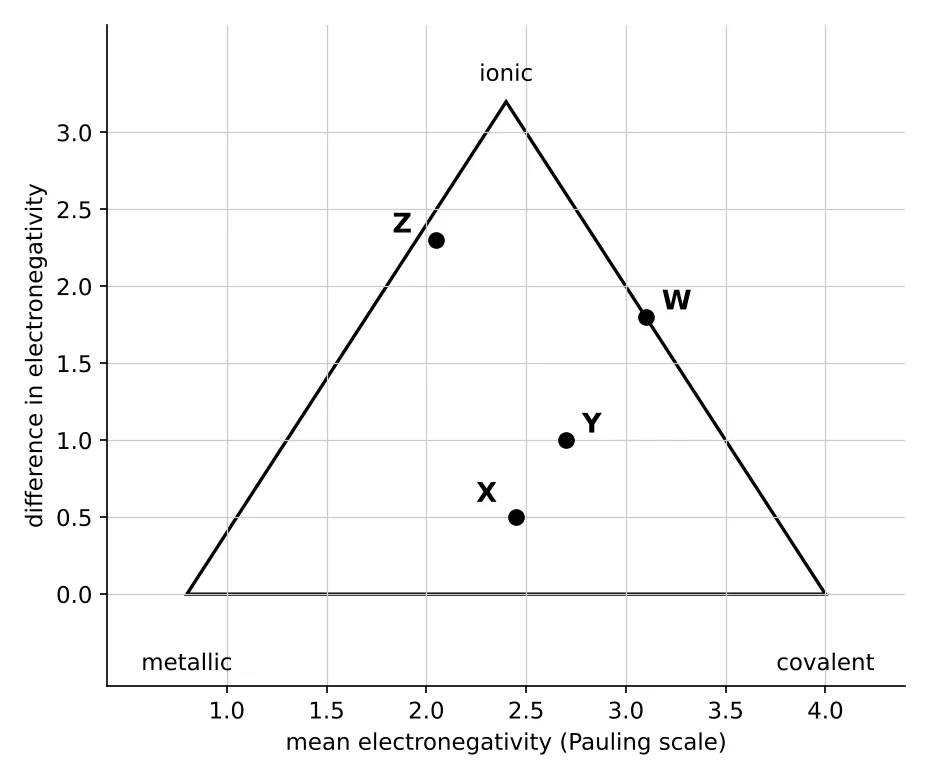
The bonding triangle has mean electronegativity on the horizontal axis and difference in electronegativity on the vertical axis. Four compounds, HI, HCl, HF and NaCl, are plotted as points W, X, Y and Z, in some order.
Electronegativity values (Pauling scale): H 2.2, Na 0.9, F 4.0, Cl 3.2, I 2.7.
Which point represents HCl?
revisionprep.com
Summary Answer
Not available for this question.
Model Answer
Not available for this question.
Marking Scheme
Not available for this question.
Examiner Insights
Not available for this question.
Physical properties of materials
The table gives physical properties of four solids, A to D. Each value is the mean of three repeated measurements, and the uncertainty is small.
Electronegativity values (Pauling scale): Mg 1.3, Cl 3.2.
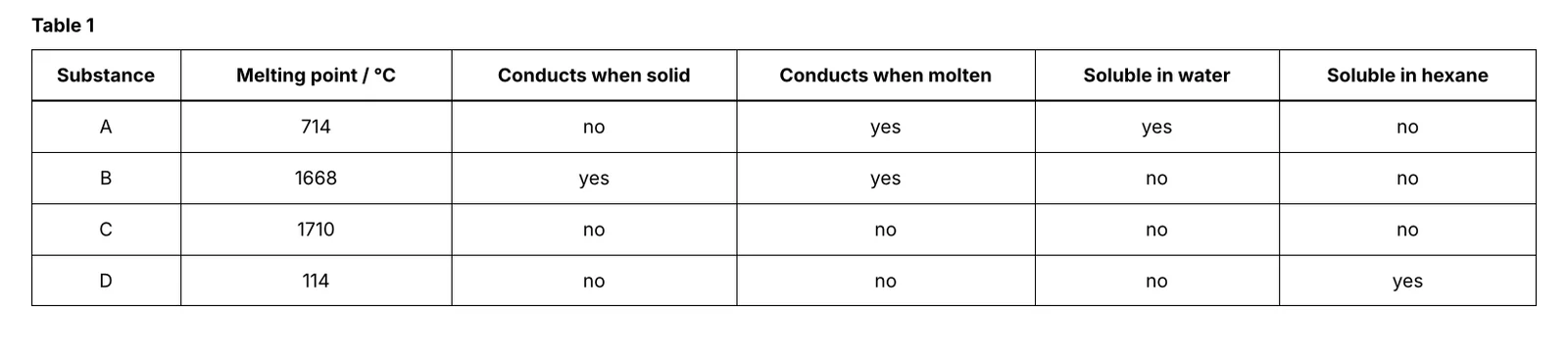
Deduce the type of structure of substance A and of substance B, using one piece of evidence from the table for each.
Deduce the type of structure of substance C and of substance D, using one piece of evidence from the table for each.
Explain why substance A conducts electricity when molten but not when solid.
Substance A is magnesium chloride, . Calculate the difference in electronegativity and the mean electronegativity of A.
A student claims that C should melt at a lower temperature than A because covalent bonds are weaker than ionic bonds. Evaluate this claim using the data.
revisionprep.com
Summary Answer
Not available for this question.
Model Answer
Not available for this question.
Marking Scheme
Not available for this question.
Examiner Insights
Not available for this question.
Physical properties of materials
Graphite is soft, yet it sublimes only at about . Which statement explains why both are true?
revisionprep.com
Summary Answer
Not available for this question.
Model Answer
Not available for this question.
Marking Scheme
Not available for this question.
Examiner Insights
Not available for this question.
Addition polymers
A supermarket compares three types of carrier bag. Table 1 shows data from a study of the manufacture of the bags and the number of times customers use each bag. The poly(ethene) and poly(propene) bags are addition polymers. The values are for one bag, and the uncertainty in each value is about (values chosen for this question).

Calculate the mass of carbon dioxide released per use, in g, for each type of bag.
Determine the minimum number of uses at which the woven poly(propene) bag releases less carbon dioxide per use than a single-use poly(ethene) bag used once.
Deduce which bag has the lowest carbon dioxide release per use, and explain why this does not prove that it is the most environmentally friendly.
Evaluate the claim that paper bags are better for the environment than poly(ethene) bags because paper is biodegradable.
revisionprep.com
Summary Answer
Not available for this question.
Model Answer
Not available for this question.
Marking Scheme
Not available for this question.
Examiner Insights
Not available for this question.
That's every free question here — 6 of 80.
+74 more questions, plus Mock Papers & Worksheets, are waiting in Premium.