The Ionic Model · Paper 1 — Free Chemistry SL Practice Questions
Free questions
Open in full, with answers, mark scheme and examiner insights.
Properties of ionic compounds
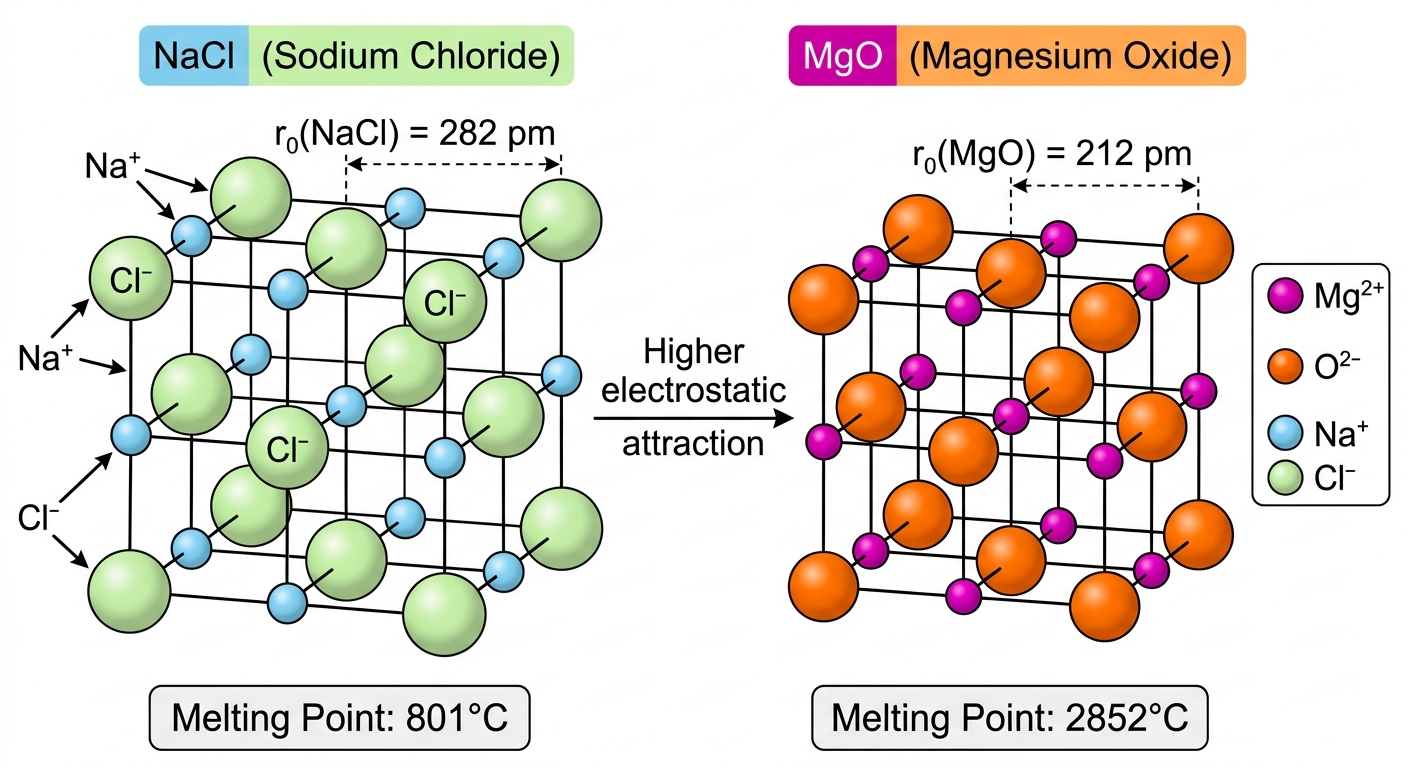
The compares the rock-salt lattices of NaCl and MgO. Which statement best explains why MgO has the much higher melting point?
revisionprep.com
Summary Answer
Not available for this question.
Model Answer
Not available for this question.
Marking Scheme
Not available for this question.
Examiner Insights
Not available for this question.
Lattice structure in ionic solids
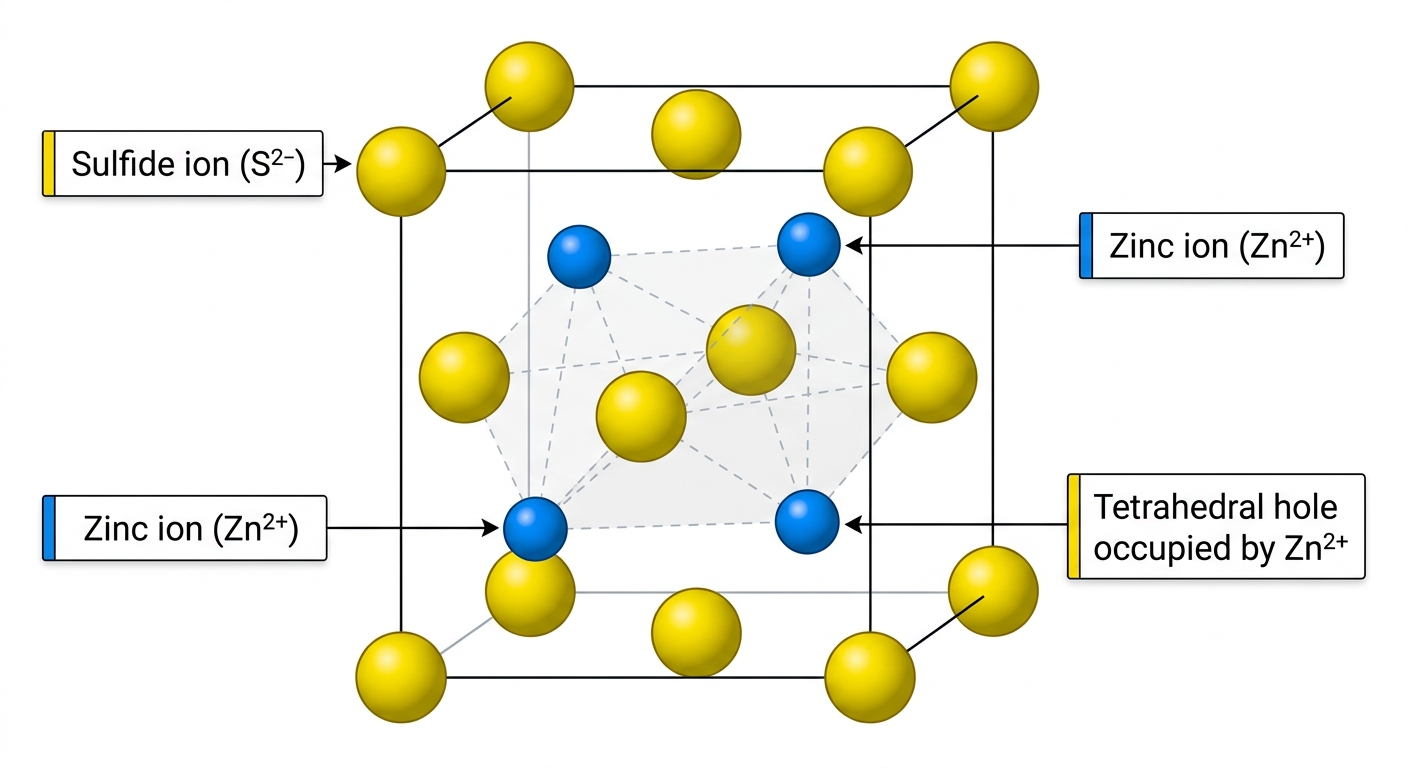
Sodium chloride is written as NaCl and called a formula unit, not a molecule. Which statement explains why?
revisionprep.com
Summary Answer
Not available for this question.
Model Answer
Not available for this question.
Marking Scheme
Not available for this question.
Examiner Insights
Not available for this question.
Properties of ionic compounds
A student tests three white solids, A, B and C, and records the results.
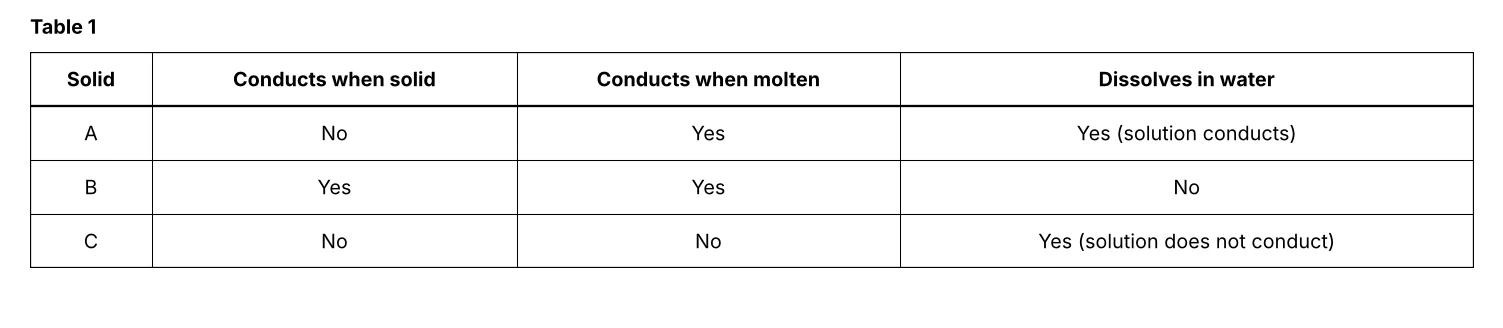
Deduce which solid is ionic. Justify your answer using two observations.
Explain why solid A does not conduct electricity but molten A does.
Identify the type of substance that solid B and solid C are most likely to be.
Suggest one improvement to the procedure that would increase confidence in the identification of solid A as ionic.
revisionprep.com
Summary Answer
Not available for this question.
Model Answer
Not available for this question.
Marking Scheme
Not available for this question.
Examiner Insights
Not available for this question.
Lattice structure in ionic solids
The table gives data for three sodium halides, which all have the same lattice structure.
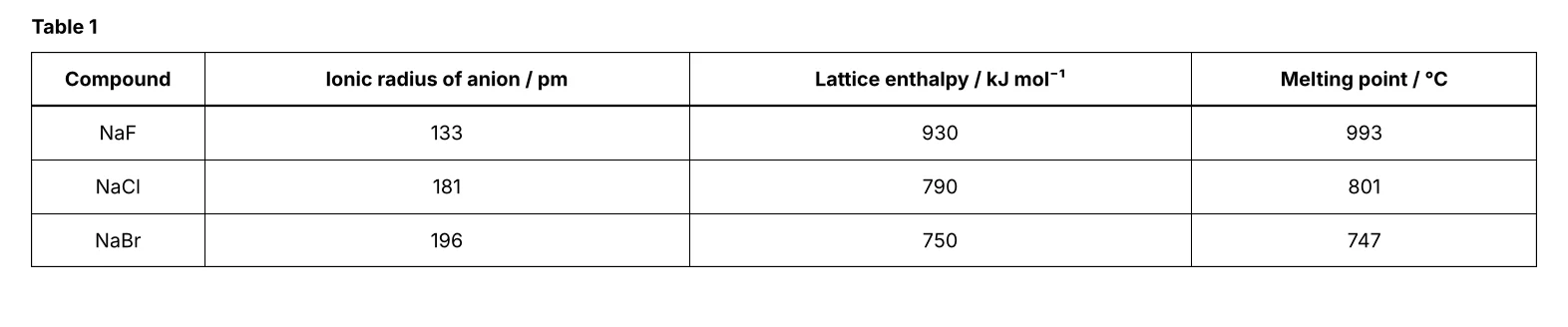
State the trend in lattice enthalpy from NaF to NaBr.
Explain this trend, referring to the ionic radius.
Sodium iodide, NaI, contains the ion of radius . Predict, with a reason, whether its melting point is higher or lower than that of NaBr.
Calculate the percentage difference between the lattice enthalpies of NaF and NaBr, relative to NaF.
revisionprep.com
Summary Answer
Not available for this question.
Model Answer
Not available for this question.
Marking Scheme
Not available for this question.
Examiner Insights
Not available for this question.
Properties of ionic compounds
The melting points of the potassium halides are given. The ionic radius of is .
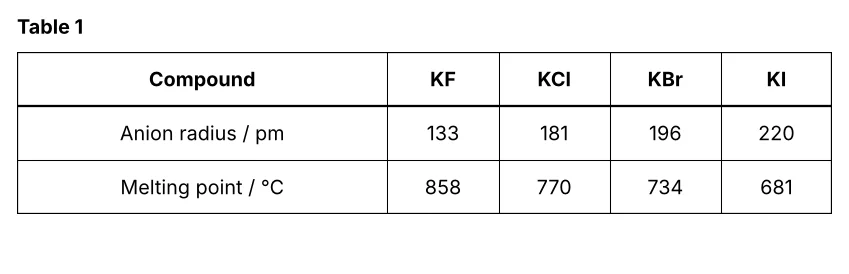
Calculate the interionic distance in each compound.
State the relationship between interionic distance and melting point.
Explain the relationship using the ionic model.
A compound of potassium with an anion of radius is made. Estimate its melting point, showing your method.
Evaluate how well the data support the claim that the ionic radius of the anion is the only factor that controls the melting point.
Suggest one improvement to the procedure that would make the estimate in (d) more reliable.
revisionprep.com
Summary Answer
Not available for this question.
Model Answer
Not available for this question.
Marking Scheme
Not available for this question.
Examiner Insights
Not available for this question.
Lattice structure in ionic solids
The table shows the melting points of four sodium halides, which all have the same lattice structure.
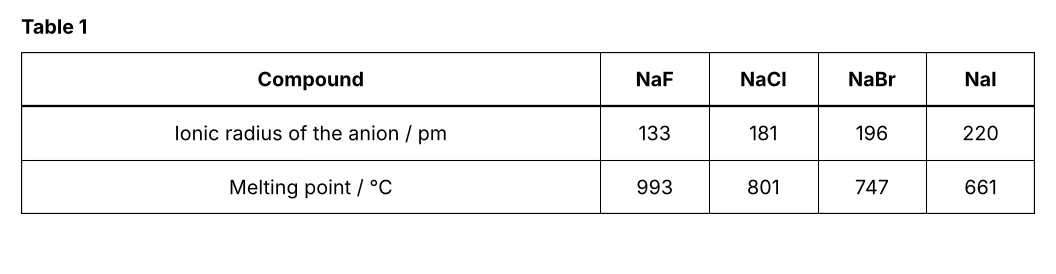
State the trend in melting point down the series from NaF to NaI.
Explain this trend in terms of the ions in the lattice.
Predict, with a reason, whether potassium chloride has a higher or lower melting point than sodium chloride. The ionic radius of is and that of is .
Predict the shape of a graph of melting point against anion radius for these four compounds.
Calculate the percentage difference between the melting points of NaF and NaI, in kelvin, relative to NaF.
revisionprep.com
Summary Answer
Not available for this question.
Model Answer
Not available for this question.
Marking Scheme
Not available for this question.
Examiner Insights
Not available for this question.
That's every free question here — 6 of 109.
+103 more questions, plus Mock Papers & Worksheets, are waiting in Premium.