The Metallic Model · Paper 1 — Free Chemistry SL Practice Questions
Free questions
Open in full, with answers, mark scheme and examiner insights.
Metallic bonding and electron sea model
Which statement describes the metallic bond in sodium?
revisionprep.com
Summary Answer
Not available for this question.
Model Answer
Not available for this question.
Marking Scheme
Not available for this question.
Examiner Insights
Not available for this question.
Electrical conductivity of metals
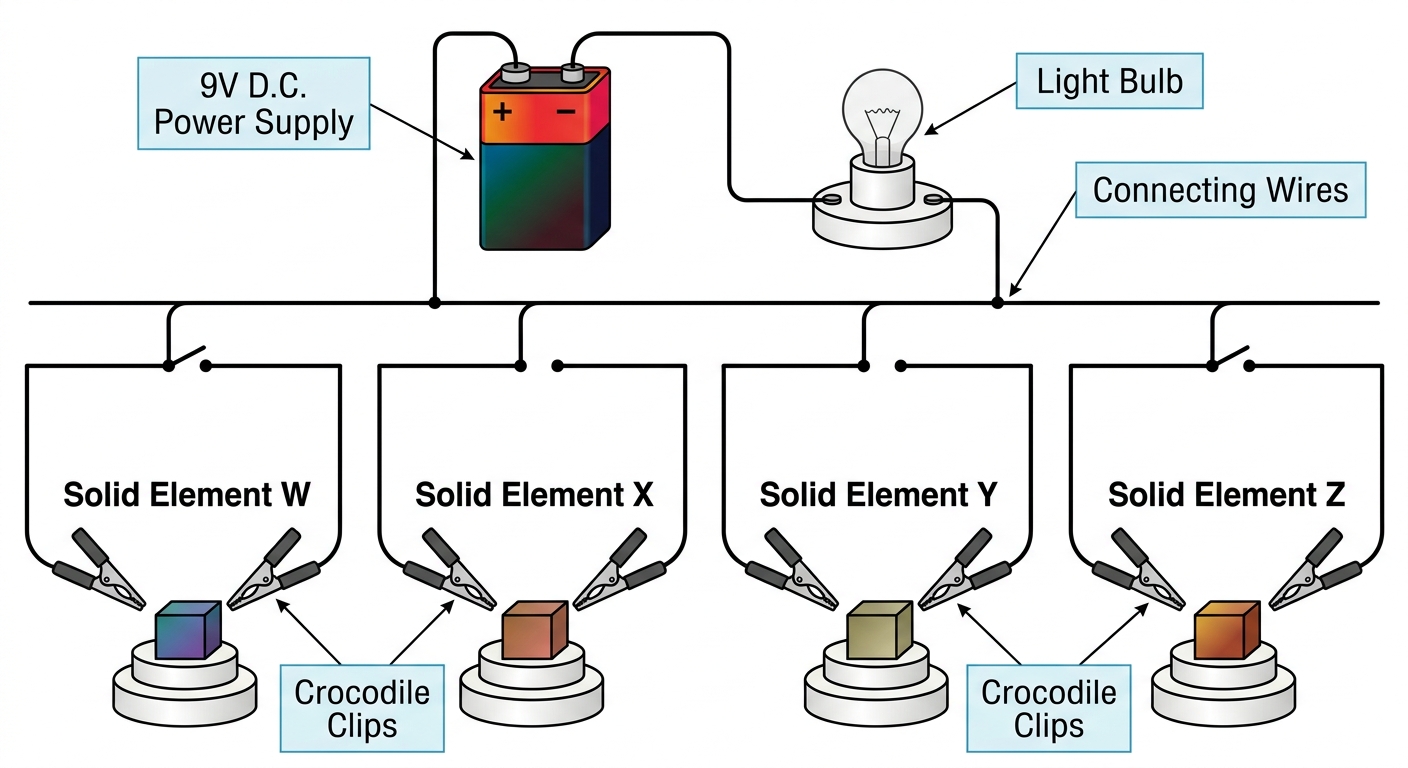
Four solid elements are tested for electrical conductivity at room temperature. Elements W and Y conduct electricity, while elements X and Z do not. Which two elements are most likely to be metals?
revisionprep.com
Summary Answer
Not available for this question.
Model Answer
Not available for this question.
Marking Scheme
Not available for this question.
Examiner Insights
Not available for this question.
Metallic bonding and electron sea model
The table gives data for three metals.
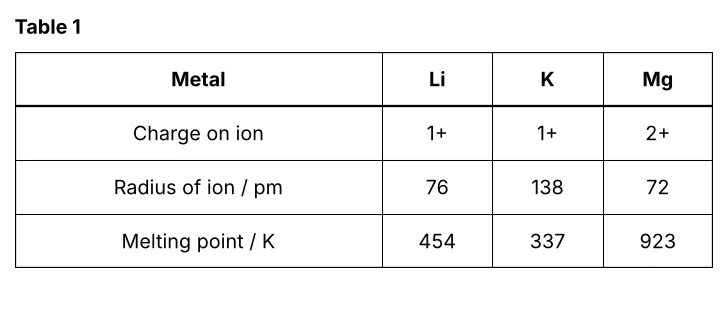
State which of the three metals has the strongest metallic bonding.
Explain why the metallic bonding in lithium is stronger than in potassium.
Explain why magnesium has a higher melting point than lithium.
Determine the melting point of magnesium in .
A metal Z forms ions of radius . Predict, with a reason, how its melting point compares with that of magnesium.
Identify one limitation of predicting melting points from ion charge and radius alone.
revisionprep.com
Summary Answer
Not available for this question.
Model Answer
Not available for this question.
Marking Scheme
Not available for this question.
Examiner Insights
Not available for this question.
Electrical conductivity of metals
A chemist measures the melting point and the electrical conductivity of four substances, P, Q, R and S. S does not melt below , so its liquid was not measured.
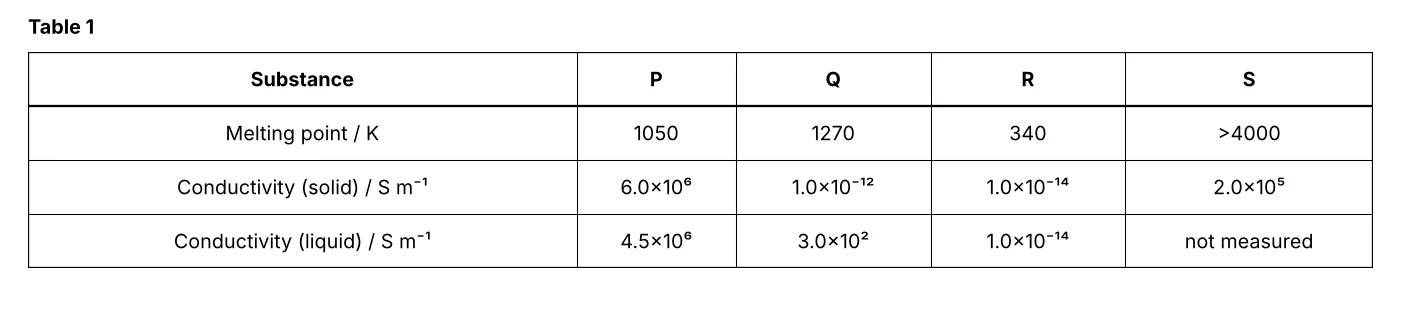
Deduce the type of bonding in P, Q and R.
Justify your answer for Q, using the conductivity data.
S conducts electricity as a solid and does not melt below . Suggest the structure of S.
The conductivity of P falls when it melts. Suggest one reason for this.
State one limitation of using the conductivity data alone to classify the substances.
revisionprep.com
Summary Answer
Not available for this question.
Model Answer
Not available for this question.
Marking Scheme
Not available for this question.
Examiner Insights
Not available for this question.
Metallic bonding and electron sea model
The ionic radius and the melting point of four metals are shown in Table 1. Each melting point was measured once, using a sample heated in an oil bath.
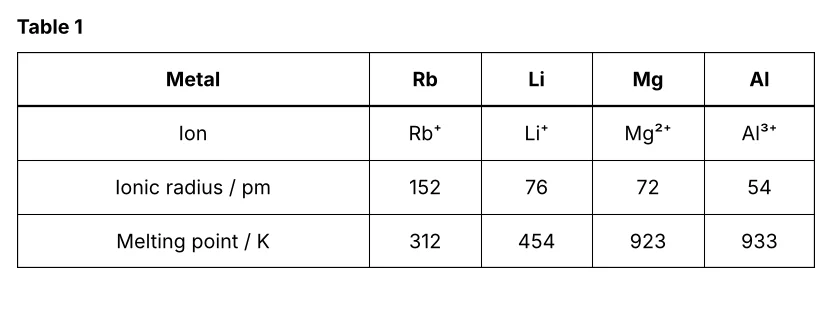
Determine the melting point of lithium in .
Deduce the order of increasing strength of the metallic bond in the four metals.
Suggest one improvement to the method that would make the melting points more reliable.
revisionprep.com
Summary Answer
Not available for this question.
Model Answer
Not available for this question.
Marking Scheme
Not available for this question.
Examiner Insights
Not available for this question.
Electrical conductivity of metals
A lamp is connected to a cell by a long copper cable. The lamp lights as soon as the switch is closed, although each delocalized electron drifts only slowly along the cable. Which statement explains why the lamp lights immediately?
revisionprep.com
Summary Answer
Not available for this question.
Model Answer
Not available for this question.
Marking Scheme
Not available for this question.
Examiner Insights
Not available for this question.
That's every free question here — 6 of 86.
+80 more questions, plus Mock Papers & Worksheets, are waiting in Premium.