You're viewing 1 free preview question for Chemistry SL — subscribe to unlock 100 more, plus the Full Question Bank, Mock Papers & Worksheets.Upgrade
From Models to Materials · Paper 2 — Free Chemistry SL Practice Questions
1ChallengeSAQ-LSolids, liquids, and gases: Structural differences10 marksPaper 2~15 min

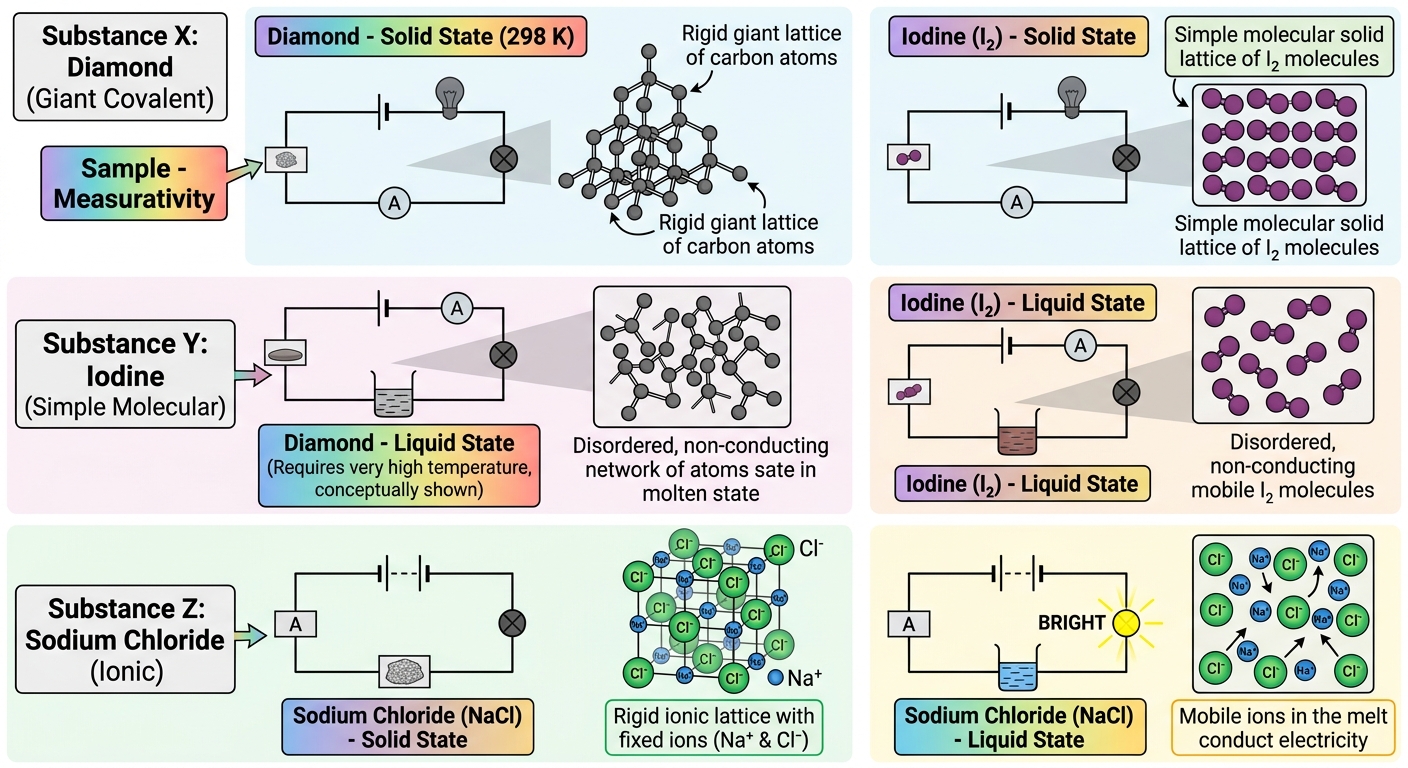
A student investigates the properties of three different solid substances at room temperature () and standard pressure.
- Substance X: Diamond — a giant covalent network solid
- Substance Y: Solid iodine () — a simple molecular solid
- Substance Z: Sodium chloride (NaCl) — an ionic lattice
The student measures the electrical conductivity of each substance in the solid state and again after melting. Results are shown below.
Substance — Conductivity (solid) — Conductivity (liquid)
Diamond — Does not conduct
Iodine — Does not conduct
Sodium chloride — Does not conduct — Conducts
(a)
State the type of particle (atoms, ions, or molecules) present in each substance in the liquid state. [3 marks]
(b)
Explain how the bonding and structure of each substance accounts for its electrical conductivity, or lack thereof, in the liquid state. [3 marks]
(c)
Evaluate the following statement, using all three substances as evidence:
"The boiling point of a substance is always higher than its melting point because intermolecular forces are stronger in the liquid state than in the solid state." [4 marks]

Solutions
That's every free question here — 1 of 101.
+100 more questions, plus Mock Papers & Worksheets, are waiting in Premium.