The Covalent Model · Paper 2 — Free Chemistry SL Practice Questions
Free questions
Open in full, with answers, mark scheme and examiner insights.
Covalent bonding and electron sharing
The diagram shows a molecule of hydrogen peroxide, . In some water treatment plants, UV light shining on dilute breaks one bond in each molecule, forming hydroxyl radicals that destroy pollutants. Bond enthalpies: O–O ; O–H .
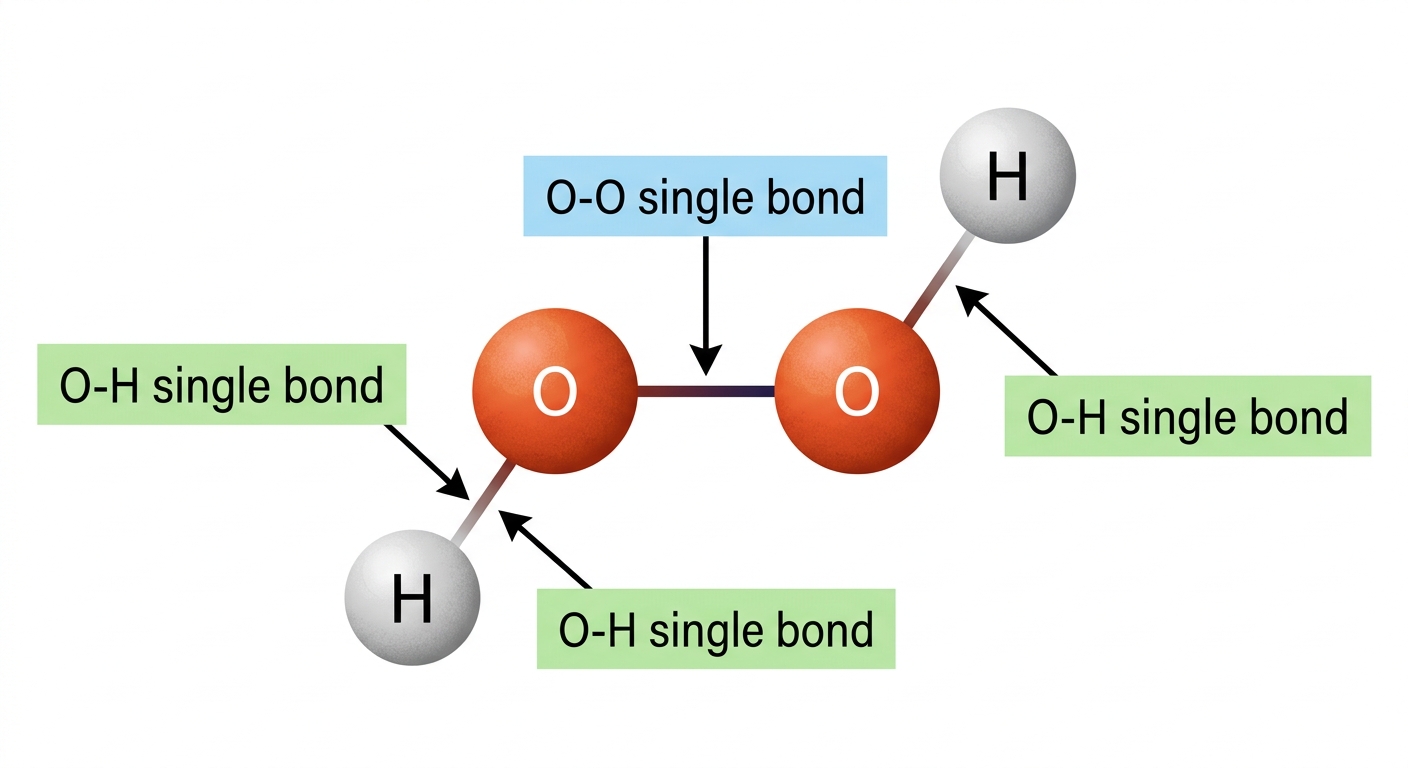
State the number of lone pairs on each oxygen atom in and deduce which bond breaks when the molecule absorbs UV light, giving a reason.
Formulate an equation for this homolytic fission, showing the unpaired electrons.
Calculate the minimum energy, in kJ, needed to break this bond in of .
Outline why hydroxyl radicals are very reactive.
revisionprep.com
Summary Answer
Not available for this question.
Model Answer
Not available for this question.
Marking Scheme
Not available for this question.
Examiner Insights
Not available for this question.
Bonding in simple molecules (e.g., H₂O, CO₂)
The table gives Pauling electronegativity values.
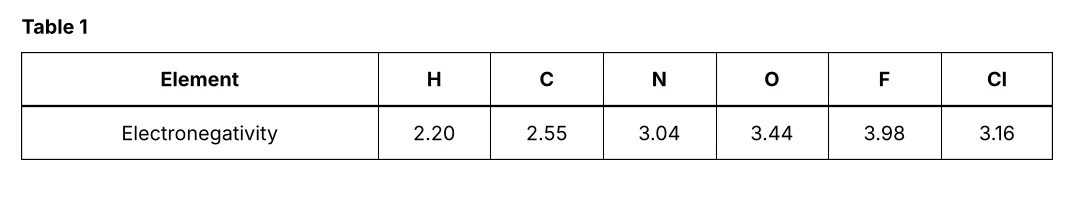
Calculate the electronegativity difference for the N–H bond and for the O–H bond and state which bond is more polar.
State the polarity of the C–F bond using and .
State why the Cl–Cl bond is non-polar.
State whether the bond in HCl is more polar or less polar than the C–Cl bond.
revisionprep.com
Summary Answer
Not available for this question.
Model Answer
Not available for this question.
Marking Scheme
Not available for this question.
Examiner Insights
Not available for this question.
Single, double, and triple bonds
A student states that 'a carbon–carbon triple bond is three times as strong as a carbon–carbon single bond and a double bond is twice as strong.'
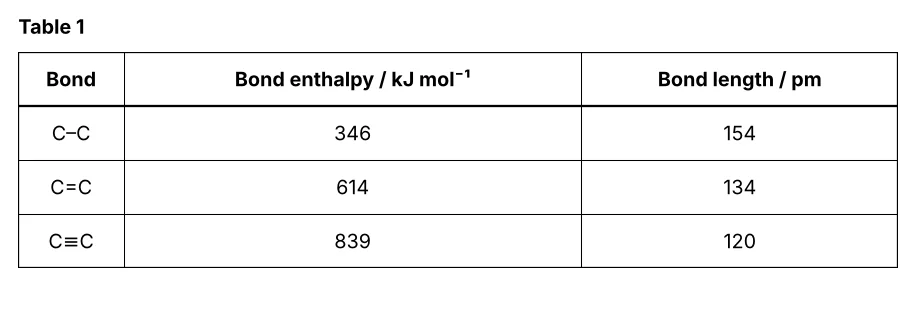
State the relationship between the number of shared pairs and the bond enthalpy.
Use the data to evaluate the student's statement about bond strength.
The student also predicts that the triple bond is one third as long as the single bond. Use the data to test this prediction.
revisionprep.com
Summary Answer
Not available for this question.
Model Answer
Not available for this question.
Marking Scheme
Not available for this question.
Examiner Insights
Not available for this question.
Giant covalent structures and allotropes of carbon
Four pure samples, W to Z, are each an allotrope of carbon. Some of their properties are shown.
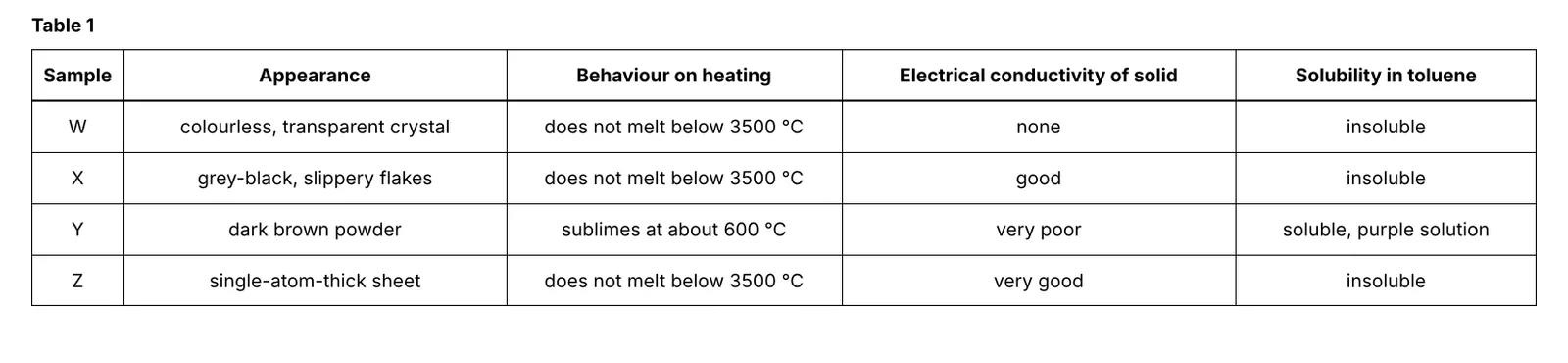
Identify the allotropes W and X.
Explain why X conducts electricity but W does not.
Identify Y and explain why it sublimes at a much lower temperature than W or X.
Deduce the name of Z and state how its structure is related to the structure of X.
Explain, in terms of bonding, why X is soft and is used as a lubricant.
Calculate the number of carbon atoms in of X. (; )
revisionprep.com
Summary Answer
Not available for this question.
Model Answer
Not available for this question.
Marking Scheme
Not available for this question.
Examiner Insights
Not available for this question.
Electronegativity, bond polarity and molecular polarity
Phosgene, , is a planar molecule. The diagram shows its bond dipoles. Electronegativity values: C 2.55, O 3.44, Cl 3.16, H 2.20.
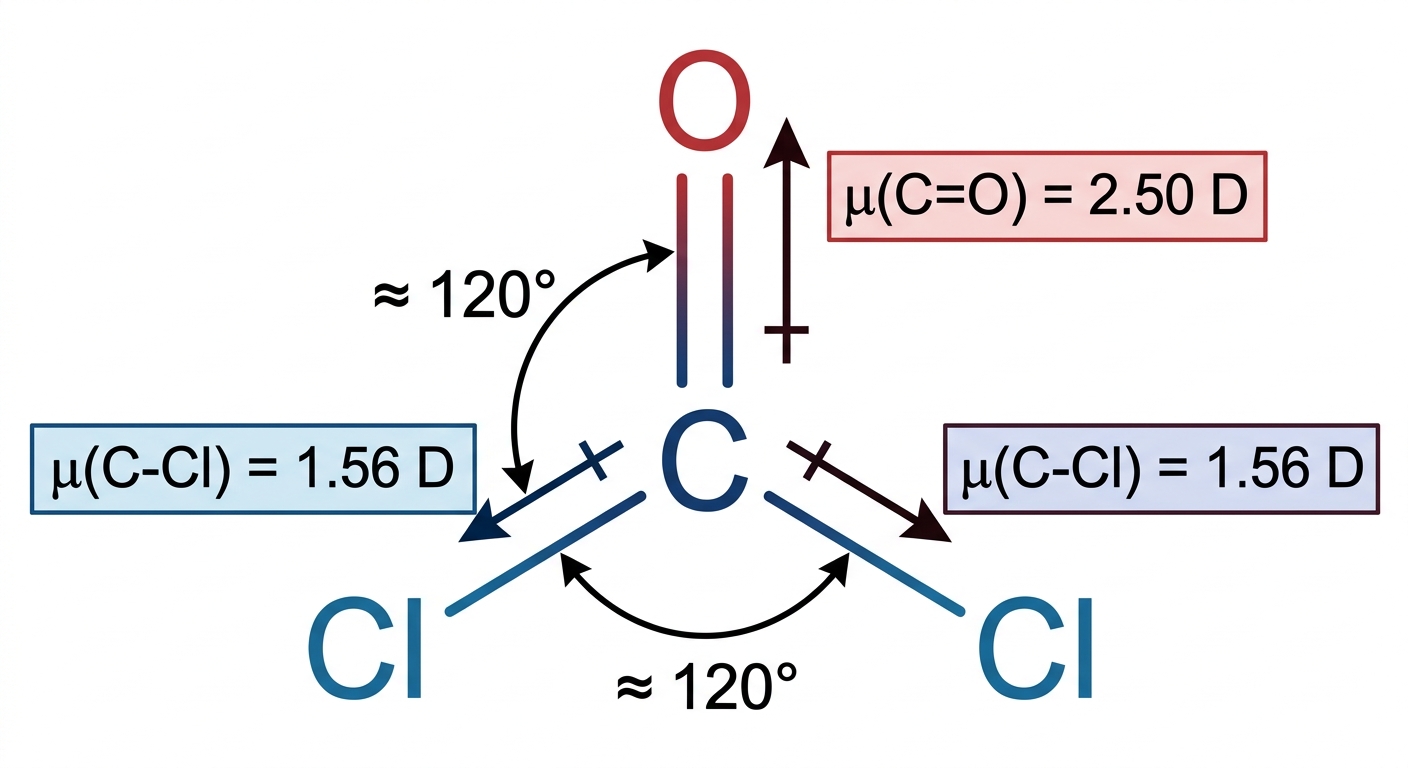
Calculate the electronegativity difference for the C=O and C–Cl bonds, and state the partial charge on each atom.
The two C–Cl bond dipoles combine to give a resultant of 1.56 D along the C=O axis, directed away from the oxygen atom. Deduce whether is polar and the direction of any net dipole.
Methanal, HCHO, has the same shape but a larger net dipole than . Explain this, with reference to the direction of the C–H bond dipoles.
Phosgene boils at , while methanal boils at despite its larger dipole. Suggest why.
revisionprep.com
Summary Answer
Not available for this question.
Model Answer
Not available for this question.
Marking Scheme
Not available for this question.
Examiner Insights
Not available for this question.
VSEPR: shapes and bond angles
Methane, , ammonia, , and water, , are covalent hydrides of period 2 elements. The H–X–H bond angles are in methane, in ammonia and in water.
Draw the Lewis formulae of and , showing all bonding pairs and lone pairs.
Deduce the number of electron domains and the molecular shape of , and .
Explain why the H–N–H bond angle in ammonia is smaller than the H–C–H bond angle in methane.
Explain why the H–O–H angle in water is smaller than the H–N–H angle in ammonia.
Calculate the number of lone pairs of electrons in of ammonia. ; .
Predict whether the bond angle in is larger or smaller than in , and explain.
revisionprep.com
Summary Answer
Not available for this question.
Model Answer
Not available for this question.
Marking Scheme
Not available for this question.
Examiner Insights
Not available for this question.
That's every free question here — 6 of 245.
+239 more questions, plus Mock Papers & Worksheets, are waiting in Premium.